


China to maintain status as one of world's most populous nations for long time to come; newborns drop but remain at 8 mln level: NHC
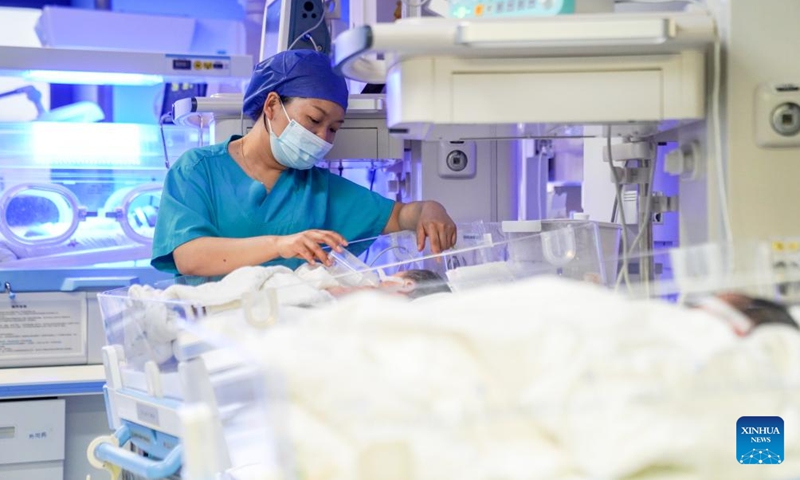
A nurse feeds a neonatal patient at the neonatology department of the First People's Hospital of Yunnan Province in Kunming, southwest China's Yunnan Province, May 10, 2026. (Photo: Xinhua)
China will maintain its status as being among the world's most populous nations for a long time to come, health officials said Monday as the authorities roll out measures to strengthen its policy framework to support childbearing during the 15th Five-Year Plan period (2026-2030) as part of a broader strategy to foster high-quality population development.
Despite recording four consecutive years of negative population growth, Lei Haichao, director of the China's National Health Commission (NHC) emphasized at a State Council Information Office press conference on Monday that China's fundamental standing as a major populous nation remains unchanged.
With a population currently standing at 1.405 billion, China is expected to maintain its status among the world's most populous nations for a long time to come, Lei told reporters.
The health official pointed to the structural strengths of China's workforce, noting that higher education continues to expand rapidly. With more than 10 million students enrolling in colleges and universities each year, the nation maintains a robust supply of high-caliber talent to drive economic growth.
Addressing demographic shifts, Lei highlighted that while annual births have declined in recent years, new births remain steady at around 8 million annually—a figure matched by very few countries globally, ensuring a relatively abundant labor reserve for the foreseeable future.
To further ease financial pressure on young families, authorities plan to accelerate the creation of a birth-friendly social environment. Building on the child care subsidies launched last year—which benefited over 30 million families by offsetting expenses for childbirth, rearing, and education—the government will focus heavily on expanding early childhood services over the next five years.