


China's Gen Z | Zero-experience county youths turn out hit AI short drama in 40 days
A team of first-time filmmakers from Cangxi county in Sichuan Province has scored a breakout hit with its debut AI-produced short drama, which has climbed to No.16 on Hongguo's new-drama chart and surpassed 200 million views in about a month.
Return to the College Entrance Examination, a 60-episode series that premiered on August 6, has also reached a peak popularity index of 46 million in China's booming AI short-drama market.
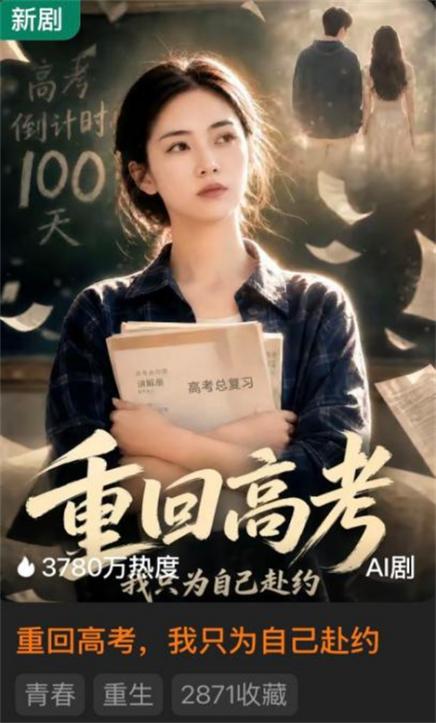
A poster for Return to the College Entrance Examination, an AI-produced short drama made by a first-time team of county youths in Cangxi county, Sichuan Province. (Photo: Cangxi County Converged Media Center)
The team, whose members average 23 years old, went from the start of training to the final cut in 40 days.
The group consists of recent college graduates and youths who returned to their hometowns, according to media reports. None had a background in film or television.
Working only from creative instinct and a set of AI tools, they handled the script, visuals and voice dubbing themselves.
The project has been widely seen as a microcosm of two forces at once: AI lowering the barriers to content creation and the digital economy pushing down into county-level regions.
40 days: from zero experience to final cut
In May this year, Luo Yingping, a rural special envoy with Alibaba stationed in Cangxi county, sent Yang Ruiqi and three other youths to an AI short-drama company in Hangzhou for a 40-day production training program, with board, lodging and travel costs covered by Alibaba Philanthropy, according to reports from Cover News, Chuanguan News and other outlets.
In June, the four trainees returned to the county and built a 16-member team, pairing veteran hands with newcomers.
In July, the team settled on a script adapted from a web novel on Tomato Novel, a popular Chinese online fiction platform, with a college-entrance-exam theme, timing the release to coincide with the announcement of exam results.
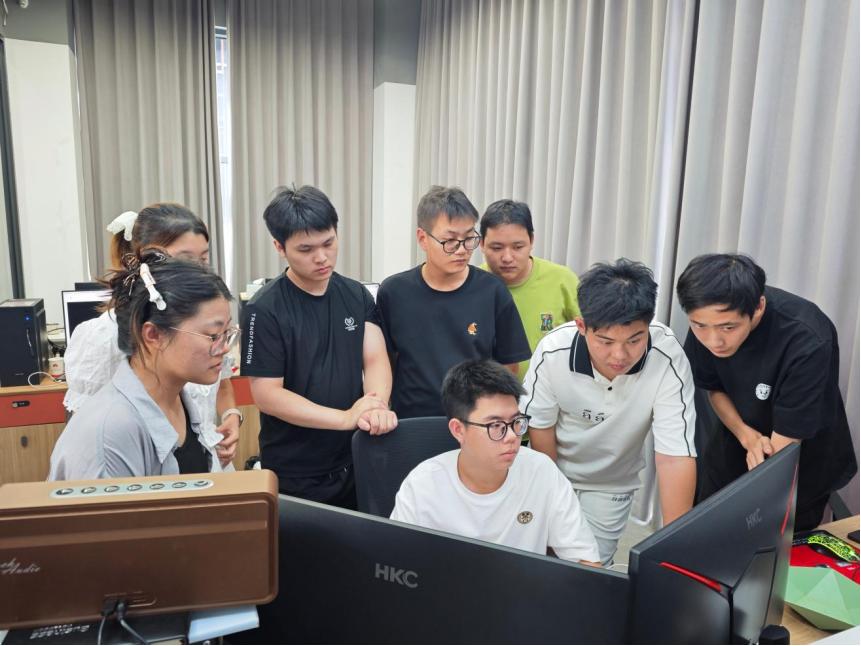
Recent graduates and youths who returned to their hometown gather around a computer screen to review their AI-generated footage in Cangxi county, Sichuan Province. (Photo: Sichuan Daily Network Media)
The team has since grown to 20 members and now turns out four short dramas a month under an annual framework contract for 50 dramas.
Monthly salaries of 5,000 to 6,000 yuan count as upper-middle income in the area.
"What we lack is not ability, but opportunity," said team leader Luo Jie.
China's AI short-drama market enters high-speed growth
China's domestic market for AI-produced short dramas and comic dramas topped 22 billion yuan from January to May 2026, with the annual total projected to reach 40 billion yuan: up roughly 138% year-on-year (about 2.4 times), according to figures from market research firm DataEye.
The number of AI short-drama users grew from 120 million to 600 million within six months. In the first quarter, according to the China Netcasting Services Association, the industry put out about 128,000 micro-short dramas, more than 95 percent of them made with AI.
Sharply lower production costs are driving much of that expansion. Industry data shows an AI short drama costs about one-fifth as much to produce as a live-action one. A single computer and a few software programs are enough to cover the script, visuals and dubbing.
The National School of Development at Peking University estimates the micro-short-drama industry directly supports about 690,000 jobs, a figure that climbs past 2.03 million once upstream and downstream industry chains are counted in.
County regions emerge as new opportunity hubs
In Luo Yingping's view, AI short dramas are opening up new employment channels for young people in county regions, much as livestreaming pushed into lower-tier cities a few years ago.
Labor costs are lower, business models are easier to replicate and there is more room for locally rooted content.
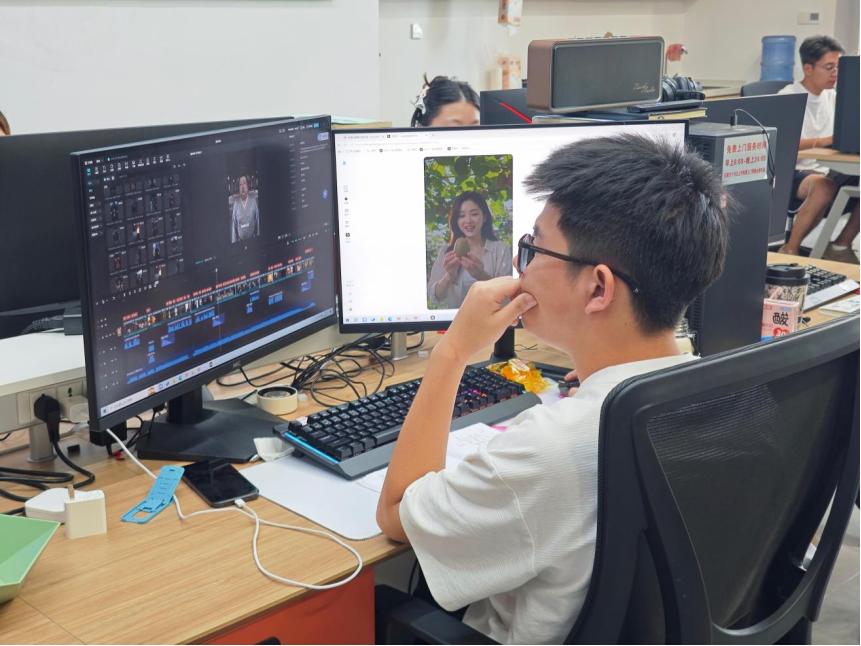
A young editor creates AI short-drama frames with AI tools at a dual-screen workstation in the Cangxi–Hangzhou Digital Industry Park, Cangxi county, Sichuan Province. (Photo: Sichuan Daily Network Media)
By lowering the industry's entry barriers, AI has made a professional film background no longer a prerequisite. What now counts for more is esthetics, internet savvy and a knack for storytelling.
For some, the pull of home is starting to outweigh the city.
Nan Luoran, 23, studied economics and had worked in photography in Chengdu before deciding to return after seeing local recruitment ads.
"In our area, this salary is reasonable," she said, noting that the rent and commuting costs she faced in Chengdu can be saved at home.
AI short-drama production projects have also been initiated in Kaihua and Pan'an counties, Zhejiang Province, according to a report by Guangming Online.
Alibaba's Rural Special Envoy program has so far sent 35 people to 30 county regions nationwide. "Only by stimulating the intrinsic motivation of rural society and making sustained efforts in retaining, nurturing and attracting talent can we make young people willing to return to the countryside," said Wang Wei, vice president of Alibaba Philanthropy.
AI is reshaping how film and television get made, and loosening content creation's grip on top-tier cities.
Whether the trend can hold in county regions, though, will come down to whether supply-chain support and talent cultivation can keep pace.