


Digital technologies bring new way of farming to China's fields
CHANGCHUN, Sept. 15 (Xinhua) -- As the Jiuyuefeng Family Farm in northeast China's Jilin Province prepares for harvest season this autumn, farm manager Xiao Jianbo no longer needs to walk into its 267 hectares of rice fields to check on growth.
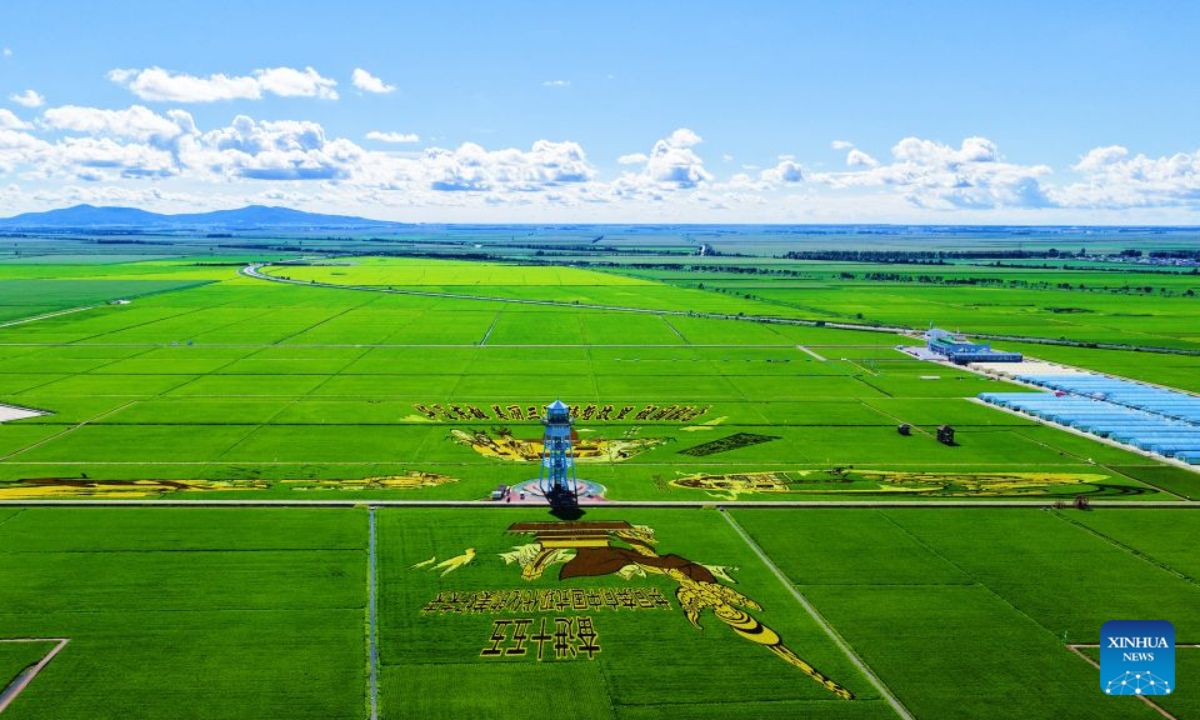
This photo taken on July 29, 2026 shows a panoramic view of rice paddy art pieces at a rice park in Fujin City, northeast China's Heilongjiang Province. (File photo: Xinhua)
In his office, a smart agriculture management system continuously updates data on the farm's soil conditions, weather and crop growth. On his mobile phone, he can view live images from high-definition cameras in the fields in Yongji County's Yilaxi Township, as well as readings from soil sensors. When an on-site inspection is needed, he can dispatch drones to survey the fields.
These changes, now taking place across Jilin, are part of China's broader push to modernize agriculture with digital technologies.
"Satellite remote sensing technology sends data on rice growth of each plot to the system in real time," Xiao said. "Green means the rice is growing normally. Yellow or red may indicate pests or diseases, and we can then promptly check and take action."
The technology has proved useful in this year's flood season. Heavy rainfall triggered alerts when paddy fields were inundated by rainwater backflow.
"In the past, if we failed to discover a problem in time, it could have caused losses. But field management efficiency now has improved significantly," Xiao said.
For farmers like Xiao, satellite remote sensing, drones and the Internet of Things are becoming increasingly important new farming tools, alongside traditional ones.
Jilin, part of one of the world's three major black soil regions and a major grain-producing area, has leveraged its satellite technology hub status to modernize agriculture.
In recent years, Chang Guang Satellite Technology Co., Ltd., headquartered in Changchun, capital of Jilin Province, has launched 161 satellites for its "Jilin-1" satellite constellation.
Liu Huimin, an engineer at the company, said the constellation integrates agricultural information, including weather, farmland conditions and agricultural mechanization data.
Satellite remote sensing is being applied throughout the agricultural production cycle, from plowing and sowing to field management and harvesting, Liu said.
With high-resolution imagery, fast response and broad coverage, the technology can help agricultural authorities assess disasters, monitor farmland protection, and track crop distribution and acreage, Liu said.
This summer, severe convective weather, including strong winds and hail, affected crops in some counties and districts in Jilin.
"We immediately contacted the satellite technology service provider and obtained information on the distribution and severity of the affected farmland," said Wang Hao, an official with the Jilin Provincial Department of Agriculture and Rural Affairs.
The information provided an important reference for post-disaster recovery and verification of crop damage statistics, Wang said.
Digital agriculture is also changing how agricultural products are marketed and sold.
In Yongji County, a visual agriculture livestreaming system allows overseas buyers to see the production and harvesting process, helping build consumer trust. This year, it has helped win customers from the Republic of Korea, Japan, Australia and Southeast Asia.
Over the past few years, the Ministry of Agriculture and Rural Affairs has issued a series of policies to promote smart agriculture.
China has also built innovation platforms to support smart agriculture. So far, 34 national smart agriculture innovation centers and sub-centers, along with 30 ministry-level key laboratories for agricultural information technology, have been established.
"Watch from the sky, calculate in the cloud and manage from the palm of your hand," Xiao said, referring to the farming revolution. "Farming used to be a laborious and demanding job. Now it is gradually becoming easier and more efficient."