


Pinglu Canal to promote regional connectivity, ocean-oriented development
On Monday, the container-laden vessel Beigang Canal 001 made a trial voyage to the operation area of Qinzhou Port in South China's Guangxi Zhuang Autonomous Region. With the Pinglu Canal about to open, the river and the sea - long separated by mountains - will finally be connected.
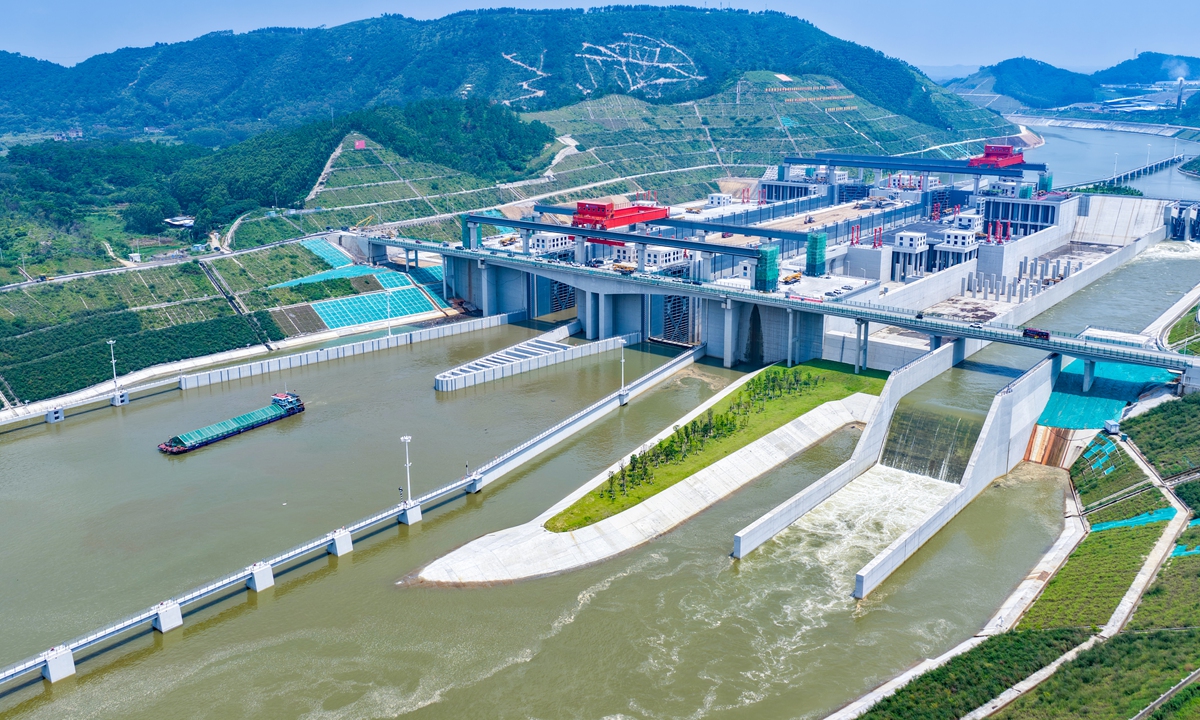
A vessel sails along the Pinglu Canal near the Madao hub. (Photo: Courtesy of Pinglu Canal Group)
As a backbone project of the New International Land-Sea Trade Corridor that connects with China's proposed Belt and Road Initiative, and as the first canal planned and coordinated at the national level since 1949 to connect a river to the sea, the 134.2-kilometer Pinglu Canal opens up the shortest, most economical, and most convenient sea outlet for southwestern China. It marks a major addition to the nation's river network.
The dream of a canal reflects the dream of a strong nation. A vision for a sea outlet for China's southwestern provinces and regions long existed, but before 1949 the blueprint remained on paper. In the new era, the governance of rivers, lakes, and seas has been planned with long-term vision and firm action.
Construction began in August 2022. Over more than 1,400 days and nights, with central coordination, local cooperation, technological breakthroughs, and industrial linkages, more than 20,000 builders of all ethnic groups worked together in Guangxi.
Now the Pinglu Canal flows into the sea, marking a new chapter in the pursuit of maritime strength.
From river to sea
On the upper reaches of the Xijiang River, which connects with the Pinglu Canal, navigation facilities at the Baise water control hub project are under intense construction. The construction progress is closely watched by company management at Guangxi Jili Baikuang Group, a leading aluminum enterprise. Once completed, imported bauxite and thermal coal can be shipped from Qinzhou Port in the Beibu Gulf, travel through the Pinglu Canal, and reach Baise directly.
"In the past, raw materials arrived at port and were moved by train and truck - small volume, high cost," said Su Yonghui, the company's logistics management director. By water, comprehensive logistics costs fall by 30 percent, saving tens of millions of yuan a year.
The Xijiang River and Beibu Gulf are separated by mountains, and detouring through Guangzhou Port in South China's Guangdong Province adds more than 500 kilometers. The New International Land-Sea Trade Corridor has brought road-rail-sea transport, but inland water transport is far cheaper than rail and road, according to Mo Weihua, an official with the Guangxi Maritime Safety Administration.
Southwest China's Yunnan and Guizhou provinces also stand to benefit. Yunnan is building the Funing Port, which is scheduled for completion within the year. Landlocked Guizhou is accelerating construction of the Huangtong-Baise Railway, helping it reach the sea. Southwest China's Sichuan Province and Chongqing Municipality now have a new sea outlet in addition to the Yangtze River.
Logistics costs could fall by 18 to 30 percent, with long-term annual savings of over 5 billion yuan ($745 million) along the route, according to an executive with Pinglu Canal Group, the constructor of the canal.
The canal also adds a mutually beneficial channel between China's 1.4 billion people and ASEAN's nearly 700 million. Diplomatic envoys from ASEAN countries, after inspecting the canal, praised it not only for facilitating the flow of goods but also for strengthening people-to-people bonds.
Inland shipping is vital for strengthening domestic circulation, improving the domestic-international dual circulation, and promoting regional coordination. Looking ahead, the Pinglu Canal, together with several other canals under study, will link the Yangtze and Pearl River systems, build a water network that connects east and west and north and south, and reshape southern China's economic geography, said Luo Jing, a research fellow with the Guangxi Academy of Social Sciences.
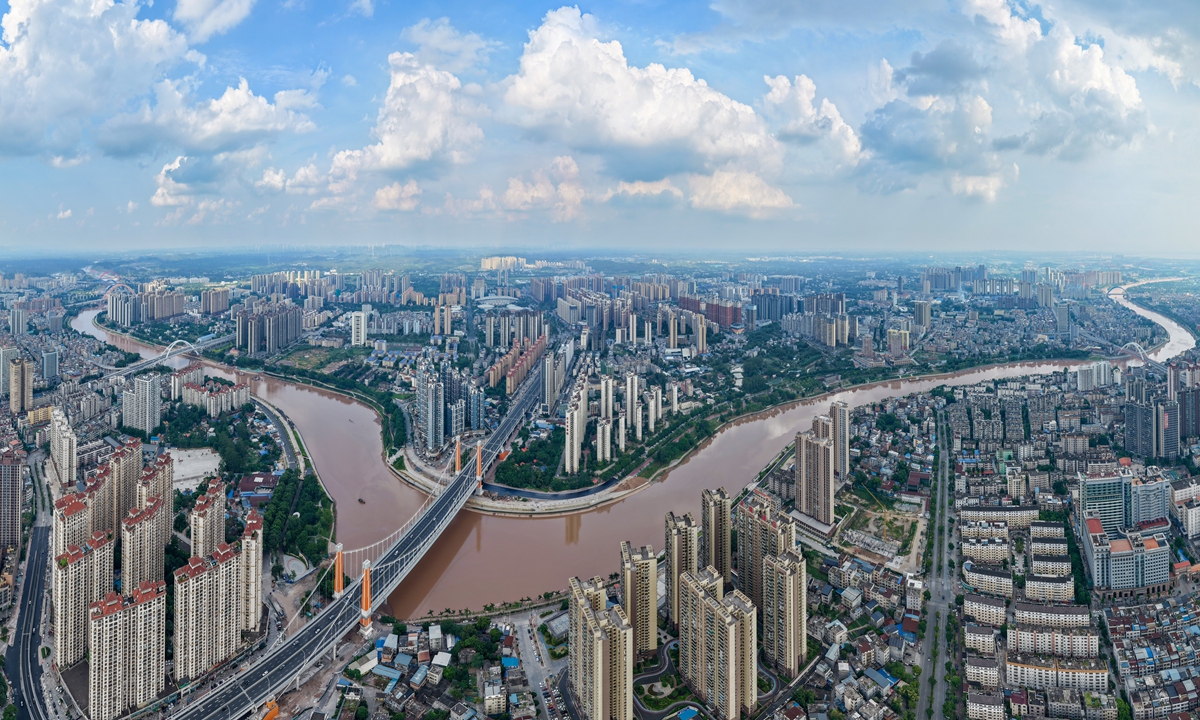
An aerial photo of the Pinglu Canal and the city of Qinzhou, South China's Guangxi Zhuang Autonomous Region. (Photo: Courtesy of Pinglu Canal Group)
Engineering marvel and ecological care
The Pinglu Canal has a total water-level drop of 65 meters. How can flow speed be controlled to ensure safe navigation for 5,000-ton vessels? The answer is "stairs" on the river: three cascade hubs - Madao, Qishi, and Qingnian - absorb the drop level by level.
Water-saving ship locks were also used. At Madao hub, a dynamic "storage tank" enables the lock to achieve a water-saving rate of 60 percent, saving about 1 billion cubic meters a year - equivalent to 70 West Lakes, said an engineer.
With support from academicians and research institutes, and with top domestic hydraulic manufacturers joining, the canal's builders conducted thousands of experiments. They invented a "labyrinth buffer" hydraulic opening-and-closing technology, fixing valve closure time at 30 seconds. This allows six 5,000-ton ships per lock cycle to pass Madao Hub within one hour.
At the Qingnian hub, a smart fishway monitoring platform monitors every fish passing through. Two fish flash by, swimming upstream. Their speed, length, and width are recorded in real time. This is a migration route that had been interrupted for more than 60 years. The Qingnian Sluice, built in 1959, benefited local people but blocked fish migration. During reconstruction, a domestically pioneered composite fishway was built.
"Fish from the sea and the river can find their way home here," said Chen Zhu, a resident engineer. The hub has a drop of nearly 10 meters. To allow fish to move gradually through the elevation change, the fishway has a vertical-slot structure with three winding loops. Sonar monitoring has recorded 78,474 fish moving upstream, 119,987 moving downstream, and more than 10 species successfully migrating.
The canal excavation reached 315 million cubic meters. If piled into a one-meter-square dike, it would circle the equator nearly eight times. Where should the dirt go? Seven disposal technologies, including land filling, mine restoration and land reclamation, were deployed, and more than 98 percent of the spoil was reused.
There are also bridges covered not with asphalt but with fertile soil, cherry trees, water collection points, and rocks - built specially for animals to travel between the banks.
Sailing to the blue
At Maowei Sea in Qinzhou, ship whistles sound as freighters head into the blue waters of the Beibu Gulf. The first half of the canal story has been brilliantly written; how will the second half of building an ocean-oriented economy begin?
On June 30, the regional party committee of Guangxi held a plenum dedicated to studying the high-quality development of the ocean-oriented economy. The keyword was "leaf-vein." The Pinglu Canal economic belt is the "main vein," concentrating large-volume, port- and water-appropriate industries. Other areas are "branches," and industrial parks and enterprises are "fine veins," deeply embedded in supply chains.
In Nanning, the capital of Guangxi, industries producing battery materials, high-end paper and chemical materials are clustering. In Qinzhou, at the canal's mouth, petroleum coke and coal tar pitch are set to arrive by canal, and products are sold to nearby cities and ASEAN. Around the ports in Beibu Gulf, Guangxi Investment Group Co has invested in nearly 60 projects worth over 12.5 billion yuan in the economic belt.
Supporting this "leaf-vein" layout are not only the canal but also 65 land routes out of the region, to the sea, and to borders; 50 container routes to ASEAN; various air routes; and 12 international terrestrial optical cables.
As the canal opens, inland shipping and ocean shipping will connect, raising port capacity. At the Baise water control hub project, workers are pressing ahead. Market entities across provinces are cooperating.
Hu Huaping, party secretary of Beibu Gulf Port Group, summed up the spirit of cooperation in jointly building the New International Land-Sea Trade Corridor. "Pursuing maritime strength through joint building and sharing. Upstream and downstream, main streams and tributaries, rivers and waterways, land and sea - there are no bystanders; we are all problem-solvers."
This was compiled and translated by Global Times reporter Chu Daye based on an article published by the People's Daily on September 15, 2026.