


Chinese manufacturing thrives through agility and innovation

Foreign merchants purchase smart companion toys at the Yiwu International Trade Market in Yiwu, east China's Zhejiang province. (Photo: Shi Bufa)
Chinese manufacturing continues to win over consumers worldwide. According to China's Ministry of Commerce, overseas visitors spent 263.6 billion yuan ($39.28) in China from January to July this year, up 27.8 percent year on year. The number of overseas travelers who applied for departure tax refunds more than tripled over the same period.
Why has China maintained the world's largest manufacturing value-added output for 16 consecutive years? An examination of several popular products offers insight into the logic behind building a stronger, more dynamic manufacturing sector.
Yiwu, in eastern China's Zhejiang province, known as the "world's supermarket," is neither on the border nor by the sea, yet local businesses have turned small commodities into big business.
Recently, a "palm-sized hat" went viral overseas. It trended on social media in the morning, entered mass production in Yiwu by the afternoon, and quickly reached markets in Europe and the United States.
Earlier this year, a "crying horse" toy unexpectedly became popular. Yiwu manufacturers ramped up production within 48 hours. By mid-year, they had already stocked up on blockbuster World Cup merchandise well before the tournament kicked off.
Yiwu has moved beyond its old model of passive OEM manufacturing. It now identifies market demand with "zero time lag" and connects it to production with virtually no barriers.
Rather than waiting for the next trend to emerge, it is increasingly helping drive consumer trends. The shift from "waiting for the wind" to "catching the wind" shows how a flexible market mindset can quickly turn emerging demand into business opportunities.
In May of this year, Chinese tech giant Huawei introduced its Tau Scaling Law, replacing "geometric scaling" with "time scaling" and successfully designing and mass-producing hundreds of chip models.
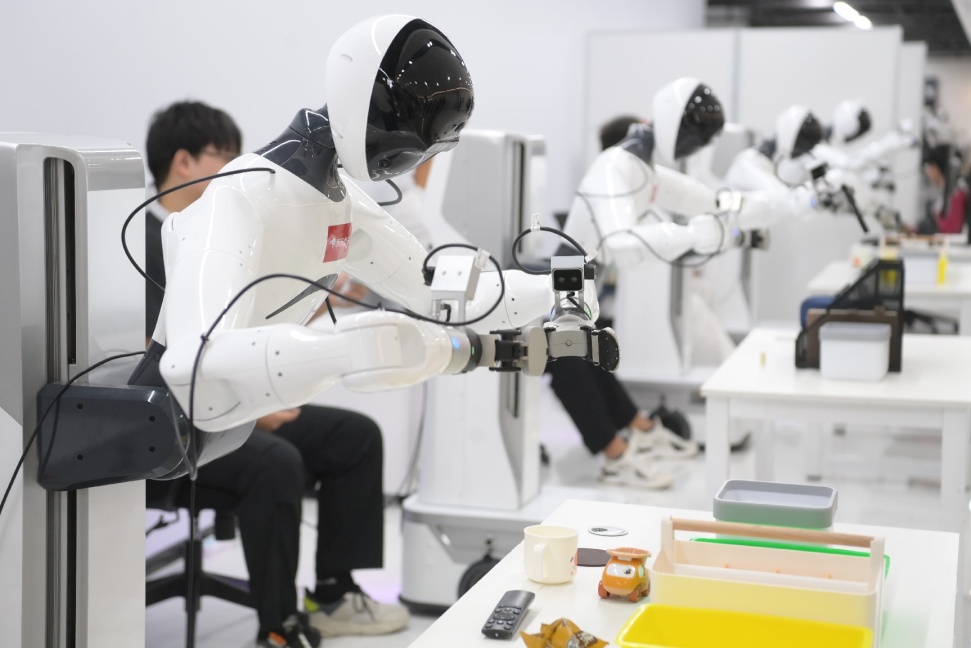
Humanoid robots are trained at an embodied intelligence robot data collection and training center in Suqian, east China's Jiangsu province. (Photo: Wang Shuaifu)
Similarly, Chinese new energy vehicle manufacturer BYD broke away from the conventional cylindrical and prismatic battery designs and developed its Blade Battery, addressing key safety challenges in power batteries through structural innovation.
Chinese motorcycle manufacturer ZXMOTO took a different route to develop a three-cylinder, water-cooled engine, making a splash on the international racing circuit.
What these examples demonstrate is not merely a shift in technological approaches, but a broader wisdom in industrial upgrading: by daring to break with convention and pursue new paths, seemingly insurmountable bottlenecks can become breakthroughs in independent innovation.
In recent years, new products have been brought to market in rapid succession, and new technologies have evolved at an accelerating pace. One important reason is that China has planned ahead, laying the groundwork and building capacity to weather changes.
Take AI, for example. The ultimate foundation of AI is electricity. Developing large AI models requires not only cutting-edge AI chips and advanced algorithms, but also abundant and reliable power infrastructure. Through sustained investment over the years, China has built the world's largest ultra-long-distance power transmission network and a renewable energy system, giving it a distinctive energy advantage in the AI race.
From 5G networks and modern logistics needed to support advanced manufacturing to the cultivation of a large pool of highly skilled engineers and technicians, China has steadily invested in key foundations. These efforts have built a comprehensive, multilayered industrial structure covering all major sectors and strengthened the resilience of the manufacturing sector, enabling it to withstand pressure and adapt to changing conditions.
China has grown its manufacturing sector into a global powerhouse not through beggar-thy-neighbor policies or zero-sum competition, but through openness, cooperation, and mutual benefit.
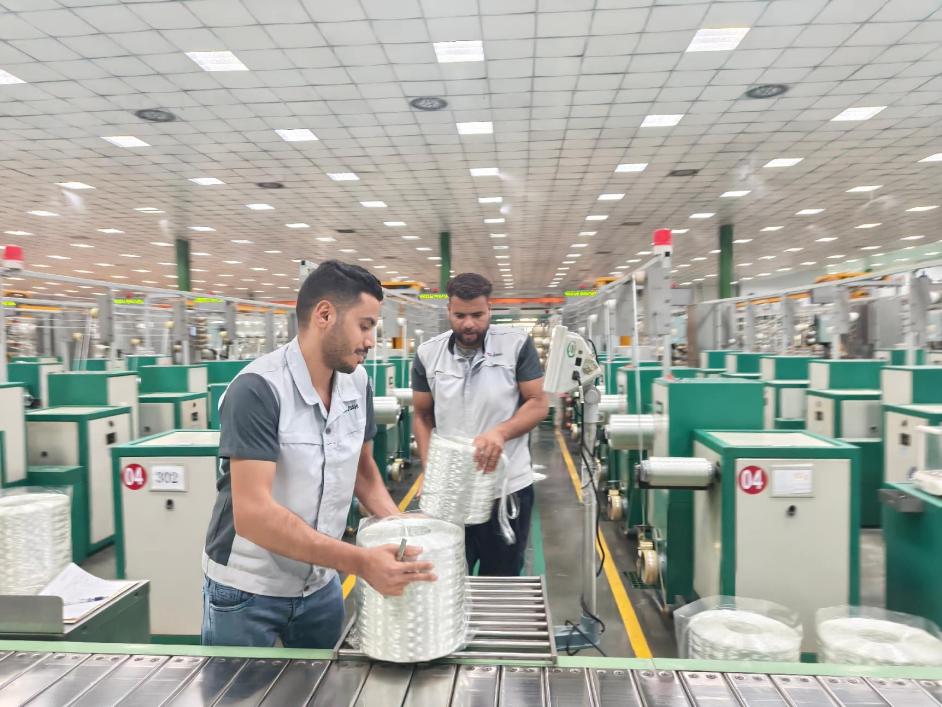
Local employees work in a workshop of Jushi Egypt for Fiberglass Industry S.A.E in the China-Egypt TEDA Suez Economic and Trade Cooperation Zone. (Photo: People's Daily/Zhou Zhou)
Recently, the realistic film Once Upon a Time in the Middle East has been a hit, with one line from the movie -- "Don't forget to eat well" -- touching the hearts of many foreign viewers. The simple words convey a value that cherishes peace and development, as well as mutual benefit and win-win cooperation. This is closely aligned with the underlying logic of Chinese manufacturing.
As Chinese manufacturing goes global, it is bringing with it an ever-growing list of opportunities.
In Africa, the China-Egypt TEDA Suez Economic and Trade Cooperation Zone has built up industries spanning new energy and home appliances, generating jobs for over 10,000 people.
In Southeast Asia, China's textile sector has forged deep integration with industrial chains of Malaysia and other nations, forming a cooperative model: "China supplies raw materials, ASEAN manufactures finished garments, and the world opens up markets."
In Latin America, multiple Chinese automakers have set up plants in Brazil, boosting local industrialization via capital investment and homegrown talent development.
All this highlights the flexibility, strong execution and openness of Chinese manufacturing. As profound changes unseen in a century accelerate and a new round of scientific and technological revolution and industrial transformation gains momentum, Chinese manufacturing, by staying dynamic and adapting to changes, will be full of vitality and go on to achieve even greater successes.