


HK unveils 1st five-year plan, marking new chapter in 'one country, two systems' practice
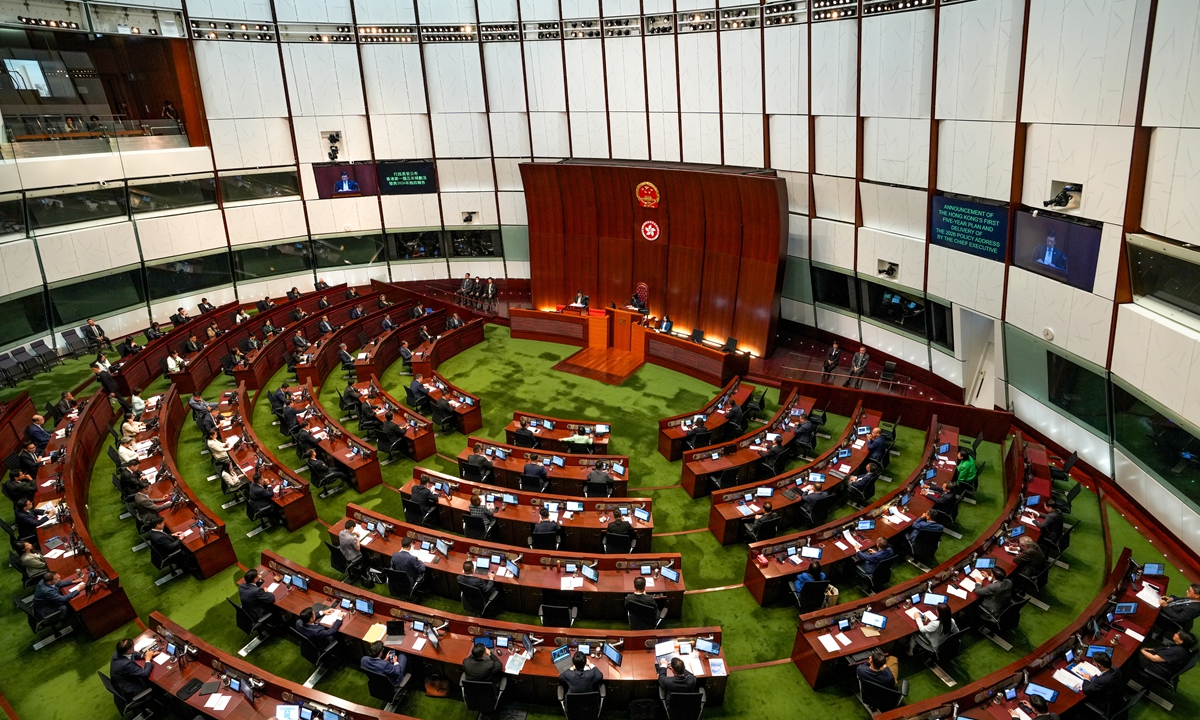
The Hong Kong Special Administrative Region (HKSAR) unveiled its first five-year plan for economic and social development (2026-2030) on September 16, 2026. (Photo: VCG)
The Hong Kong Special Administrative Region unveiled its first Five-Year plan for Economic and Social Development (2026-2030) on Wednesday. The plan will provide a medium- to long-term roadmap for the city's development, with a focus on optimizing resource allocation, stabilizing expectations, protecting the interests of investors and strengthening Hong Kong's role as a bridge and gateway between the Chinese mainland and the rest of the world.
Some political, business and academic figures in Hong Kong said the plan marks not only a milestone in the city's innovation of governance since its return to the motherland, but also a proactive step in advancing the practice of "one country, two systems," upholding and improving executive-led governance, and pursuing high-quality development.
In unveiling the plan alongside the Chief Executive's 2026 Policy Address at the Legislative Council on Wednesday, the HKSAR Chief Executive John Lee said reading the two documents together would provide a clearer understanding of how the HKSAR government will translate the five-year strategy into concrete policies and measures in 2026.
The first five-year plan consists of seven parts and 28 chapters, totaling about 60,000 Chinese characters, Lee said.
The plan covers seven major areas: opening a new chapter for Hong Kong's development; strengthening the city's four major centers and building a talent hub to consolidate and enhance its international competitiveness; accelerating the development of the Northern Metropolis to optimize the city's spatial structure; deepening development of the Guangdong-Hong Kong-Macao Greater Bay Area and building a global cooperation network; improving people's well-being and the social security system; coordinating development and security while enhancing public governance; and strengthening mechanisms to ensure the implementation of the plan.
Hong Kong's first five-year plan not only marks a new chapter in the practice of "one country, two systems," but also provides the world with an example of a new form of capitalist development, Liang Haiming, an economist on Hong Kong and dean of the Hainan University Bel and Road Research Institute, told the Global Times on Wednesday.
Compared with traditional Western capitalism, the practice places greater emphasis on balancing social equity and economic efficiency. Compared with the mainland's socialist market economy, it incorporates more international and diverse elements. This unique development model not only demonstrates the institutional strengths of "one country, two systems," but also offers innovative ideas for global economic governance and the development of capitalism, Liang said.
Lau Siu-kai, consultant to the Chinese Association of Hong Kong and Macao Studies, told the Global Times on Wednesday that Hong Kong's long-held governance principles of "positive non-intervention" and "small government, big market" have long been outdated and are increasingly out of step with the city's development needs and expectations across society.
Under Hong Kong's capitalist system, the HKSAR government's simple, low-tax regime means it has far less capacity than governments at various levels on the Chinese mainland to control and mobilize development resources, and also lags far behind other capitalist economies and regions such as Singapore, Lau noted.
"Hong Kong needs an active and proactive SAR government to chart a development strategy for the city's future, while relying primarily on market forces to achieve its strategic goals," the expert said.
Lee said that the plan is guided by seven principles, including upholding the "one country, two systems" principle, putting people's livelihoods first, maintaining an executive-led system of governance, pursuing reform and innovation, combining an "efficient market" with a "proactive government," coordinating development and security, and ensuring that the plan is pragmatic and action-oriented.
Among the targets, Hong Kong aims to increase total local expenditure on innovation activities to 3 percent of GDP after 2030. For the development of the Northern Metropolis, the plan aims to produce 900 hectares of developed land within five years, representing a cumulative increase of 7.5 times, and complete 70,000 housing units.