


Xiong'an builds full-cycle ecosystem for aerospace information and satellite internet industries
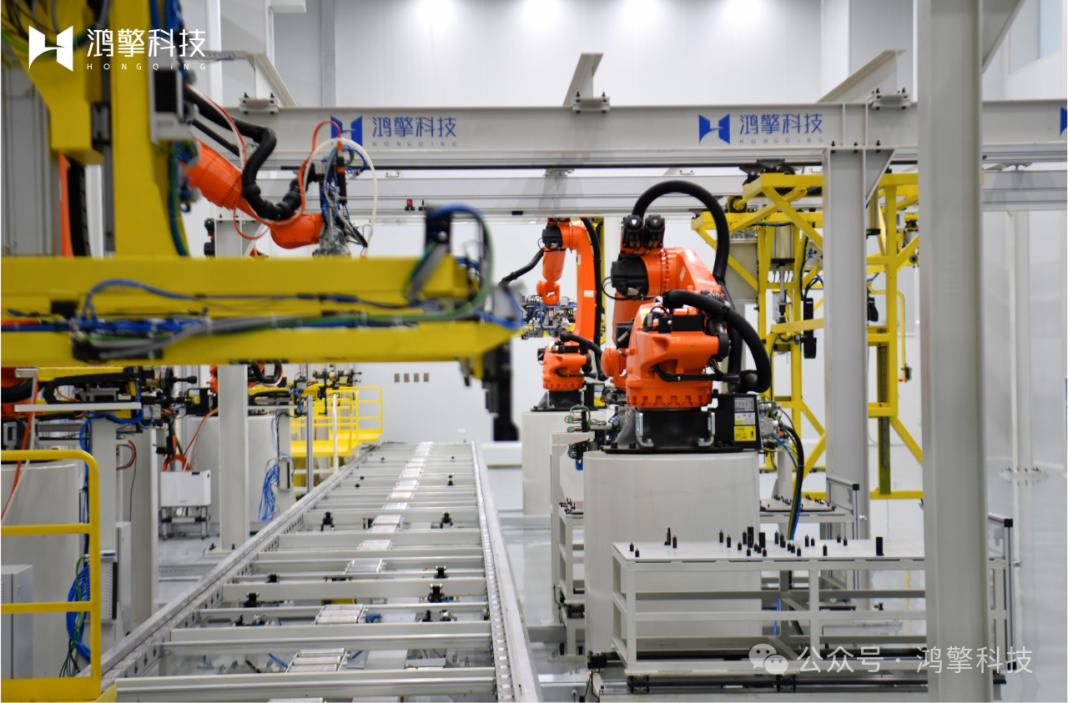
Photo shows the first smart production line for Xiong'an-1 satellite. (Photo courtesy of Hongqing)
Xiong'an New Area in north China's Hebei province is accelerating the development of its aerospace information and satellite internet industries. A growing industrial ecosystem now covers research and development, manufacturing, testing, launch, and in-orbit applications.
The latest milestone came on Aug. 19, when the Honghu-03 satellite, also known as Xiong'an-1, was successfully launched into orbit aboard a Zhuque-3 Y2 reusable rocket from the Dongfeng commercial space innovation pilot zone in Jiuquan, northwest China.
At the satellite intelligent operation and management center of Hongqing, China's only fully integrated satellite constellation solution provider with full ecosystem capabilities, in the pilot production base of the Xiong'an Science and Technology Innovation Center, when telemetry signals from Xiong'an-1 appeared on a large display screen, staff members erupted in cheers.
As the first satellite developed and launched by Xiong'an New Area to enter orbit, Xiong'an-1 incorporates dozens of advanced technologies. Its successful launch marked the completion of a full-cycle industrial chain in the aerospace information and satellite internet sectors of Xiong'an New Area, spanning research and development and manufacturing to in-orbit applications.
Just a few years ago, aerospace information and satellite internet were still relatively new concepts in Xiong'an. In 2021, China Satellite Network Group Co., Ltd. (China SatNet) was established there. In October 2024, the group officially relocated its headquarters to Xiong'an New Area. As a "chain leader" tasked with spearheading China's development of aerospace information and satellite internet, the company has generated strong demonstration and spillover effects.
"China SatNet is here, so we came here too. Being closer to the chain leader helps us iterate our products faster," said Chen Wei, chairman of CHIP LINKING INNO, a company focused on the R&D and production of high-end optoelectronic devices.
Chen spent more than a decade conducting research at the Institute of Semiconductors under the Chinese Academy of Sciences. Sensing an opportunity in the emerging industry, he led a team to Xiong'an in 2023 to advance the R&D and production of key components for satellite laser communications, including lasers, amplifiers, and communication modules.
When Chen started his business in Xiong'an, the aerospace information and satellite internet industries were still in their infancy, with a relatively weak industrial foundation. What gave him confidence, however, were the new area's clear and forward-looking industrial planning, supportive policies for talent and full-cycle services for businesses.
"Xiong'an connects innovation with industry. Companies across the upstream and downstream segments are gathering and developing here, and there will be even more platform resources in the future," Chen said.
Today, CHIP LINKING INNO is far from the only company that has made its way to Xiong'an.
At the pilot production base of the Xiong'an Science and Technology Innovation Center, technicians at the satellite intelligent manufacturing workshop of Blue Arrow Hongqing (Xiong'an) Space Technology Co., Ltd. were testing a visual recognition system on an intelligent production line. Hongqing is currently applying AI and other emerging technologies to continuously improve production-line efficiency.
The development of industrial platforms is advancing in parallel. Equipment installation and commissioning have been completed at a shared satellite intelligent manufacturing center and shared satellite testing center in the second phase of the pilot production base. Nearby, construction is also moving ahead on a satellite super factory and a supporting base for the final assembly of commercial satellites.
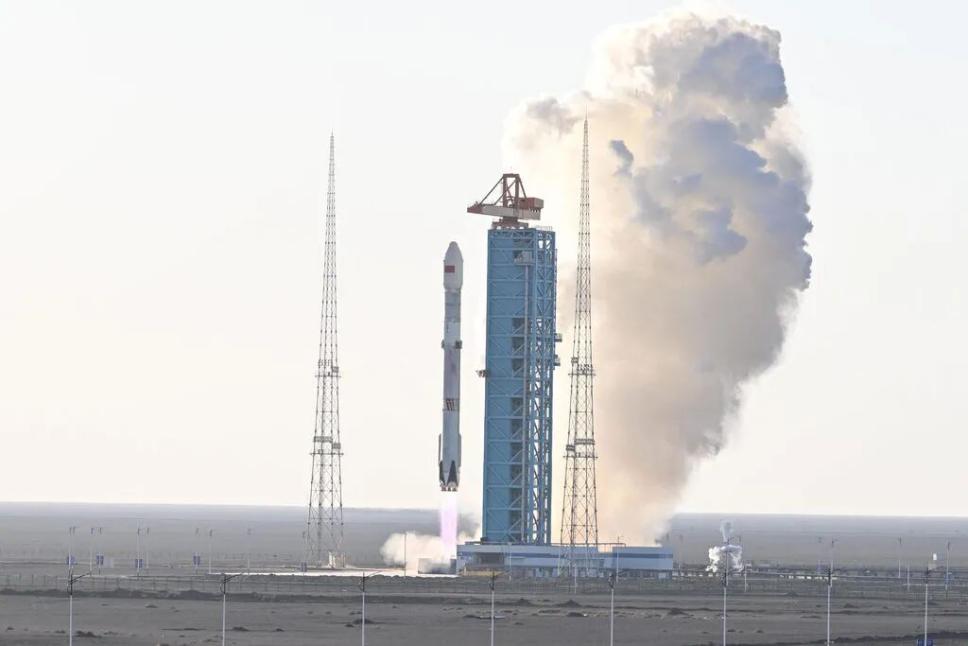
The Honghu-03 satellite, also known as Xiong'an-1, was successfully launched into orbit aboard a Zhuque-3 Y2 reusable rocket from the Dongfeng commercial space innovation pilot zone, Aug. 19. (Photo: Wang Weiqian)
"Once these industrial platforms become operational by the end of this year, Xiong'an will have the capacity to produce 300 satellites annually," said an official with the industry, information technology, science and technology, and data bureau of Xiong'an New Area.
"Xiong'an New Area has made aerospace information and satellite internet the first industrial chain to receive priority deployment. We are creating favorable conditions, building platforms, opening up application scenarios, providing policy support, improving the business environment, and upgrading services to attract more companies and foster industrial clustering," the official told People's Daily.
"Our goal is to build Xiong'an into an important source of innovation for China's commercial space industry and satellite internet sector, as well as a key supplier for the development of low-Earth-orbit constellations," the official added.
Innovation resources are also rapidly gathering. Xiong'an is now home to 69 companies across the aerospace information industrial chain and nine innovation platforms.
As one of China's pilot cities for the large-scale application of the BeiDou Navigation Satellite System (BDS), Xiong'an is also making active use of aerospace information technologies to support urban development and accelerate the rollout of "BeiDou +" applications.
At a smart construction site in the start-up area of Xiong'an New Area, construction equipment such as road rollers and asphalt pavers are equipped with the BDS. They can automatically plan their routes and adjust their operating pace, with positioning accuracy controlled to the centimeter level.
Baiyangdian Lake, the largest freshwater lake on the North China Plain, is another example. In Anxin county, all 24 rural tourism piers and more than 1,500 vessels have been equipped with dedicated BeiDou terminals. High-precision BeiDou positioning enables continuous monitoring of vessel movements and intelligent scheduling of water-based tourism services.
Today, "satellite internet + BeiDou" is being applied in a range of scenarios in Xiong'an, including underground spaces, smart construction sites, and the low-altitude economy.
And BeiDou is only one part of the picture. An increasing number of aerospace information technologies are being put to practical use in Xiong'an.
Recently, CHIP LINKING INNO's research team joined forces with a payload company in the new area to explore ways of bringing laser communications "from the sky to the ground."
Baiyangdian Lake is dotted with numerous scattered islands, making it difficult to lay fiber-optic cables between them. The team is therefore building laser communication links to replace fiber optics, with a transmission range of up to 10 kilometers.
"Satellite internet technology is bringing about a transformation from the sky to the ground," Chen said.
Looking ahead, his team will continue to tackle key technologies for ultra-high-speed laser communications while exploring a wider range of applications, with the aim of bringing the benefits of satellite internet technology to households across the country.