


Pinglu Canal opens new channel for China-ASEAN connectivity
The Pinglu Canal, a landmark project of the New International Land-Sea Trade Corridor in western China, officially opened to navigation on September 16. Carved through mountainous terrain, the 134.2-kilometer waterway provides the most cost-effective and efficient inland shipping route connecting China's interior with ASEAN countries.
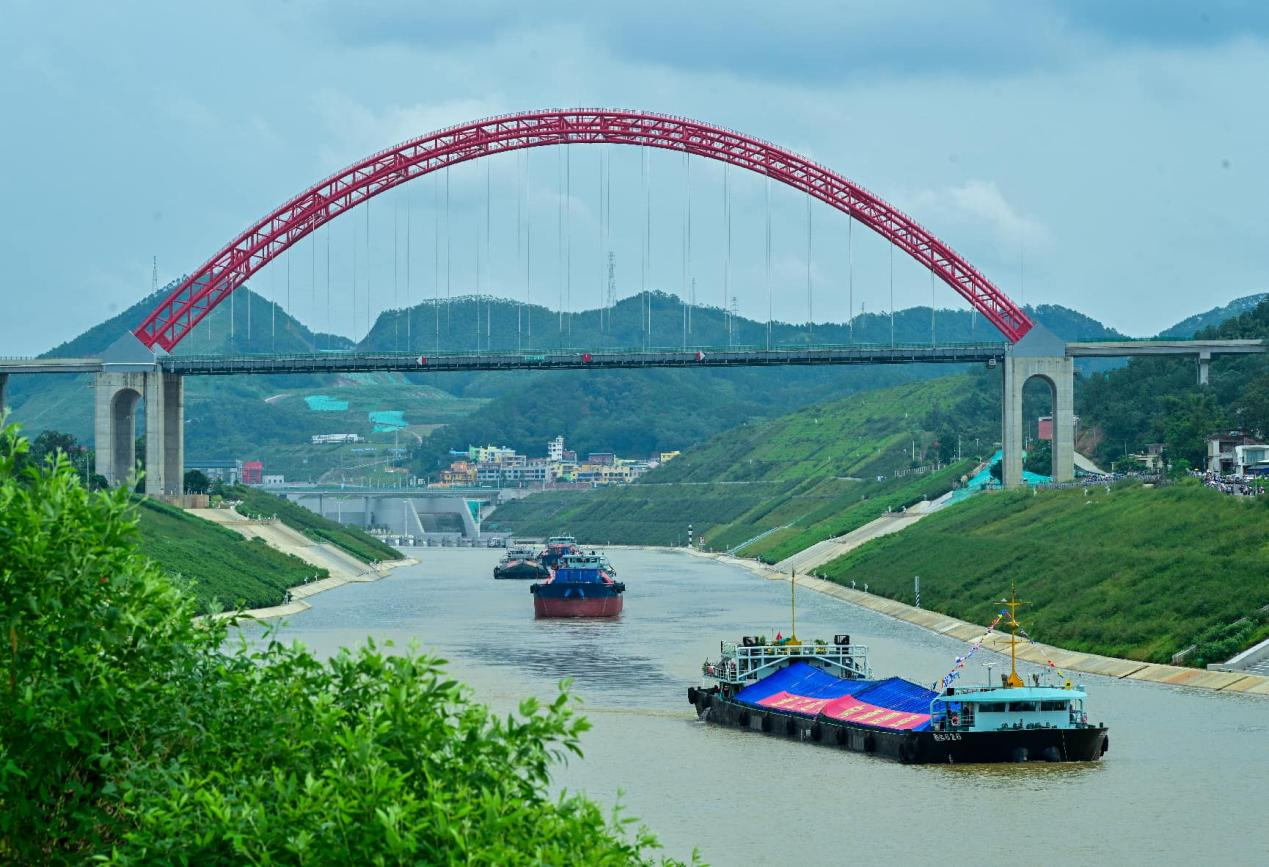
After the opening ceremony of the Pinglu Canal, the first batch of cargo vessels departed from the Madao hub in Qinzhou, south China's Guangxi Zhuang Autonomous Region, September 16. (Photo: Xie Feiyu/People's Daily)
Representatives from across the ASEAN countries and the broader regional community said the canal will significantly improve regional connectivity, bringing ASEAN countries closer to China's vast consumer market and industrial clusters in the southwest. It will facilitate greater two-way flows of trade, talent, and capital, promote deeper opening up and cooperation, and contribute to the building of a closer ASEAN-China community with a shared future.
Capable of handling vessels up to 5,000 tons, the canal has set multiple world records, including the fastest operational cycle for locks of its class and the highest vertical lift achieved by a water-conserving ship lock system. These innovations reflect advanced engineering practices tailored to complex topography.
Foreign diplomats and business leaders highlighted the project's technical rigor and sustainable design.
Vietnamese Ambassador to China Pham Thanh Binh, who inspected the site prior to opening, praised the canal's integration of cutting-edge technology, modern management protocols, and environmentally conscious planning. "It showcases China's infrastructure expertise while demonstrating how large-scale projects can align with ecological preservation and public benefit," he said.
Cambodian Ambassador to China Soeung Rathchavy said the Pinglu Canal provides valuable experience for Cambodia in developing water infrastructure. She expressed confidence that the canal's opening will bring tangible development opportunities to Cambodia.
"The opening of the Pinglu Canal fully demonstrates China's capabilities in modern engineering and technology," said Boonyong Yongchalearnrat, vice chairman of the Thai-Chinese Chamber of Commerce.
He noted that China completed the technically complex and highly integrated project in just four years, calling the pace of China's infrastructure development "astonishing." China, he said, has provided a "Pinglu solution" that can serve as a reference for major canal projects around the world.
At 1:50 pm on September 16, a long ship horn blared as a cargo vessel loaded with auto parts slowly entered the lock chamber of the Qishi hub of the canal. This marked the inaugural voyage of the foreign trade sea-river direct route linking Nanning Port in South China's Guangxi Zhuang Autonomous Region and Can Tho Port in Vietnam.
On the same day, the foreign trade route was launched alongside the domestic Nanning Port-Yangpu Port route, with vessels setting off in both directions on each route.
Shipping goods from southwest China to the sea via the Pinglu Canal shortens the inland waterway journey by more than 560 kilometers compared with traditional routes and cuts overall logistics costs by 18 to 30 percent. The canal is expected to save more than 5 billion yuan (about $746.53 million) in social transportation costs each year.
For ASEAN exporters, the canal provides faster access to China's southwestern market via Guangxi's Beibu Gulf ports, while Chinese imports benefit from smoother inbound supply chains. The two-way flow of goods will reinforce each other, helping build a stable and more resilient regional logistics network and creating win-win opportunities for China and ASEAN.
"This is major good news for strengthening trade between Thailand and China," said Chakra Yodmani, Deputy Permanent Secretary of Thailand's Ministry of Commerce, who was in Nanning, Guangxi, for the China-ASEAN Expo.
China has remained Thailand's largest trading partner for many consecutive years, he noted, adding that the Pinglu Canal offers tremendous economic opportunities. The new route, he said, will significantly reduce the logistics costs of Thai products bound for China, enabling more Thai goods to reach southwest China faster and giving Chinese consumers more choices.
Ngeow Chow Bing, director of the Institute of China Studies at the University of Malaya, noted that the canal will substantially reshape economic linkages between ASEAN and China.
"The canal will strengthen the connection between China's inland markets and the Beibu Gulf, helping further expand trade between ASEAN and China," he said. "It will also enhance the role of Qinzhou Port as a shipping hub and benefit the China-Malaysia Qinzhou Industrial Park."
Justin Low, chairman of the Singapore South China Business Association, said Singaporean companies can leverage the canal's lower logistics costs to invest and expand their presence in Guangxi. "We believe China and Singapore will explore more investment and cooperation opportunities around the canal," he said.
As a major piece of infrastructure supporting multimodal transport by river, rail and sea, the Pinglu Canal connects ASEAN to the south and Eurasia to the north. Linked with the China-Europe freight train services and rail-sea intermodal transport routes, it also connects Belt and Road partner countries.
Representatives from ASEAN countries said the canal's opening will enable deeper integration of industrial and supply chains, inject new momentum into connectivity between China and ASEAN, and contribute to high-quality Belt and Road cooperation.
"From a broader perspective of regional connectivity, the impact of the Pinglu Canal may extend beyond Southeast Asia. Going forward, it could also open up trade routes via the Indian Ocean to Europe and Africa," Ngeow said.
By linking inland waterways to the sea, the Pinglu Canal is unlocking a new era of regional development. As a conduit connecting ASEAN to global markets, it will promote economic openness through enhanced exchange and stimulate growth through improved connectivity, demonstrating the transformative potential of large-scale infrastructure integration.