


China-converted hospital ship sets sail, showcasing capability for highly complex ship conversions
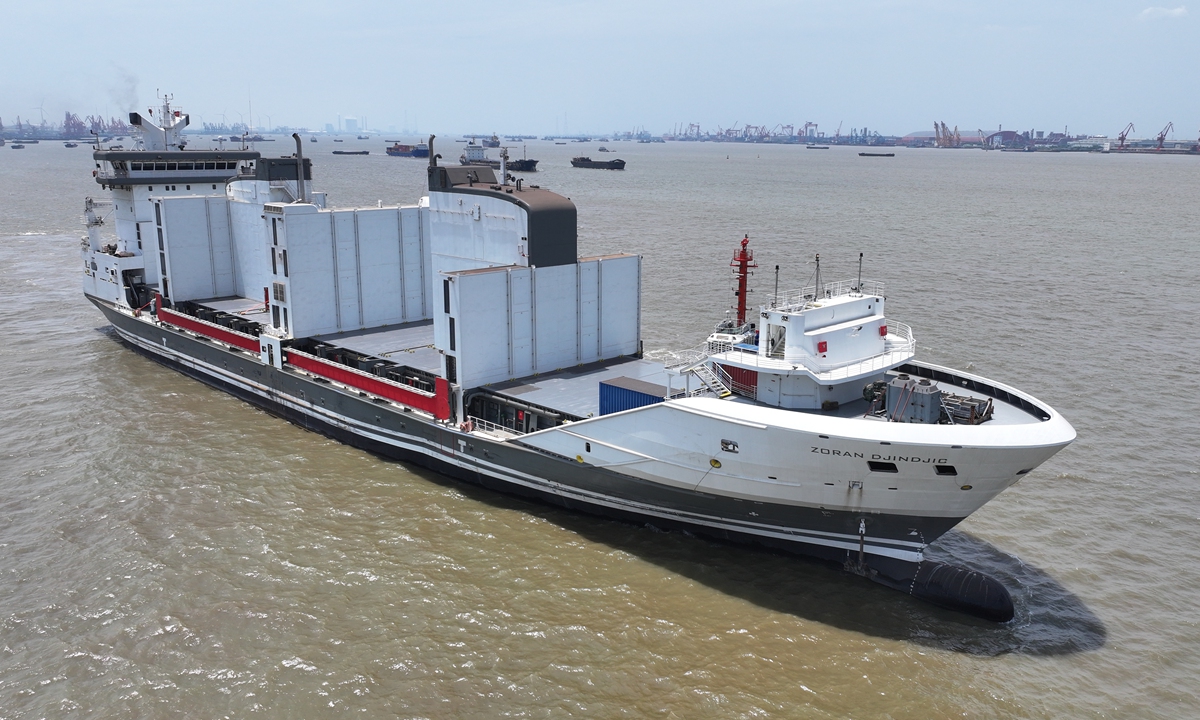
The Beograd, a container ship converted into a hospital ship by a Chinese company for an overseas client, set sail on September 19, 2026. (Photo: Courtesy of CSSC Chengxi Shipyard)
The Beograd, a container ship converted into a hospital ship by a Chinese company for an overseas client, recently set sail, marking the completion and delivery of the two ship-conversion projects undertaken by the company following the delivery of the first vessel Sunshine 1 in June, the Global Times learned from China State Shipbuilding Corporation Limited (CSSC) on Tuesday.
The completion of the projects demonstrates that Chinese shipyards have developed the system-wide capabilities needed to undertake some of the world's most technically demanding conversion projects.
The two vessels were converted from 700-TEU container ships and will serve as self-propelled hospital ships after delivery, providing medical support to remote and less-developed areas as well as disaster-hit regions.
The conversion involved far more than simply installing medical equipment. While retaining the vessels' navigational capabilities, the projects required the deep integration of medical, residential and ship systems, testing the shipyard's capabilities in system integration, multidisciplinary coordination and rapid on-site design, a representative from CSSC Chengxi Shipyard told the Global Times.
The conversion required a fundamental reconfiguration of the vessel's entire interior spaces. "The layout of medical areas such as outpatient departments, operating rooms and isolation wards can affect the entire vessel. From the location of a partition to the load-bearing capacity of the hull, any adjustment can have a knock-on effect on the safety and functions of the vessel," the representative said.
The project strictly followed relevant classification society guidelines on epidemic prevention, clearly dividing the vessels into clean, buffer and contaminated zones and establishing multiple isolation corridors to prevent cross-infection, according to the company.
At the same time, multiple core systems, including ventilation, water supply and drainage, power and electrical systems, as well as the main hull structure, had to be systematically rebuilt and upgraded. The work transformed the original cargo vessels into a maritime medical support system capable of meeting requirements for medical treatment and infection control, according to the representative.
More than 50 technical personnel worked on the project, with all design drawings issued as scheduled. The project also resulted in five patents and two corporate standards, while close coordination among different teams helped improve the project's response efficiency.
"Hospital ship conversion involves the deep integration of multiple specialties, including hull structures, marine engineering, electrical systems, ventilation and air conditioning. Completing such a project and developing replicable experience demonstrates that Chinese shipyards now have the system-wide capabilities needed to take on some of the world's most technically demanding conversion orders," the representative said.
China's ship repair industry has become one of the most important suppliers in the global market, while specialized ship conversion is among the most technically demanding segments, with high barriers to entry, the representative added.
Unlike standardized repairs of conventional vessels, specialized conversion requires the fundamental reconstruction of multiple systems, including the hull structure, mechanical and electrical systems and ventilation, while simultaneously meeting stringent classification society requirements and specific functional requirements from clients. This places demands on a shipyard's ability to integrate capabilities across the entire project chain.
The company has undertaken a wide range of technically demanding specialized conversion projects, including bulk carriers, livestock carriers, orange juice carriers, ro-ro and passenger vessels, semi-submersible vessels, marine research vessels, the rebuilding of container ships following total loss, and the conversion of large ore carriers into transshipment platforms.
The world's first livestock carrier converted to meet the requirements of the Australian Maritime Safety Authority (AMSA) was also completed and delivered in 2012, with capacity to transport up to 20,000 cattle or 110,000 sheep on a single voyage. The vessel became the world's second-largest livestock carrier at the time.
"As China moves from a major shipbuilding nation toward becoming a shipbuilding powerhouse, such high-tech specialized conversion capabilities represent a more tangible indicator of industrial upgrading than shipbuilding tonnage alone. The experience gained from the hospital ship projects can be further developed into replicable modular technologies, shifting the business model from customized "one-ship-at-a-time" conversion toward solutions based on modular components and standardized interfaces," the representative said.
While ensuring the structural safety of the hull, the approach will allow different functional modules to be rapidly installed and removed, helping shorten conversion times.