


China to step up recycling of solar panels, wind turbines and EV batteries: Ministry of Ecology and Environment
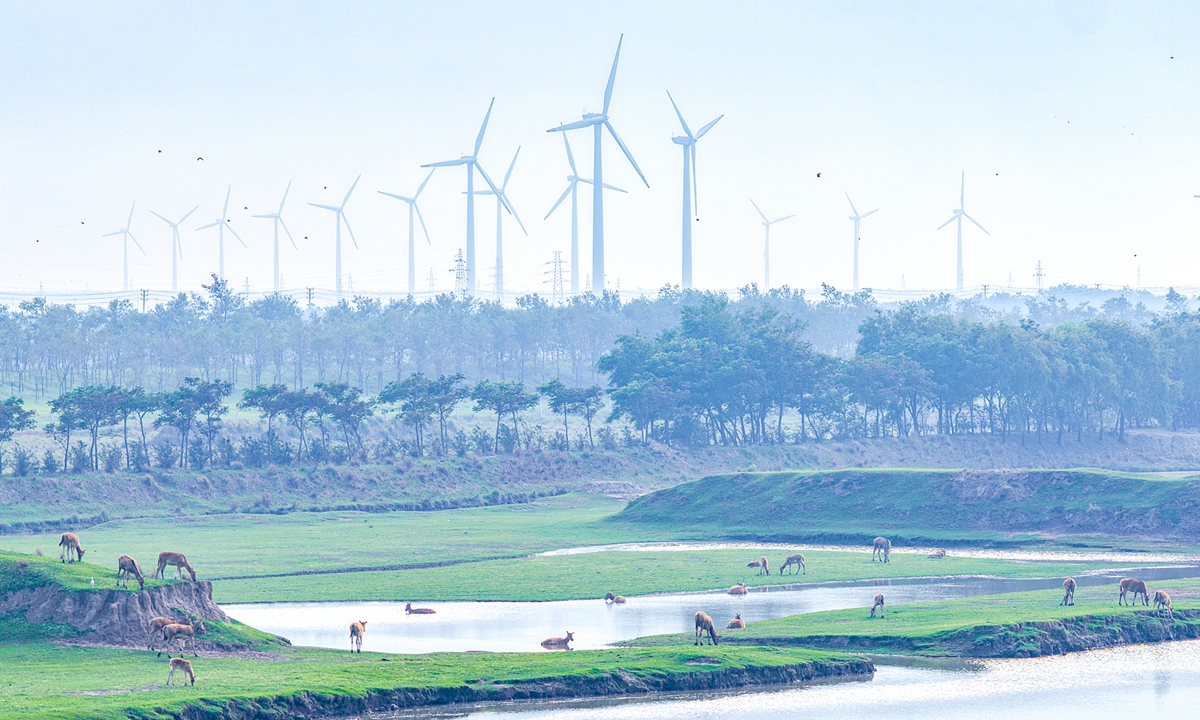
Herds of elk graze in the foreground of a lush wetland in Yancheng, East China's Jiangsu Province, while rows of wind turbines turn gracefully against the distant sky on July 16, 2026. (Photo: VCG)
China will step up recycling and pollution controls for waste generated by its fast-growing new energy industry, including retired photovoltaic modules, wind power equipment and power batteries, the Global Times learned from the Ministry of Ecology and Environment on Tuesday.
"Many people may not have seen illegal processing of discarded solar panels," Zhong Bin, director general of the ministry's Department of Solid Wastes and Chemicals, said at the ministry's September regular press conference.
Because photovoltaic modules are difficult to dismantle and separate, some small workshops use rudimentary burning methods to recover materials, leaving the air filled with an acrid smell, Zhong said.
The problem is becoming more prominent as clean energy equipment reaches the end of its service life. Beyond retired solar panels and wind turbine blades, solid waste from power batteries has become a key issue for the healthy development of China's new energy industries.
China's Ecological and Environmental Code, which took effect in August, sets out different responsibilities according to the source of the waste. Enterprises that build and operate wind and solar power projects are required to handle retired equipment themselves or entrust companies with the necessary capabilities to recycle or safely dispose of materials such as wind turbine blades and photovoltaic modules.
For retired power batteries, which largely come from consumer use, the Code applies an extended producer-responsibility system. Producers are required to build, either independently or through third parties, collection systems matched to their sales volumes and to fulfill recycling and utilization responsibilities.
Zhong said several government departments have issued policies on recycling retired photovoltaic modules, wind power equipment and power batteries, establishing an initial closed-loop management system covering their life cycles.
The Ministry of Ecology and Environment has also issued pollution-control standards for the treatment of waste lithium-ion power batteries and waste photovoltaic equipment. A standard for waste wind power equipment is being drafted, with a focus on pollution risks in processes such as roasting and metal recovery from battery black mass, separation of laminated photovoltaic components, and the harmless disposal of retired wind turbine blades.
Enforcement will be another focus. Illegal dismantling and disposal of retired new energy equipment and power batteries have been included in a nationwide campaign against illegal dumping and treatment of solid waste, Zhong said. The ministry will require local authorities to crack down on environmental violations and direct retired equipment toward formal recycling and disposal channels.
The need for such safeguards is growing alongside the sector itself. By the end of 2025, China had installed solar capacity of 1.2 billion kilowatts and wind capacity of 640 million kilowatts, after adding 318 million kilowatts of solar power and 120 million kilowatts of wind power during the year, according to the National Energy Administration.
In the press conference in November 2025, the Ministry of Ecology and Environment estimated that by 2030, China could generate roughly 1.5 million to 2 million tons of waste photovoltaic modules, 500,000 tons of retired wind turbine blades and 1 million tons of used power batteries.
"As installations increase, China will face large-scale waste equipment," Ma Jun, director of the Beijing-based Institute of Public and Environmental Affairs, previously told the Global Times, noting that recycling panels scattered across vast western and rural areas can be difficult, while blades made largely from fiberglass present a separate recycling challenge.
The next step will be to strengthen oversight of retired solar and wind equipment no longer used for power generation by bringing them under industrial solid waste management, while encouraging more retired power batteries to enter regulated recycling channels, Zhong said.