


China-US port ties run deep
Beneath rows of towering ship-to-shore cranes at the Port of Los Angeles, containers rise from massive vessels and move toward trucks and rail lines that fan out across the United States. Ships berth, cranes swing, trucks queue and freight trains pull inland in a steady rhythm at one of the busiest container gateways in the Western Hemisphere.
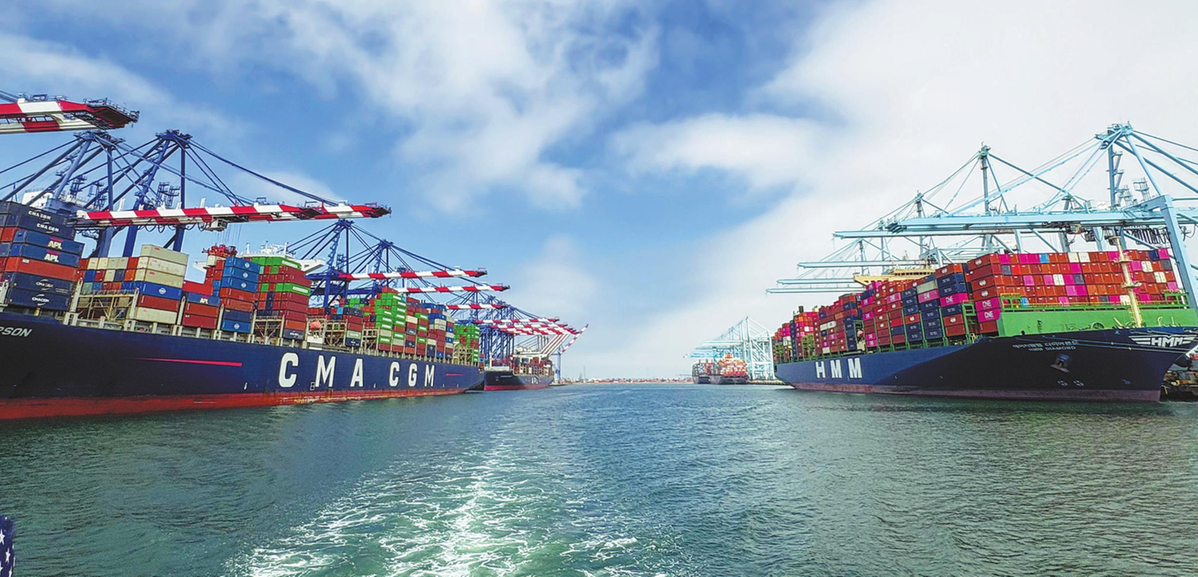
Container ships are berthed at the Port of Los Angeles, a major gateway for trans-Pacific commerce and a longstanding link in China-US trade. (File photo: China Daily)
Covering more than 30,000 hectares along 70 kilometers of waterfront, the port has seven container terminals, 85 ship-to-shore cranes and nearly 200 kilometers of rail. It handled 10.2 million twenty-foot equivalent units, or TEUs, in 2025, its third-busiest year on record. The port has remained the busiest container port in the Western Hemisphere for about a quarter century.
Its strong cargo run has continued this year. Through the first eight months of 2026, the port handled just over 7 million TEUs, 1.5 percent more than a year earlier. August alone totaled 955,907 TEUs, 6 percent above the five-year average for the month, while June, July and August became the busiest three consecutive months in the port's history, with more than 2.9 million TEUs moving across its docks.
But the significance of the port extends beyond cargo volume. For decades, Los Angeles has served as a major physical link between China and the United States, connecting Asian manufacturing and ports with American retailers, manufacturers and consumers. More recently, those ties have expanded into cleaner shipping, port technology, digitalization and supply-chain resilience.
That relationship is again in focus during the summit between President Xi Jinping and President Donald Trump in Washington on Thursday.
For Port of Los Angeles Executive Director Eugene Seroka, the current moment recalls an earlier chapter in bilateral ties.
Xi, then China's vice-president, visited the Port of Los Angeles in February 2012 and toured the China Shipping Group terminal with then-California governor Jerry Brown and Los Angeles mayor Antonio Villaraigosa.
"When President Xi visited the Port of LA as China's vice-president in 2012, it underscored the importance of the trade relationship between China and the United States and the role Los Angeles plays in connecting our two economies," Seroka told China Daily.
"That relationship continues today. China remains an extremely important trading partner for the Port of LA, and our longstanding relationships with Chinese ports have also created opportunities to work together beyond cargo movement," he said.
China was the port's largest trading partner by cargo value in 2025, accounting for about $82 billion, followed by Vietnam at $48 billion and Japan at $45 billion. Northeast Asia accounted for 59 percent of cargo handled, while Southeast Asia represented 30 percent.
Seroka said China's share of the port's business portfolio has declined from roughly 60 percent in 2018 to about 40 percent today, as sourcing from other Asian economies has expanded.
At neighboring Long Beach, a similar pattern is visible.
Noel Hacegaba, CEO of the Port of Long Beach, said China remains a major trading partner even as companies broaden sourcing across Asia.
"In 2019, cargo tied to China accounted for about 70 percent of our imports and exports. Today that's down to 60 percent," Hacegaba said. "But last year we still set an all-time record."
The Port of Long Beach handled a record 9.9 million TEUs in 2025.
Hacegaba said growing trade with Vietnam, Thailand and Malaysia has broadened the region's Asian sourcing network, although shipments from some Southeast Asian production centers can take longer to reach Southern California.
Even as tariff uncertainty and geopolitical tensions have accelerated supply-chain diversification, many companies continue to maintain longstanding commercial ties with China.
Asked by China Daily whether California manufacturers were moving production away from China or mainly broadening sourcing while retaining Chinese suppliers, Lance Hastings, president and CEO of the California Manufacturers & Technology Association, said the latter was more accurate.
"It's really assessing the global profile that we face right now," Hastings said, suggesting that manufacturers are diversifying while continuing to maintain established relationships with Chinese suppliers as part of their long-term sourcing strategies.
When asked what businesses hope to see from the China-US summit, particularly on tariffs and trade policy, Brian Dodge, president and CEO of the Retail Industry Leaders Association, said, "What we want to have is predictability, stability in the relationship."
He said sudden changes in trade policy make it difficult for companies to make long-term plans without affecting prices or the consumer experience, and that businesses hope the talks can provide "a clearer picture of what the long-term relationship will be" and create more room for cooperation.
That need for certainty is particularly important because major supply-chain and investment decisions are made years in advance.
Dan Letter, CEO of logistics real estate company Prologis, said customers that have absorbed repeated disruptions are again making longer-term commitments.
"Our customers have been digesting all of these issues, and we're seeing them again make decisions," Letter said. "They're making these five-plus-year decisions with us."
Retailers brought some merchandise into the US earlier this year amid uncertainty over tariffs, fuel costs and other supply-chain pressures, helping produce the record summer at Los Angeles. Such short-term adjustments are supported in part by longstanding sourcing relationships with China, which remains the port's largest trading partner, according to Seroka.
Seroka said continued dialogue between the US and China matters throughout the supply chain.
"It's certainly positive when the leaders of the world's two largest economies sit down to negotiate," he said.
Agricultural trade offers another example of the economic relationship.
For US farmers, China remains one of the world's largest agricultural markets, while Beijing has increasingly sourced soybeans from Brazil and Argentina during periods of trade tension. Those shifts show how commercial relationships can be difficult to rebuild once buyers establish alternative suppliers.
"For these two largest economies to work together is, I think, a global necessity," Seroka said. "I'm hoping for progress of any kind that can be tangible that keeps the temperature down and trade up."
Cooperation between US and Chinese ports has meanwhile extended beyond traditional cargo movement.
One of the clearest examples is the Los Angeles-Long Beach-Shanghai Green Shipping Corridor. Launched in 2022, it brings together the three ports, shipping lines, cargo owners and C40 Cities to reduce emissions and advance low — and zero-carbon technologies along a major trans-Pacific trade route.
The corridor has moved from planning into implementation. By January, Seroka said all Phase 1 objectives had been completed, including expanded use of shoreside electricity, introduction of cleaner vessel technologies and groundwork for future lower-carbon marine fuel bunkering.
"Our partners in Shanghai have been wonderful to work with every day," Seroka said. "The Shanghai-Long Beach-Los Angeles green shipping corridor is gaining momentum, and our partnership will only get stronger."
The corridor links Shanghai, the world's busiest container port, with the Los Angeles-Long Beach complex, North America's busiest container gateway. According to previous China Daily coverage, the trade lane carries more than $300 billion in two-way goods annually.
Seroka said the cooperation is broadening.
"I see significant opportunities to continue that cooperation, particularly in cleaner shipping, technology and supply-chain resilience," he said.
"We're already working with ports including Shanghai and Guangzhou on green shipping corridors, digitalization and other initiatives aimed at reducing emissions and improving the efficiency and resilience of global trade. More recently, we expanded our collaboration with Shenzhen."
"These port-to-port relationships demonstrate how practical cooperation can produce benefits on both sides of the Pacific," he said.
In July, the Port of Los Angeles signed a memorandum of understanding with Shenzhen Port Group and Yantian International Container Terminals to advance sustainable trade, maritime innovation and global supply-chain development. The agreement covers green technologies, clean energy, port operations, logistics and technical exchanges.
The green transition has also extended from vessels to terminal equipment.
Shanghai Zhenhua Heavy Industries, or ZPMC, one of the world's largest port-equipment manufacturers, has supplied ship-to-shore cranes and other equipment to US gateways, including Los Angeles. In 2021, two ZPMC cranes entered service at the Everport terminal as part of a modernization project that also included deeper berths, additional electrical infrastructure and charging equipment for clean-energy trucks.
ZPMC told China Daily that its cooperation with US ports has increasingly included clean-energy retrofits, equipment electrification, hybrid power systems and energy-recovery projects.
The company said green-port development now extends beyond vessel emissions to terminals, cargo-handling equipment, energy systems and the wider logistics chain, and that Chinese equipment manufacturers and US port operators can complement each other as ports seek greater efficiency and lower emissions.
That cooperation has unfolded alongside trade and security disputes.
Chinese ship-to-shore cranes have been subject to a 25 percent Section 301 tariff since 2024. The US Trade Representative later imposed an additional 100 percent duty on certain ship-to-shore cranes in 2025, but the broader maritime Section 301 action was suspended for one year beginning Nov 10, 2025.
The current push for greener ports also has roots stretching back more than two decades.
On June 21, 2004, the Port of Los Angeles opened the West Basin Container Terminal at Berth 100, the irst container terminal in the world to use shore-side electrical power for container ships, according to the port. The system, known as Alternative Maritime Power, or AMP, allows ships to shut down auxiliary diesel engines while berthed and plug into the local electricity grid.
China Shipping was directly involved in that early effort. Port records say the company's Xin Yang Zhou became the first container ship to plug into AMP at Berth 100 in 2004.
California later incorporated shore power into its regulatory framework. As of 2026, the Port of Los Angeles has 80 AMP vaults, more than any other port in the world, with all container and cruise berths equipped with shoreside power.
The progression from a China Shipping terminal project more than two decades ago to today's Shanghai green shipping corridor illustrates how cooperation has moved from individual technologies toward cleaner fuels, digital systems and entire shipping networks.
The broader value of international trade was also a focus at the centennial celebration of World Trade Week in Los Angeles in May.
Peter Tirschwell, who has held senior roles covering maritime trade and founded the TPM container shipping conference, said trade creates economic opportunity even as tariffs, geopolitical rivalry and supply-chain disruptions reshape global commerce.
"We believe firmly in the value of trade to expand markets, create opportunities, create interdependencies and thus bring countries and societies together," Tirschwell said.
He pointed to the ports of Los Angeles and Long Beach as examples of trade's economic reach.
"The message being that trade creates jobs, it creates growth, it creates prosperity," Tirschwell said.
But he said the global environment has changed markedly from the period following the creation of the World Trade Organization, when trade liberalization enjoyed broader political support.
"There used to be a global consensus regarding the value of trade," he said. "We've entered into a new era defined by national self-interest, geopolitical power plays and strategic supply chains."
For Southern California, the scale of that trade remains substantial. The Port of Los Angeles supports an estimated 1.3 million jobs nationwide. Combined with Long Beach, the San Pedro Bay port complex supports about 2.4 million US jobs and handled approximately 31 percent of all US containerized international waterborne trade in 2025.
Changes in China-US trade policy can therefore influence retail orders, sourcing decisions, agricultural exports and cargo lows through California's logistics network.
At the same time, the history of the two ports shows how commercial and technical ties can continue through changing political and economic cycles.
Seroka said China still represented about 40 percent of the Port of Los Angeles' business, more than two and a half times its next-largest trading partner.
"There is no faster way to get cargo from China to the US than through LA," he said. "These partnerships have run deep for many decades, and we intend to continue them."