


China-developed world's largest pile-driving vessel departs for Brazil's landmark Salvador-Itaparica Bridge project
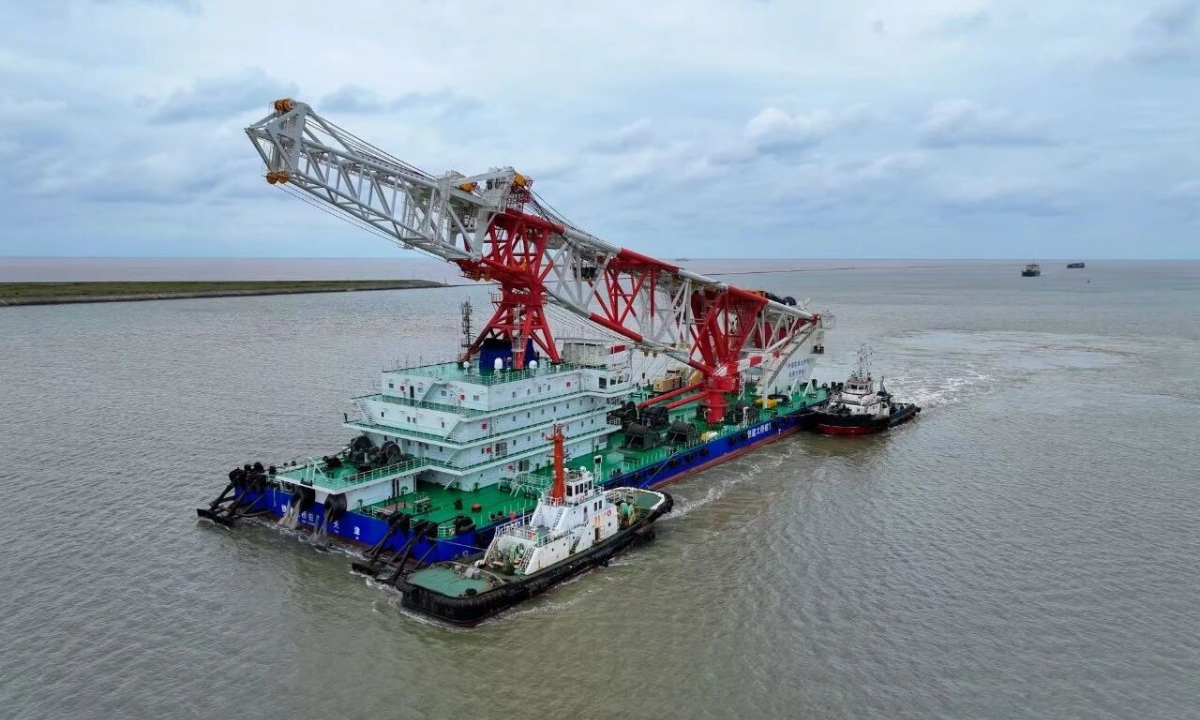
Invested and built by the China Railway Construction Corporation (CRCC), CRCC Bridge Piling No. 1 is the world's largest dynamic-positioning pile-driving vessel. (Photo: Science and Technology Daily)
CRCC Bridge Piling No.1, the world's largest dynamic-positioning pile-driving vessel invested and built by the China Railway Construction Corporation (CRCC), departed on Sunday from the Lüsi port in East China's Jiangsu Province for the Bay of All Saints in the state of Bahia in Brazil to support construction of the cross-sea Salvador-Itaparica Bridge project, the Global Times learned from the CRCC on Sunday.
After completing a dedicated transport plan, route planning and risk assessments, the vessel is scheduled to travel 11,300 nautical miles, passing through the Strait of Malacca and the Cape of Good Hope, before entering the South Atlantic Ocean and reaching waters off Recife, capital of Pernambuco in northeastern Brazil, with the voyage expected to take about 45 days, according to a statement the Global Times obtained from the China Civil Engineering Construction Corporation under the CRCC.
A pile-driving vessel is a specialized marine engineering ship that drives massive steel or concrete piles into the seabed, providing foundations for projects such as cross-sea bridges, offshore wind farms and deep-water ports, the People's Daily reported.
Independently invested and built by the CRCC, the vessel measures 130.5 meters in length, 40.8 meters in width, and 8.4 meters in depth, Xinhua News Agency reported.
It is currently the world's largest pile-driving vessel by the pile-frame height of 156 meters, pile-lifting capacity of 700 tons, and the maximum operating depth of 70 meters, which enable the vessel to handle oversized and extra-long pile foundations in complex conditions in deep and distant waters, marking a major leap in China's marine engineering equipment manufacturing technology from catching up with global leaders to taking a leading position, per the People's Daily.
The voyage to Brazil marks the vessel's first overseas mission since its delivery in March. It will face the demanding engineering challenge of constructing the world's deepest pile foundations for the Salvador-Itaparica Bridge, which is Latin America's largest cross-sea cable-stayed -bridge.
Construction of the Salvador-Itaparica Bridge, one of Brazil's largest infrastructure projects and one being built by Chinese companies with a total investment of 15.8 billion Brazilian reais ($3.05 billion), officially began on July 1, local time, China News Service reported.
The bridge has a total length of 46.8 kilometers, including a 12.4-kilometer, two-way, six-lane cross-sea bridge, a 4.2-kilometer road connection system in Salvador, and a 30.2-kilometer road system on Itaparica Island. It will feature a cable-stayed design with a 682-meter main span and 85-meter navigational clearance, setting multiple world records in engineering and construction while allowing large vessels and cruise ships to pass safely, according to China News Service.
The Salvador-Itaparica Bridge spans Brazil's famed Bay of All Saints, with the main bridge's pile-foundation work taking place in waters 64 meters deep and amid complex marine geological conditions.
During pile-driving operations, the vessel uses a hydraulic hammer to drive steel piles into the seabed with an instantaneous impact energy of up to 1,360 kilojoules per blow. To counter the resulting vibrations and maintain precision, the vessel is equipped with the world's largest 5,000-ton-class hydraulic cylinders, which firmly stabilize the pile frame during operations, per the People's Daily report.
Technologically, the vessel features two world-first innovations. It is the first large pile-driving vessel to combine dynamic positioning and a mooring positioning system. Combined with China's domestically developed high-precision BeiDou Navigation Satellite System, the technology enables pile-driving positioning accuracy at the centimeter level.
It is also the first pile-driving vessel to use a closed-loop hydraulic system for its main cylinders. The domestically developed system converts the potential energy generated when the pile frame is lowered or tilted forward into electrical energy, achieving an energy recovery rate of up to 40 percent, according to the CRCC.
Once the bridge is put into operation, it is expected to handle an average of about 28,000 vehicles a day. Travel time between Salvador and Vera Cruz is expected to be cut dramatically from the current one hour by ferry to just 15 minutes, and the transportation distance for goods such as grain, cotton and fruit produced in western Bahia state will be shortened by 200 kilometers, fundamentally reshaping the region's logistics landscape. The project is also expected to boost new investment in tourism, industry, commerce and logistics, benefiting millions of local residents, according to the China News Service.
In recent years, China's domestically built pile-driving vessels are becoming taller and capable of working at greater depths. As a growing number of high-end marine engineering vessels and equipment are deployed overseas, Chinese equipment is expected to play a greater role in marine engineering projects around the world, according to the CRCC.