


China Coast Guard holds law-enforcement drill near Huangyan Dao
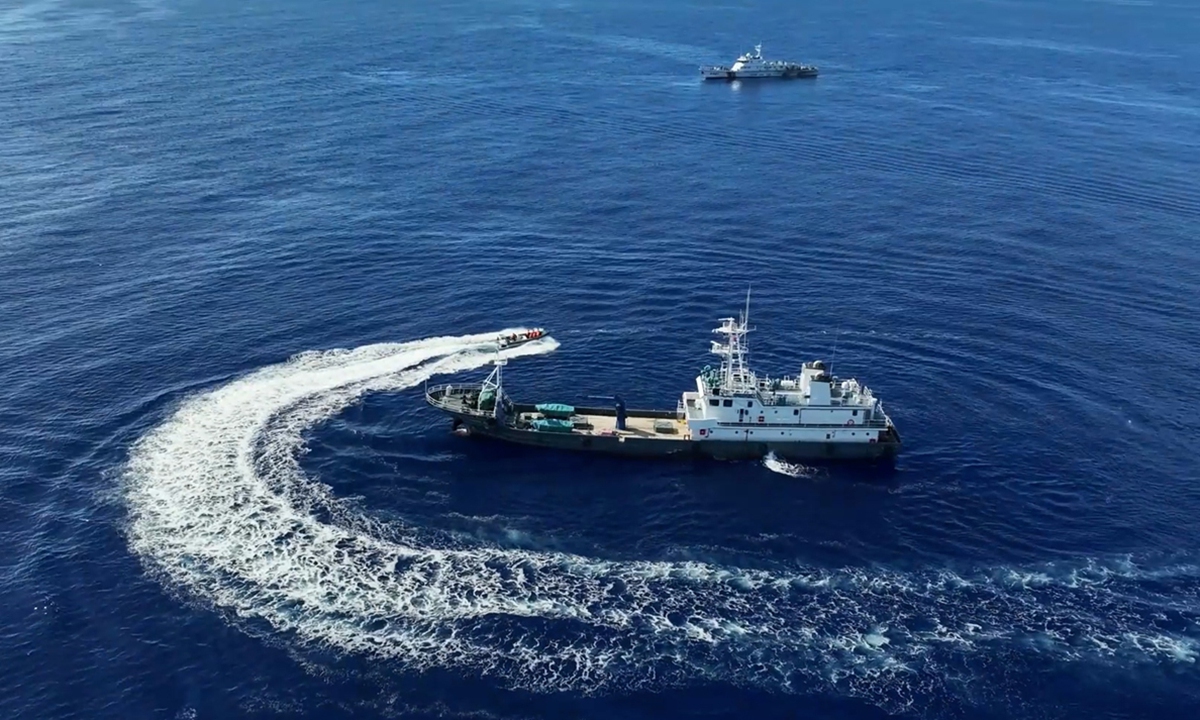
China Coast Guard (CCG) vessels conduct drills on rights-protection law enforcement, as well as management and control in the waters near China's Huangyan Dao on August 1, 2026. (Photo: Courtesy of CCG)
The China Coast Guard (CCG) on Sunday conducted a drill on law-enforcement as well as management and control in waters near China's Huangyan Dao, focusing on operations including boarding inspections, blocking attempted intrusions and forced towing, as part of efforts to strengthen law enforcement and control in the area in accordance with the law.
Global Times reporters at the scene learned that multiple types of coast guard vessels took part in the drill, which covered a range of law-enforcement scenarios.
During an exercise simulating efforts to block vessels attempting to force their way into the area, the CCG formation carried out identification and verification, verbal warnings, route control, and water-cannon operations in sequence.
Global Times reporters saw high-pressure jets of water shooting into the air in broad arcs with a thunderous roar. Zheng Longbiao, a CCG law-enforcement officer, told the Global Times that water cannons can effectively prevent foreign vessels from forcing their way through.
During the boarding inspection exercise, CCG officers carrying law-enforcement equipment boarded a vessel simulating a foreign ship intruding into territorial waters and conducted an inspection.
The drill also included a scenario involving the towing away of a simulated intruding foreign vessel. CCG officers carried out operations including encircling and blocking the target vessel and forcing it to stop at close range.
Global Times reporters saw two CCG boats approach the target vessel at full speed from both sides, forming an encirclement and repeatedly intercepting its route until it was forced to slow down and stop.
In addition, this drill made full use of drone-based law enforcement evidence collection throughout, demonstrating coordinated operations between forces at sea and in the air.
"Drones provide a broader and more comprehensive perspective, allowing us to record the entire process of unprofessional and irregular operations by foreign vessels infringing on China's rights and interests from a higher vantage point," CCG officer Qiu Canhui said.
The Philippines recently drew in some countries from outside the region to conduct a field training exercise under the ADMM-Plus Experts' Working Group on Maritime Security near China's Huangyan Dao. The move, carried out under the name of security cooperation, constituted infringement and provocation and deliberately undermined regional peace and stability.
Huangyan Dao is an inherent part of China's territory. China has indisputable sovereignty over Huangyan Dao and sovereign rights and jurisdiction over its adjacent waters.
The Global Times learned that the CCG will further strengthen law enforcement and control in waters near Huangyan Dao and resolutely safeguard China's territorial sovereignty as well as maritime rights and interests.
Since 2023, the Philippines has carried out a series of infringement and provocative actions in multiple areas of the South China Sea, including attempting to intrude into waters around Chinese islands and reefs, ramming Chinese vessels and seeking to maintain an illegal presence in relevant waters.
In response, the China Coast Guard (CCG) has taken firm countermeasures, including blocking and driving away Philippine vessels, using water cannons and conducting forced towing operations, thwarting the Philippine side's attempts while strengthening China's control over relevant islands and reefs in the South China Sea.
China's legitimate control around Huangyan Dao and Ren'ai Jiao has now extended beyond 24 nautical miles, while regular control has been established around Xianbin Jiao and Tiexian Jiao. The scope of China's control is continuing to expand. The more the Philippine side provokes, the stronger the China Coast Guard's control measures will become.