


Shenzhou-23 crew completes payload transfers after more than 4 months in space
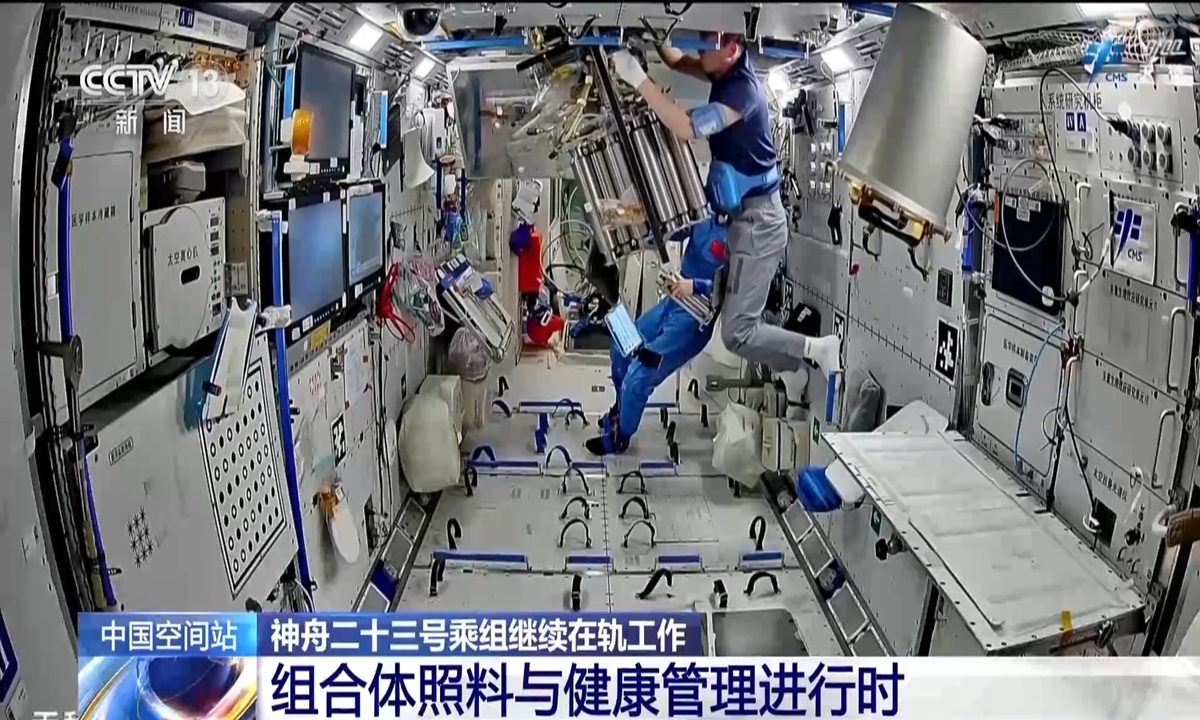
Photo: CCTV
After more than four months in orbit, the Shenzhou-23 crew has completed a range of tasks, including transferring payloads in and out of the cabin, while continuing space science experiments and routine maintenance aboard the space station, according to a CCTV News report on Sunday.
The Shenzhou-23 crew members, taikonauts Zhu Yangzhu, Zhang Zhiyuan, and Li Jiaying, have been in orbit since May 24. Last week, while steadily advancing various space science experiments and tests aboard the space station and carrying out routine maintenance of the space station complex, they also completed work related to moving payloads in and out of the spacecraft cabin.
The components and the general-purpose external experiment facility moved out of the cabin contain several experiment units, including one for remote-sensing target detection based on domestically developed AI chips. These units are being used to conduct experiments in new space-based technologies and applications, CCTV reported.
With support and coordination from ground personnel, the crew returned a materials exposure experiment facility to the cabin. Since being launched into orbit aboard the Tianzhou-5 cargo spacecraft on November 12, 2022, the facility has conducted three rounds of exposure experiments involving a total of 16 projects, achieving several world firsts. The fourth round of experiments is currently underway, covering eight scientific research projects and 26 sample units.
Last week, various space science experiments and tests aboard the space station were carried out in an orderly manner, the report noted. The crew conducted mass-perception and arm-vibration tests as part of an in-orbit tactile perception experiment to study changes in taikonauts' tactile abilities during spaceflight. They also completed assessments of their emergency decision-making abilities and tests of their emotional states in orbit, continuing to collect test data.
As part of routine maintenance of the space station complex, the crew replaced components in the water-gas separation unit of the regenerative environmental control and life support system.
The taikonauts also underwent medical examinations, including a 12-lead electrocardiogram and noninvasive cardiac function tests, and used equipment to mitigate the physiological effects of weightlessness.