


PLA STC conducts joint naval-air exercise near Huangyan Dao; move to test and enhance troops' combat capabilities in safeguarding nation’s territorial sovereignty
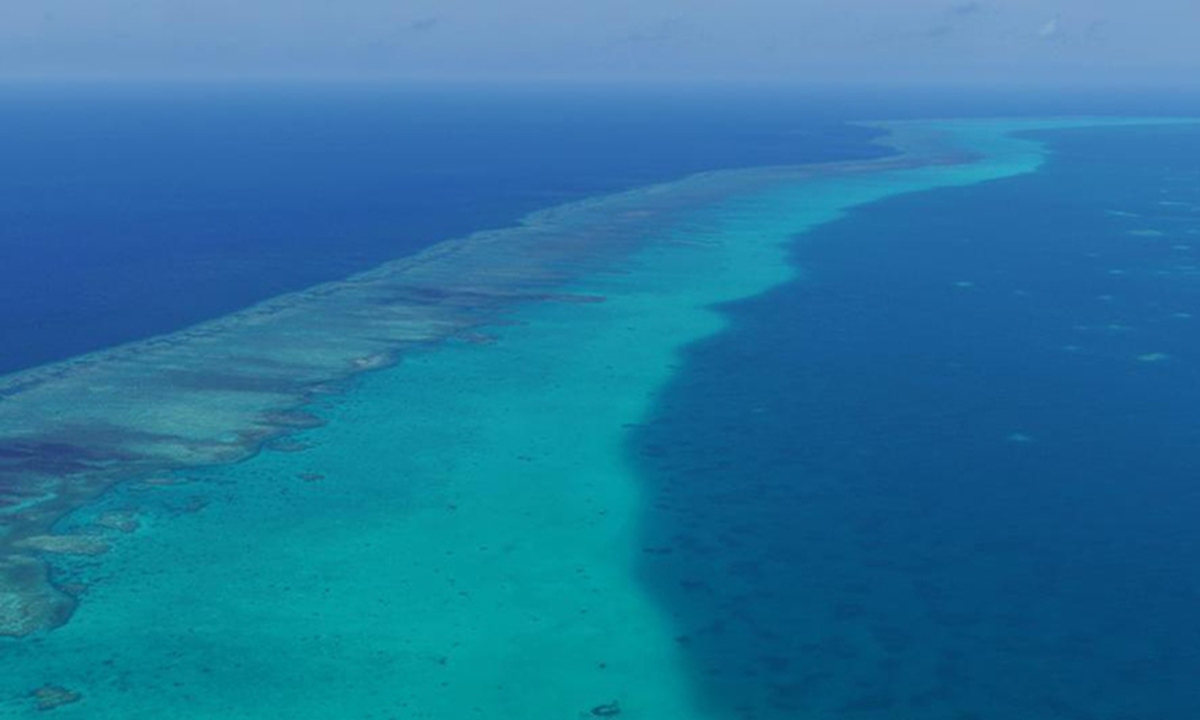
An aerial drone photo taken on May 2, 2026 shows reefs in the territorial waters of China's Huangyan Dao in the South China Sea. (Xinhua/Chen Bin)
The Chinese People's Liberation Army (PLA) Southern Theater Command (STC) conducted a joint naval-air training exercise in the waters and airspace around China's Huangyan Dao on Sunday, according to a statement released by the command on the same day.
The command said the exercise is a necessary response to actions by certain countries that undermine regional peace and stability, and was intended to test and enhance the troop's combat capabilities in safeguarding China's territorial sovereignty and maritime rights and interests.
Zhang Chi, a professor at the PLA National Defense University, told the Global Times on Sunday that the joint exercise came against two recent developments. On the one hand, the Philippine side has sought to stir up disputes at sea by relying on external support, carried out provocative actions that infringe upon rights, and acted in bad faith, undermining regional peace and stability. On the other hand, three days earlier, the Philippines had breached its commitments and sent vessel to resupply the illegally "grounded" ship at Ren'ai Jiao despite China's admonitions, Zhang said.
"By relying on external forces to stir up trouble at sea, the Philippine side will only drive up tensions in the South China Sea and damage the common interests of regional countries," Zhang said, calling the Philippines "a troublemaker and a disruptor of peace."
In recent days, the Philippines, together with several other countries, organized a field exercise under the ASEAN Defense Ministers' Meeting-Plus Experts' Working Group on Maritime Security's Joint Cooperative Activity. The relevant exercise area is located in the air and sea areas near China's Huangyan Dao.
Commenting on the exercise, Zhang said Huangyan Dao is China's inherent territory, while the scope of Philippine territory is defined by a series of international treaties and does not include Huangyan Dao.
"The Philippines took advantage of its role as a co-chair of the ASEAN Defense Ministers' Meeting-Plus Experts' Working Group on Maritime Security and, disregarding the principle of consultations, drew relevant countries into conducting a joint military exercise in the waters and airspace near China's Huangyan Dao," Zhang said. "In essence, it was a provocative act against China, dressed up as security cooperation and accompanied by publicity and hype."
In addition, on Thursday, the Philippines sent a resupply vessel to a ship illegally grounded at Ren'ai Jiao, despite China's admonitions.
"The Philippine side carried out provocative acts during a Chinese holiday and then sought to hype them up," Zhang said. "Such egregious actions seriously violate the Declaration on the Conduct of Parties in the South China Sea and seriously undermine peace and stability in the region."
Zhang said peace and stability in the South China Sea require regional countries to respect one another and resolve issues through consultation, whereas forming exclusive blocs and bringing in external forces will only be counterproductive. "Facts have repeatedly shown that attempts to rely on external forces to provoke trouble will ultimately end up becoming tools used by others. Inviting wolves into the house will eventually backfire," Zhang said.
Regarding Sunday's joint exercise by the PLA Southern Theater Command, Zhang described it as "legitimate and necessary."
He stressed that the joint naval-air training exercise conducted by the Southern Theater Command in the waters and airspace around Huangyan Dao is legitimate, professional and standardized. It is a necessary action to safeguard China's territorial sovereignty and maritime rights and interests, and also a just action aimed at maintaining peace and stability in the South China Sea, Zhang added.