


Ex-Japan FM leads delegation to China; unofficial exchanges can hardly deliver fundamental improvement to bilateral ties: expert
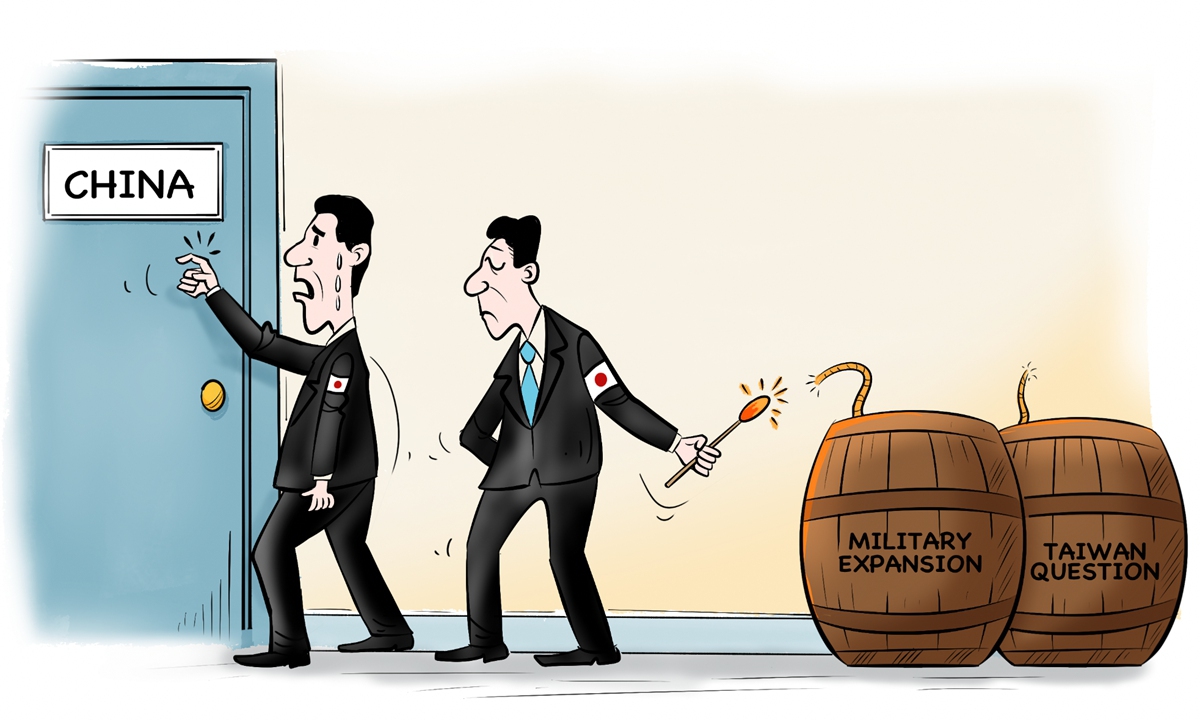
China Japan Photo: GT
Former Japanese Foreign Minister Takeshi Iwaya, head of Japan's Association for the Promotion of International Trade, a group for friendship with China, led a delegation to China and arrived in Beijing on Sunday amid strained bilateral relations, according to Japanese media outlets.
Such a visit to China, a Chinese expert said, reflects the pragmatic strategic interests of Japan's business community, which differ from the views prevailing in political circles. However, it still raises the question of whether Japanese Prime Minister Sanae Takaichi will heed this voice, the expert noted.
Around 50 Japanese corporate executives and business leaders are taking part in the delegation. The group had initially planned to visit China in June, but the trip was postponed following the death of the association's former head, Yohei Kono, according to the report by The Sankei Shimbun on Sunday.
Before departing Japan, Iwaya told reporters at Haneda Airport that "especially when Japan-China relations are strained, it is important to seek a path toward improvement through dialogue," Kyodo News reported on Sunday. He explained that the purpose of his visit to China was to facilitate and promote economic exchanges. He also said that, if he had the opportunity to meet with senior Chinese government officials, he would like to "exchange views frankly."
While Japan-China relations have been strained due to Takaichi's remarks last November over a possible contingency concerning the Taiwan region, moves to promote exchanges between the two countries are taking place ahead of the Asia-Pacific Economic Cooperation (APEC) Economic Leaders' Meeting to be held in China in November this year, according to Jiji Press.
The association is one of Japan's major friendship organizations promoting ties with China and has a long-standing tradition of organizing visits to China and engaging in economic and trade exchanges with Chinese counterparts, Wang Guangtao, an associate professor at Fudan University's Center for Japanese Studies, told the Global Times.
"The latest visit had initially been planned for June this year. Following the death of its former head, the planned exchange still proceeds as scheduled, reflecting the organization's continuity and longstanding commitment to economic and trade engagement with China," Wang said.
Amid the continued deterioration in China-Japan relations, the visit to China also reflects a pragmatic strategic interest within Japan's business community that differs from the mainstream narrative in political circles, said Wang.
Wang noted that the association is, in essence, a non-governmental friendship organization. Although its new chairman Iwaya is a member of the House of Representatives and a former cabinet minister, it remains unclear to what extent this latest private-sector initiative has received authorization from the Japanese government, or to what extent it has involved communication, exchanges, or coordination with the government.
In September, a cross-party delegation of young Japanese lawmakers from the Japan-China Friendship Parliamentarians' Union visited China, with the Chinese side urging Japan to correct its mistakes and create conditions for the sound development of bilateral relations, according to the Chinese People's Association for Friendship with Foreign Countries.
The trip also follows a visit to China in August by another delegation of young Japanese parliament members.
Lu Kang, Vice-minister of the International Department of the CPC Central Committee, said during the meeting with the delegation in August that it is hoped that Japan's ruling and opposition parties and political figures could set the record straight, urge the Japanese authorities to abide by the principles set forth in the four political documents between China and Japan, genuinely learn from history, and handle the Taiwan question honestly and faithfully in accordance with the one-China principle, thereby creating conditions through concrete actions for China-Japan relations to overcome their difficulties.
Wang said that a series of recent developments - including a previous visit to China by young lawmakers from the Japan-China Friendship Parliamentarians' Union, as well as Iwaya's trip - reflect the existence of different voices within Japan, at least when it comes to China-Japan relations. This succession of visits to China is itself an expression of those differing views.
Wang also cautioned that the key question is whether Takaichi can hear these voices, or whether she is willing to acknowledge and embrace such exchanges between China and Japan. If she is willing to do so, there could potentially be some breakthroughs in high-level interactions between the two countries in the period ahead.
However, based on the current situation, one or two unofficial visits and exchanges, whose degree of government endorsement remains unclear, are unlikely to bring about any fundamental improvement in China-Japan relations, the expert added.