


China opens four high-speed rail lines, expanding national network
BEIJING, Sept. 28 (Xinhua) -- China, home to the world's largest high-speed rail network, opened four major high-speed railway sections to traffic on Monday, improving transport links across several regions.
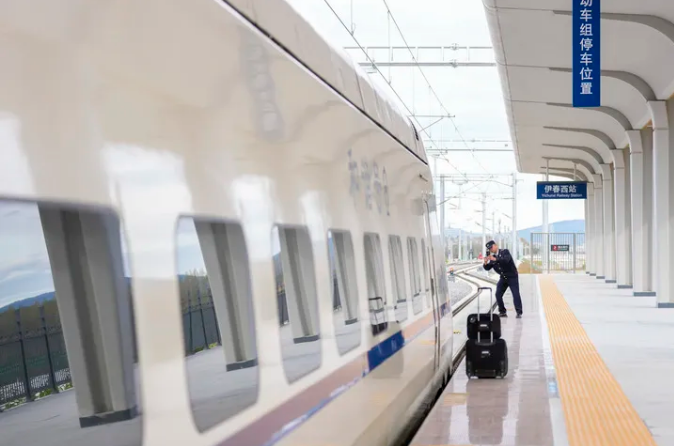
Photo: Xinhua
The new sections connect Xiong'an in Hebei Province with Shangqiu in Henan Province, Xi'an with Ankang in Shaanxi Province, Yichang with Xingshan in Hubei Province, and Harbin with Yichun in Heilongjiang Province.
Spanning northern, northwestern, central and northeastern China, the new lines will facilitate travel for residents, improve regional connectivity and support economic development.
In north China, the Xiong'an-Shangqiu section runs through Xiong'an New Area, Cangzhou, Hengshui and Xingtai in Hebei Province, Liaocheng in Shandong Province, Puyang in Henan Province, and Jining and Heze in Shandong Province before reaching Shangqiu in Henan Province, with the main line measuring 552 kilometers long.
"Once the section begins operations, the fastest journey from Xiong'an to Shangqiu will take just 2 hours and 27 minutes," said Han Yong, deputy director of the passenger transport center of China Railway Beijing Group Co., Ltd., adding that the route will further strengthen communications between Xiong'an New Area and China's vast northern and central markets.
In northwest China, the 171-km Xi'an-Ankang section crosses the Qinling Mountains, overcoming complex geological challenges while also prioritizing ecological protection. With a design speed of 350 km per hour, the train can travel between its two terminal stations in just 45 minutes.
Construction of the Yichang-Xingshan section in central China faced similar challenges, with the railway traversing the Daba Mountains through a 16.9-km-long deep-buried tunnel and a high-rise mega bridge.
The Yichang-Xingshan line connects China's two major high-speed railway arteries, namely the Shanghai-Chongqing-Chengdu high-speed railway along the Yangtze River and the Zhengzhou-Chongqing high-speed railway, and will unleash fresh development momentum along the Yangtze River Economic Belt, according to China Railway Wuhan Bureau Group Co., Ltd., its operator.
In northeast China, the 318-km Harbin-Yichun section is China's northernmost high-speed railway ever constructed. Its terminal, Yichun West Station, is located at 47 degrees north latitude, making it China's first high-speed railway station building constructed in a permafrost region, said Shi Qinwei, head of the Yichun West Station project at China Railway Construction Group Co., Ltd.
Linking Harbin, China's renowned winter destination in Heilongjiang Province with Yichun, the province's forest-enclosed haven for summer retreat, the route will cut the railway travel time between the two cities from about seven hours to roughly two hours, while extending China's modern high-speed rails to the lesser-tapped northern regions.
Opened shortly before the National Day holiday, the new railways are also expected to boost tourist flows between China's major cities along the route, as well as iconic attractions such as Yichang's Three Gorges Dam and Yichun's emerald forests.
China State Railway Group Co., Ltd., the country's railroad operator, is expecting some 284 million passenger trips during the Mid-Autumn Festival and National Day holiday period, which extends from Sept. 23 to October 8.
China is expanding and optimizing its high-speed rail network to better serve its booming domestic markets and industries.
By the end of 2025, the country's total operating railway mileage had reached 165,000 km, including more than 50,000 km of high-speed rail.
Fixed-asset investment in the railway sector totaled 511.8 billion yuan (about 75.9 billion U.S. dollars) in the first eight months of the year, up 1.5 percent year on year, according to China State Railway Group Co., Ltd.
Under national plans, China's high-speed rail network is projected to hit 70,000 km by 2035, with eight north-south vertical lines and eight east-west horizontal lines. Once complete, the network will connect major cities, city clusters and key economic zones throughout the country.