


S.Korean president cites increased exports in calling China ties 'important'; pragmatic diplomacy yields win-win outcomes: expert
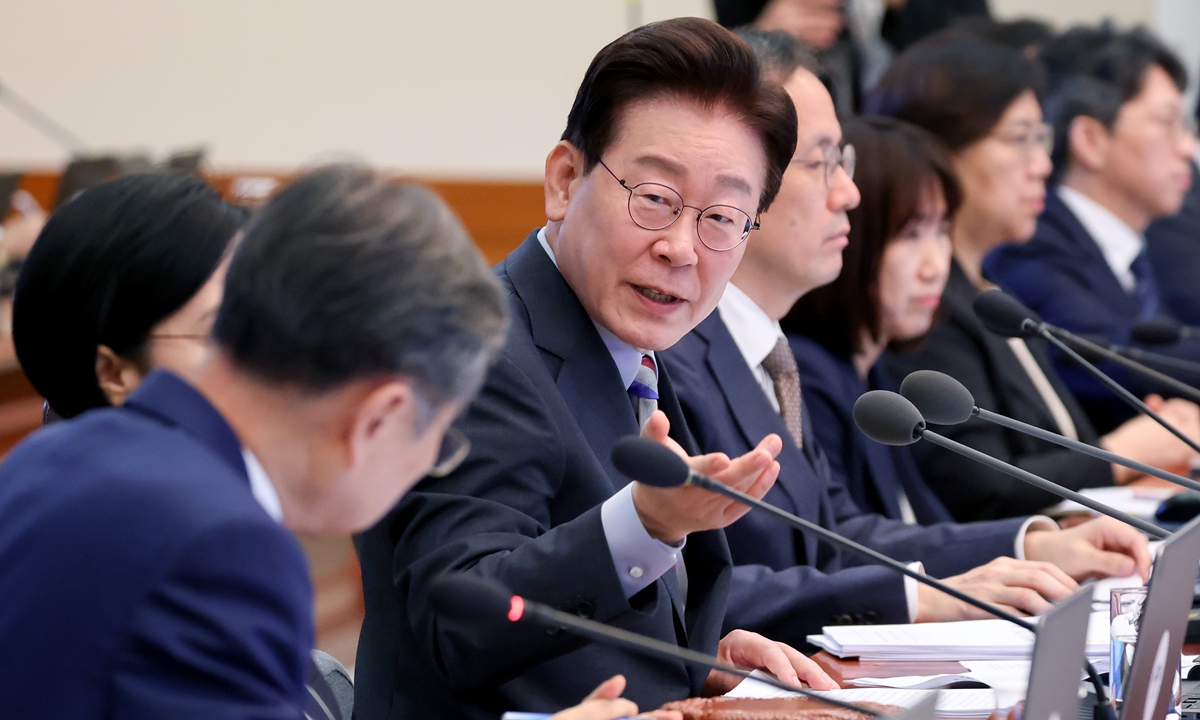
South Korean President Lee Jae myung attends a meeting at the Blue House on September 29, 2026, Seoul, South Korea. (Photo: VCG)
South Korean President Lee Jae-myung said managing relations with China is important alongside Seoul's alliance with the US, citing government data showing that monthly exports to China averaged $15.1 billion under his administration, up 36 percent from the previous government. Chinese Ambassador Dai Bing commented on Tuesday that the figures reflected the positive effect of improving bilateral ties on trade. The rising exports to China reflect the Lee administration's pragmatic approach and the value of stable bilateral ties, said a Chinese expert.
On Monday, Lee shared on X a document showing data on the trend in South Korea's exports to China. According to the material he released, monthly exports to China have averaged $15.1 billion under his administration, 36 percent higher than the $11 billion monthly average under the Yoon Suk-yeol administration.
Exports to China rose sharply after the South Korea-China summit held on the sidelines of the Asia-Pacific Economic Cooperation forum last November, the data showed. Monthly exports to China averaged $11.1 billion from June to October last year, before the APEC summit, but climbed to $17 billion from November last year through August this year, according to Seoul Economic Daily.
Lee wrote on the X that "Diplomacy aims for the national interest - namely, national development and improving the livelihoods of the people - as its greatest goal. While the ROK-U.S. alliance is the most important aspect of diplomacy, managing relations with China is also important."
Following Lee's X post, Chinese ambassador to South Korea Dai Bing on Tuesday wrote on X that the figure reflects the positive role that improvements and development in bilateral relations play in promoting economic and trade cooperation between the two countries.
"Currently, China-South Korea economic and trade relations are shifting from vertical division of labor to horizontal collaboration, but the strategic nature and mutual benefits of cooperation between the two sides remain unchanged," Dai wrote, noting that one-sidedly emphasizing competitive pressures from China does not reflect reality and is not conducive to expanding and deepening economic and trade cooperation between the two sides or to upgrading its quality.
"We hope that China and South Korea will continue to promote friendly and mutually beneficial cooperation, benefiting the peoples of both countries," Dai wrote.
South Korea's monthly exports to China have averaged about $15 billion under President Lee Jae-myung, exceeding the previous administration. The figure highlights the win-win result for Seoul to pursue the pragmatic, diversified diplomacy Lee advocates: maintaining the South Korea-US alliance as a cornerstone of its security while strengthening cooperation with China to support trade, economic growth and livelihoods, Da Zhigang, a researcher at the Institute of Northeast Asian Studies at the Heilongjiang Provincial Academy of Social Sciences, told the Global Times on Tuesday.
Stable China-South Korea relations and expanded economic cooperation serve the interests of both countries, said Da, noting that ex exports represent more than mere figures; they drive upstream and downstream industrial chains, underpinned by South Korea's technological innovation and industrial transformation. Semiconductor and AI industries represented by Samsung, SK Hynix and SK Group have also propelled the growth of industrial chains.
South Korean exports to China more than doubled to $16.6 billion from September 1 to 20, boosted by strong chip demand, South Korean media outlets reported, citing domestic customs data. Chinese experts said that the surge reflected both China's fast-expanding artificial intelligence (AI)-driven demand and South Korean chipmakers' increasingly pragmatic efforts to preserve access to a market that remains difficult to replace, according to a previous Global Times report.
Although China and South Korea compete in some manufacturing sectors, advances in AI and other emerging technologies offer new opportunities for cooperation. By keeping bilateral ties stable and pursuing practical economic cooperation, the two countries can turn those opportunities into benefits for their people, said Da.
Since taking office, Lee has reiterated cooperation with China. For example, during his visit to China in January, Lee said that South Korea and China need to expand cooperation in the fields of artificial intelligence (AI), beauty and cultural products, noting such areas of cooperation would serve as a new breakthrough in promoting bilateral trade, according to the Yonhap News Agency.
"The Republic of Korea and China are ships that sail on the same sea in the same direction," Lee said, referring to South Korea's official name. "The two countries have helped each other grow through interconnected industrial supply chains and led the global economy," he said, per Yonhap.
Da noted that China-South Korea relations have generally gained positive momentum under President Lee. There may be setbacks, but they do not change the foundation of our strategic cooperative partnership.
"Lee is seeking to maintain the South Korea-US alliance as a pillar of security while keeping relations with China stable and making the most of economic opportunities. The future of bilateral ties also depends on exchanges between local communities and young people. In the AI era, those exchanges can build understanding and give the relationship lasting strength," said the expert.