


Homegrown technologies help China's FAST telescope detect fainter cosmic signals, support deep-space missions
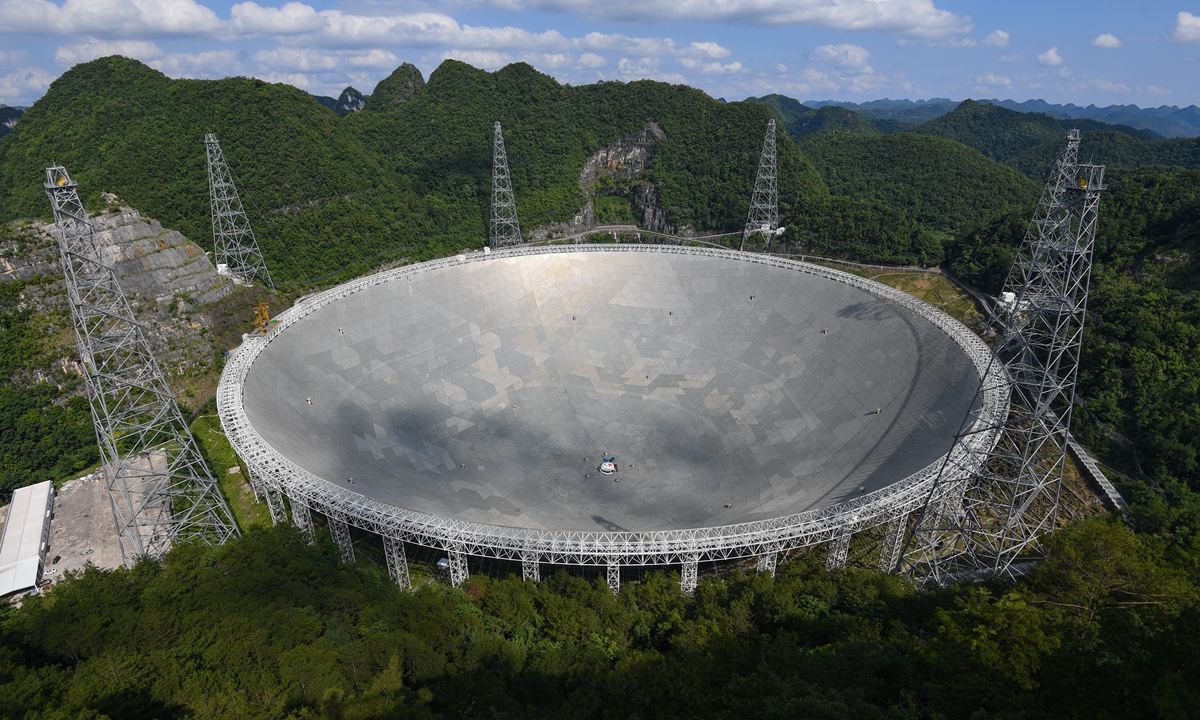
Image of China's Five-hundred-meter Aperture Spherical Radio Telescope (FAST) in Southwest China's Guizhou Province (Photo: VCG)
When a giant radio telescope turns toward the depths of the universe, it becomes a sensitive "listener," picking up faint signals from distant celestial objects amid the vast background noise of space. These signals reveal clues about the universe, and the technologies used to capture them can also help ground stations track spacecraft on deep-space missions.
On Friday, China's Five-hundred-meter Aperture Spherical Radio Telescope (FAST) in Southwest China's Guizhou Province marked its 10th anniversary. As one of the world's most vital astronomical observation facilities, FAST has achieved a series of internationally influential findings in key research fields covering pulsars, neutral hydrogen galaxies, fast radio bursts and gravitational waves, according to the Xinhua News Agency.
Behind this surge in scientific discoveries is the growing self-reliance of the technologies that makes FAST possible. When FAST was first built, many key components relied on imports. Over the past decade, its team has developed domestic alternatives for core components including laser total stations, actuators, feed-cabin steel cables and low-noise amplifiers.
The Global Times recently visited relevant institutes under China Electronics Technology Group Corporation (CETC) to explore the technologies behind FAST's highly sensitive observations and the years of effort to make its core systems increasingly self-reliant.
Making a giant dish moveAccording to the CETC, two core systems it developed - FAST's reflector panels and its feed cabin and parking platform - are crucial to the telescope's performance.
The reflector is the heart of FAST's detection capability. From above, its 500-meter aperture resembles a gigantic dish, with a collecting area of about 250,000 square meters.
But FAST is not simply a giant stationary dish. Its reflector can actively change shape, forming a 300-meter-diameter parabola within the 500-meter spherical structure to track different celestial targets.
The 4,450 triangular reflector units are themselves made up of about 100 smaller triangular sub-panels each, with side lengths of around 1.1 meters. The surface profile must be controlled to millimeter-level precision to form the required curvature, according to the CETC.
"The reflector is made up of active units that can change shape. There are nearly 400 types of reflector units and more than 6,000 types of sub-panels," Zheng Yuanpeng, chief designer of FAST's reflector system at the Academy for network and communication of CETC, told the Global Times. "The assembly alone took nearly a year."
The panels are also perforated with 5-millimeter holes, giving them an open-area ratio of 50 percent. The design allows FAST to receive radio waves across a wide frequency range while reducing structural weight and wind load. It also allows sunlight and rainwater to pass through, helping protect the vegetation and terrain beneath the telescope.
As the reflector changes shape, the feed cabin must move simultaneously to the new focal point, with positioning accuracy at the millimeter level.
The feed cabin is like the giant pupil of FAST's eye on the universe, according to the CETC.
"Although it looks like a small object hanging inside the giant dish, the feed cabin is actually a 13-meter-wide, 6-meter-high structure weighing about 30 tons," Fu Qiang, deputy chief designer of the feed cabin system, told the Global Times.
Suspended by six steel cables, it will move within a space over 200 meters in diameter and 140 to 180 meters above the ground, while keeping the receivers inside virtually motionless, Fu said.
"FAST is a national major science project. The feed cabin is perhaps the system that best demonstrates both the scientific and engineering challenges involved," said Fu.
After extensive testing, the team developed a two-stage precision adjustment system that allows the cabin to move rapidly while keeping the receivers positioned precisely to within millimeters.
The feed cabin must also provide extremely high electromagnetic shielding. Otherwise, signals generated by its own electronic systems could mix with the faint cosmic signals FAST is trying to detect.
"After years of technical breakthroughs, the team has brought FAST's electromagnetic shielding performance to 160 decibels," Fu said proudly. This achievement meets the project's performance requirements and ensures stable operation.
The drive for self-reliance extends beyond FAST's reflector and feed cabin.
On June 15, six giant steel cables developed entirely in China were installed on FAST, completing the domestic replacement of cables in its core cable-driven system. The cables act as the "muscles" pulling the 30-ton feed cabin into position, reported CCTV News.
After about two years of use, the imported cables developed problems, while technical support from the overseas supplier was unavailable. The FAST team therefore developed a domestic replacement, optimizing the steel, cable structure and manufacturing process to withstand repeated bending and changing loads while significantly extending fatigue life, according to CCTV.
The same effort has extended to electronic components.
China has independently developed high-end amplifiers for medium- and low-frequency radio astronomy, achieving internationally leading performance at substantially lower cost. The technology has since been applied to BINGO, a China-Brazil collaboration to detect baryon acoustic oscillation signals.
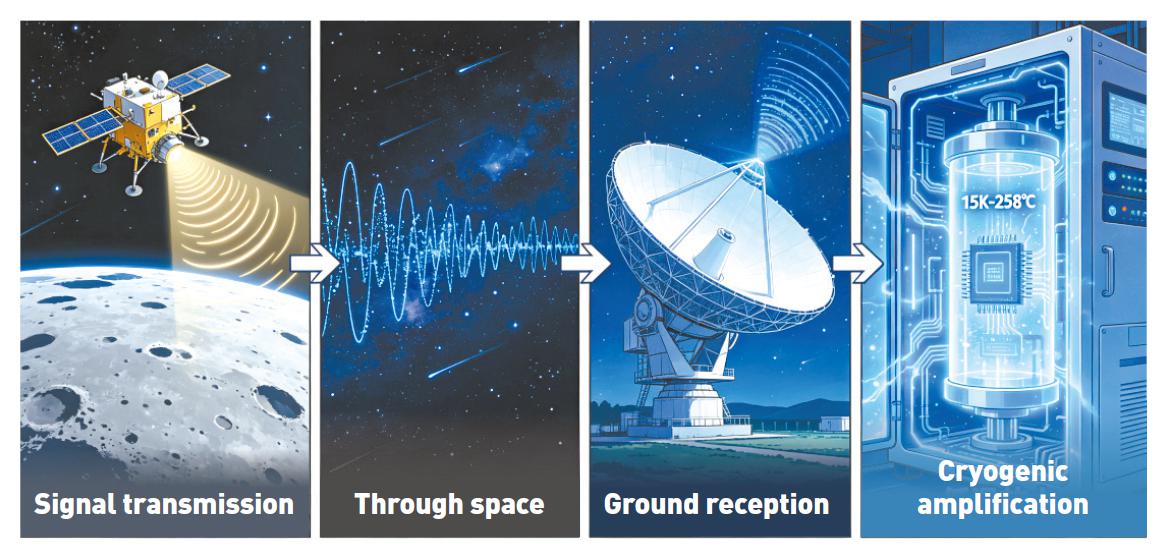
Illustration of how radio signals from the Moon reach Earth (Photo: Courtesy of CETC 16th Research Institute)
FAST may be the giant "eye," but a telescope also needs an extraordinarily sensitive "ear."
During the visit to the CETC 16th Research Institute, the Global Times reporter's conversation with researchers brought one technology into focus: cryogenics.
A broadband cryogenic receiver developed by the 16th institute is installed inside FAST's feed cabin, where it plays a critical role in receiving and processing the extremely weak radio signals arriving from the universe.
According to the institute, the cryogenic receiver is a core component that gives a radio telescope its "super-hearing" - the most sensitive "auditory nerve" deep inside the telescope.
Put simply, its job is to amplify and filter signals that are almost impossible to hear, presenting them as completely and cleanly as possible.
The receiver works at temperatures approaching absolute zero. Its front-end low-noise amplifier can operate at around 15 kelvins, or approximately -258 C.
Mobile phones, routers and car radios all contain receivers. So why do receivers used in lunar exploration and radio astronomy need to operate at temperatures approaching -258 C? The answer, according to the institute, is simple: reducing noise.
All electronic devices generate thermal noise as electrons move inside them. The warmer the device, the stronger this background noise tends to be. For a deep-space signal that may already be extremely faint, noise generated by the receiver itself can drown out the signal.
It is like trying to hear someone whispering across a crowded stadium. A cryogenic receiver effectively quiets the stadium before using an ultra-sensitive microphone to pick up the whisper. Its key advantages are lower noise, higher sensitivity and stronger resistance to interference.
At the same time, for the receiver in the FAST, its broadband capability has significantly expanded its frequency coverage, providing technical support for the observation and study of pulsars, fast radio bursts and other astrophysical phenomena. It has also opened up new possibilities for pulsar searches, studies of the interstellar medium and other areas of radio astronomy, helping scientists probe a wider range of astrophysical processes.
Listening across deep spaceThe same cryogenic receiving technology used in FAST is also deployed in China's Very Long Baseline Interferometry (VLBI) network, where it helps improve the accuracy of spacecraft orbit determination in deep-space missions.
During the Chang'e-6 mission, the VLBI orbit-determination subsystem provided tracking support from the launch of the Queqiao-2 relay satellite through Chang'e-6's return. The 16th institute supplied cryogenic receivers for VLBI stations and will continue supporting follow-up missions, including Chang'e-7.
In deep-space tracking, the receiver is only one part of a much larger system.
A spacecraft near the moon continuously transmits radio signals. Radio telescopes across China simultaneously point toward the target and receive the signals. Their cryogenic receivers amplify, down-convert and record the faint signals.
The data are then compared at a processing center. By measuring tiny differences in the time the same signal reaches different stations, scientists can calculate parameters such as signal delay and delay rate. Combined with ranging and velocity measurements, these data enable high-precision orbit determination.
This combination of ground-based ranging and velocity measurements with VLBI angular measurements has become an important approach in China's deep-space exploration missions.
The technology is also finding applications beyond China's own deep-space missions.
The year 2026 has seen the institute complete the final system integration test for a 13-meter radio telescope project, marking the completion of its installation and maintenance work for four cryogenic receiver systems at overseas stations, reported the institute on April 14.
The four-month project covered more than 10,000 kilometers. The 13-meter radio telescope is a standardized, highly reliable observation unit designed for global VLBI network observations. For its overseas stations, the institute developed the receiving-chain subsystem and adopted an innovative approach in which the entire feed is cryogenically cooled, reducing system noise to an extremely low level and improving observation performance, said the report.
Now, the second phase of FAST is moving forward, with plans to build the world's first hybrid-aperture radio interferometer array centered on a giant telescope and surrounded by medium-sized telescopes, per Xinhua.
"We are working our way down the entire chain, from the feed and RF amplifiers all the way to chips," said a researcher. "Phased arrays and the 19-beam receiver are still imported. I hope that around 2028, we can achieve domestic production across the entire chain," Jiang Peng, chief engineer of FAST, was quoted by the CCTV as saying.
For researchers at the 16th institute, the work continues to push the boundaries of cryogenic receiving technology, providing critical front-end support for deep-space tracking and control as well as radio astronomy. As humanity ventures farther into the universe, their technology will continue to serve as a "super-hearing ear," listening for the faintest responses from the stars.
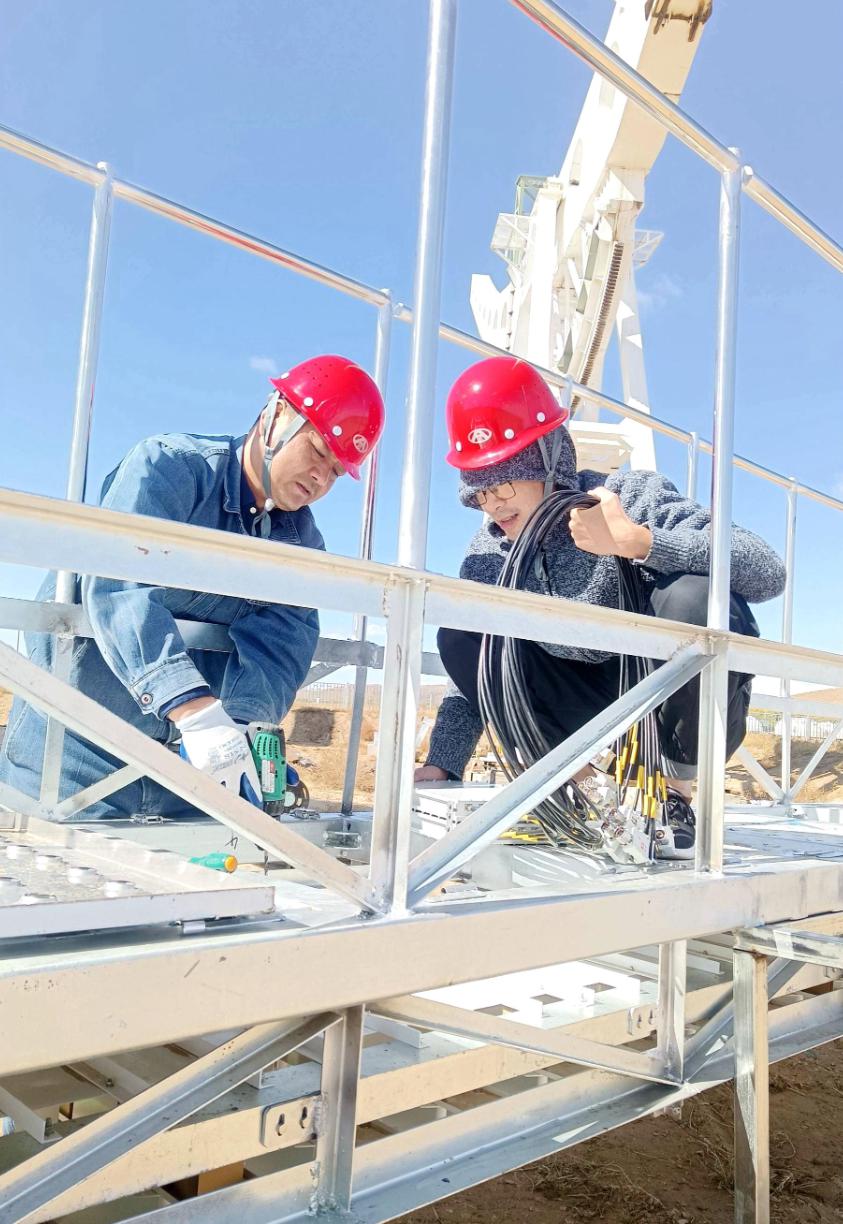
Workers install the interplanetary scintillation telescope receiver. (Photo: Courtesy of CETC 16th Research Institute)