


China's manufacturing PMI returns to expansion at 50.1 in September after two months below 50
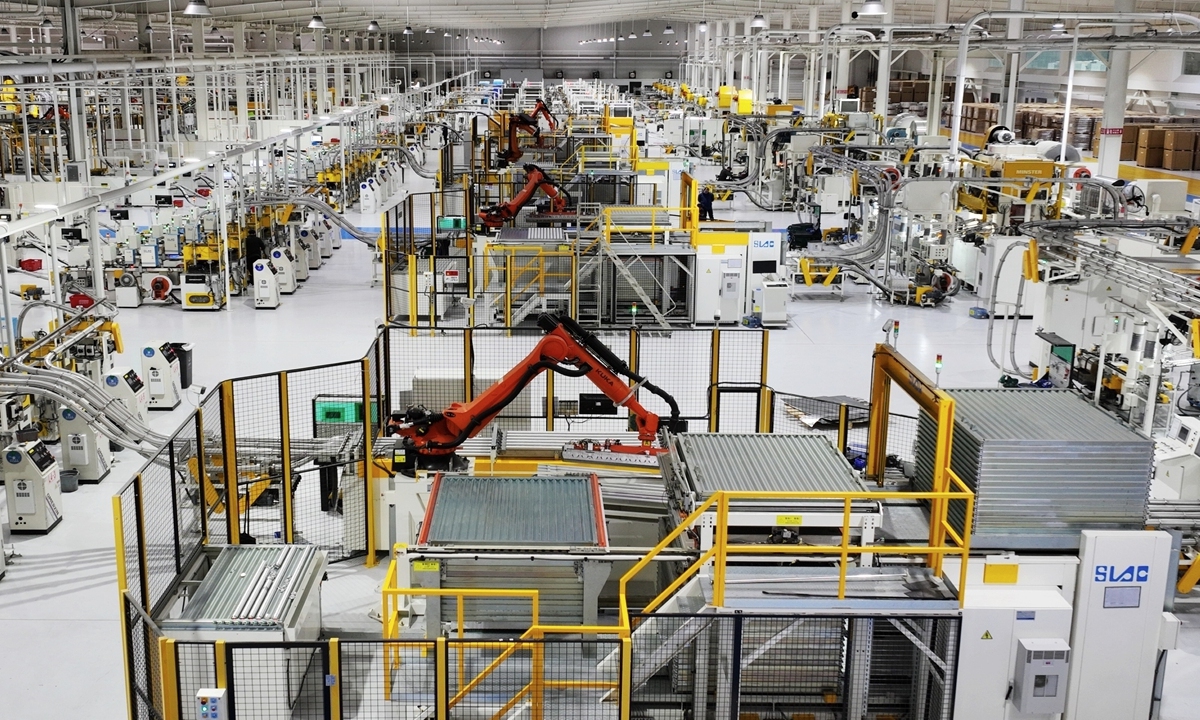
Industrial robots are operating on an intelligent production line in a smart manufacturing enterprise in Yangzhou, East China's Jiangsu Province. (Photo: VCG)
China's manufacturing purchasing managers' index (PMI) rose 0.3 percentage points month-on-month to 50.1 in September, returning to expansion territory after two months below 50, with the economic recovery trend further consolidating, data from the National Bureau of Statistics (NBS) and the China Federation of Logistics and Purchasing showed on Wednesday.
A reading above 50 indicates expansion, while a reading below 50 signifies contraction.
By enterprise size, the PMI for large enterprises stood at 50.6, unchanged from the previous month and remaining above the 50-point threshold, while the PMIs for medium-sized and small enterprises rose 0.3 and 1.0 percentage points to 49.7 and 48.9, respectively, according to the NBS.
Of the five sub-indices that make up the manufacturing PMI, the production, new orders and suppliers' delivery times indices were above the 50-point threshold, while the raw materials inventory and employment indices remained below the threshold.
The production index stood at 51.7, up 1.3 percentage points from the previous month, indicating an acceleration in manufacturing activity.
The new orders index came in at 50.5, down 0.1 percentage point from the previous month but remaining above the 50-point threshold, indicating continued improvement in market demand in the manufacturing sector.
The raw materials inventory index stood at 48.2, up 0.1 percentage point from the previous month, indicating a slight narrowing in the decline in inventories of major raw materials in the manufacturing sector.
Manufacturing PMI rose to 50.1 in September, returning to expansion territory. Of the 21 industries surveyed, 12 recorded PMIs above 50, four more than in the previous month, indicating a broader expansion in manufacturing activity, said Huo Lihui, a chief statistician with the NBS.
On production and demand, the manufacturing production index rose 1.3 percentage points to 51.7 in September, while the new orders index edged down 0.1 percentage point to 50.5, with both remaining above 50, Huo said. The purchasing volume index rose 0.5 percentage point to 51.0 as companies accelerated raw-material purchases to meet production needs, Huo said.
On prices, the purchasing price index (PPI) for major raw materials and the ex-factory price index rose 4.2 and 3.6 percentage points to 60.8 and 54.0, respectively, marking their second consecutive monthly increase, Huo said. The rise was driven partly by higher international commodity prices and increased demand in some industries.
Meanwhile, the PMIs for equipment manufacturing, high-tech manufacturing and consumer goods stood at 51.0, 52.5 and 50.7, respectively, all above the 50-point threshold, indicating relatively active production and business activity, Huo said. The PMI for energy-intensive industries rose 0.1 percentage point to 48.0, showing some improvement in business conditions.
Business conditions among small and medium-sized enterprises improved. "The PMI for large enterprises stood at 50.6, unchanged from the previous month, while the PMI for medium-sized and small enterprises rose 0.3 and 1.0 percentage points to 49.7 and 48.9, respectively, indicating improved business conditions," Huo said.
In addition, the non-manufacturing sector saw a notable recovery in September, with its business activity index rising 1.2 percentage points from the previous month to 50.2, ending two consecutive months below the 50-point mark. Consumption, infrastructure and financial sectors worked in concert, with positive structural changes emerging, NBS data showed.
Wu Wei of the China Logistics Information Center said the improving supply-demand dynamics in the non-manufacturing sector were driving price increases along the industrial chain, with the input price index rising 1.4 percentage points to 52.5 in September and the sales price index climbing 1 percentage point to 50.3, its highest level this year. He pointed out that the business activity expectations index rose 0.5 percentage point to 55.5, remaining at or above 55 for the fourth consecutive month.
Wu said the construction sector also saw improved activity in September, with its business activity index rising 3.4 percentage points from the previous month to 50.3, returning to expansion territory after eight consecutive months below the 50-point mark and up 1 percentage point from a year earlier.
According to Wu, financial support for the real economy strengthened in September, with the financial sector's business activity and new orders indices rising for a second consecutive month and both exceeding 55. The business activity index for monetary and financial services topped 60, while its new orders index exceeded 58.
Wu also noted that demand related to the upcoming National Day holidays began to pick up, particularly in transport and tourism. New orders in the railway and air transport sectors rose above 60 and 54, respectively, with railway transport orders also showing a notable year-on-year increase.