


China's durian trial crop eyes market entry amid strong consumer appetite
KUNMING, Oct. 1 (Xinhua) -- This autumn, tree-ripened durians have been harvested in southwest China's Yunnan Province, as durian trees in experimental orchards have steadily come into bearing after years of trial cultivation.
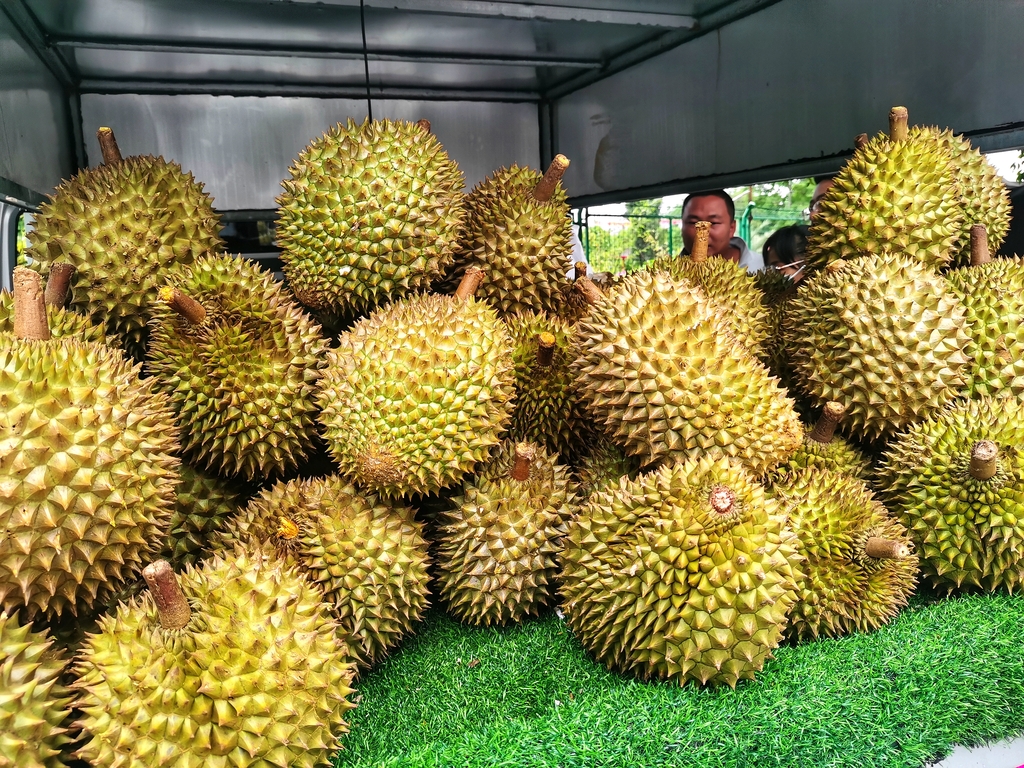
File photo: IC
Once seen as a luxury treat, the spiky, pungent "king of fruits" has triggered a shopping frenzy in China.
China's durian appetite has driven robust imports of the fruit from Southeast Asian countries. According to the General Administration of Customs, since 2022, China has approved durian imports from five countries, including Vietnam, Malaysia and Laos. China's durian imports reached 1.87 million tonnes in 2025, twice as much as in 2022.
In addition to expanding imports of the tropical fruit, China has introduced durian planting in southern provinces of Hainan and Yunnan to meet strong market demand.
"It takes at least four years for a durian tree to grow from planting to fruiting. Stable maturation and yield are extremely hard to achieve amid multiple natural challenges in Yunnan," said Ao Pingxing, director of the durian industry research center at Yunnan Agricultural University.
He said this year marks the first large-scale fruit-bearing for several pilot durian plantation trials in Yunnan, a key step in moving durian farming from sporadic trials to standardized, large-scale demonstration cultivation.
Compared to Hainan, a fully tropical province, Yunnan features diverse landforms with varying temperatures, which poses challenges to the cultivation of durian varieties.
In Honghe of Yunnan, researchers have focused on screening cold-resistant varieties and developing flower and fruit technologies for adapting the plants to the local climate. This year, 33 durian trees in the area have successfully retained fruits, yielding 123 high-quality fruits weighing over 2 kilograms each, with the highest single-tree fruit count reaching 18.
At the trial durian planting base in Jinghong City, Xishuangbanna, a mature tree can bear up to 34 fruits, with an average single-fruit weight of 3.7 kilograms and a record weight of 8 kilograms. The sugar content of the harvested durians exceeds 36.9 degrees, a premium level for commercial durian varieties.
"Comprehensive assessments on flesh color, fragrance and flavor prove that the locally-grown durians have reached a high-quality standard," said Yang Dejun, vice president of Yunnan Academy of Forestry and Grassland, adding that this round of durian harvesting has accumulated solid field data for future large-scale demonstration cultivation and industrial promotion.
Researchers and planters are still testing harvested durian fruits collected from various locations.
Data from the Yunnan Academy of Forestry and Grassland show the province's durian planting area has surpassed 17,000 mu (about 1,133 hectares), mostly in Xishuangbanna.
Currently, four durian varieties have been selected for their strong adaptability to Yunnan's climatic conditions, including premium varieties known as Musang King and Red Prawn.
In addition to Yunnan, Hainan achieved its first commercial durian harvest in 2023, marking the official entry of domestically-grown durian into the market. However, durian cultivation on the island province is confined to its tropical southern areas. The province's total durian planting area has now reached approximately 50,000 mu, yet most trees have not reached full production age. China's homegrown durian output remains far smaller than that of imported durian.