


Expanding new space for China-US economic and trade co-op to inject more certainty, stability into world economy
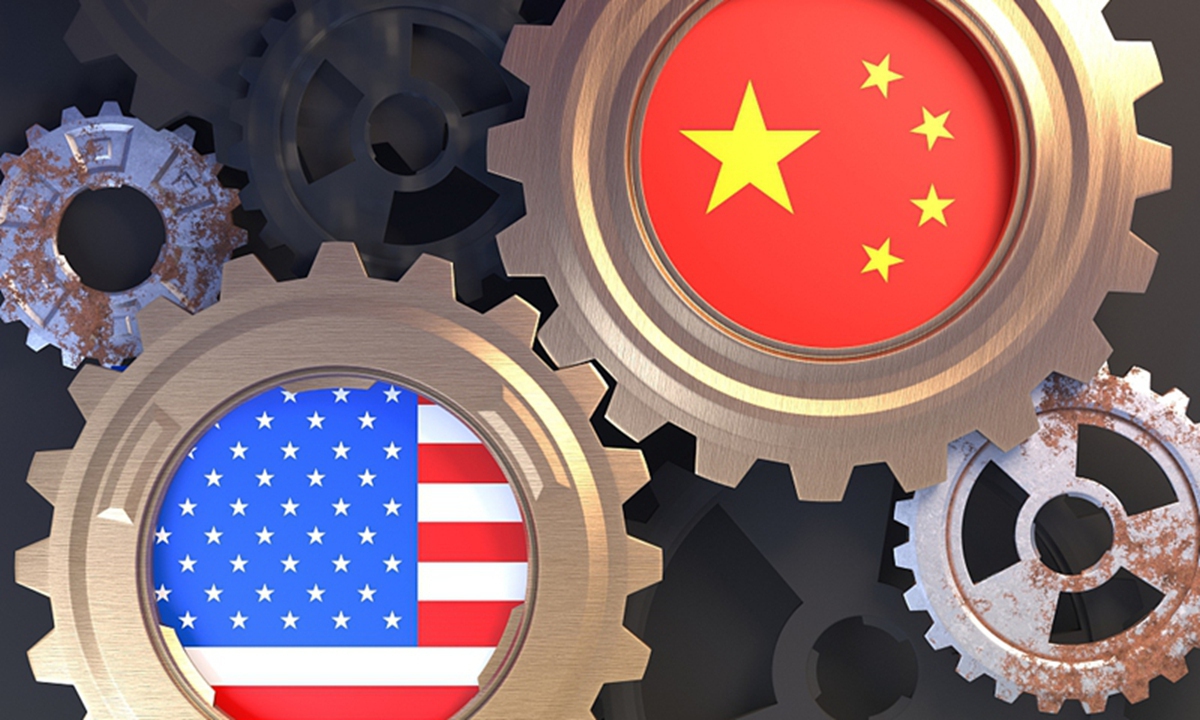
File photo: China US
China and the US are the world's two largest economies. Their economies are extensive, closely linked, and far-reaching in impact, with deeply intertwined industrial and supply chains. That each is embedded in the other is an objective fact. For more than a year, tariff frictions escalated and market expectations fluctuated repeatedly. Yet the two sides returned to dialogue, held successive rounds of consultations, gradually narrowed differences and accumulated consensus. This demonstrates that as long as both sides uphold mutual respect, equality and mutual benefit, effective solutions to problems can be found through dialogue and cooperation.
Driven by the economic and trade consultation mechanism, the two sides continued to lengthen the list of areas of cooperation and narrowed the list of issues. This has played a positive role in maintaining overall stability in bilateral economic and trade relations.
The economic and trade consultations serve as a "stabilizer" for in-depth communication and strategic consensus. The mechanism is key to translating the consensus of the two heads of state into concrete action and as an institutional arrangement for deepening communication and enhancing mutual trust. Since last year, China and the US have held eight rounds of economic and trade consultations, reaching a series of mutually beneficial, balanced and positive outcomes on important issues of bilateral trade and investment.
During this latest round, the two sides agreed to extend the joint arrangement of the Kuala Lumpur economic and trade consultations to January 2027. This provides important safeguards for further in-depth discussion of solutions and space to jointly advance China-US economic and trade relations.
The economic and trade consultations provide a booster to expand the boundaries of trade and investment cooperation. The two sides agreed to establish a Board of Trade under the consultation mechanism and, within its framework, reached an arrangement for a $30 billion reciprocal tariff reduction, with tariffs on about 90 percent of the products on each side to be lowered to most-favored-nation (MFN) rates. They also agreed to set up an agriculture working group under the Board of Trade to advance solutions to non-tariff barriers and market access for some agricultural products, and to promote expanded coal trade and other arrangements to optimize bilateral trade. In addition, they established a Board of Investment under the mechanism as a regular dialogue platform for potential investment promotion and resolution of investment obstacles.
Overall, the mechanism has evolved from a crisis-response tool into a foundational institutional arrangement for handling bilateral economic and trade relations, bringing highly specialized issues such as tariffs, investment, inspection and quarantine, and technology governance onto a long-term dialogue track while providing solid institutional safeguards to continuously expand cooperation.
The consultations serve as a "ballast" to stabilize market expectations. For the business community, policy predictability is the most important business environment. The 10 important outcomes achieved by the two economic and trade teams have reassured businesses and global markets. Practice has fully proven that China-US economic and trade relations are mutually beneficial and win-win in nature as cooperation benefits both while confrontation hurts both. Handling differences through dialogue and consultation rather than a zero-sum game is the only correct choice.
Promoting the sustained and sound development of China-US economic and trade relations is conducive to bilateral cooperation and global economic growth. These outcomes help further consolidate the interest foundation for the long-term stable development of China-US relations. Economic and trade relations have always been an important part of the relationship and one of the areas where interests are most intertwined and market links are broadest.
Over decades, the relationship has moved forward through storms fundamentally because the two economies have formed extensive and deep interest foundations through long-term exchanges. Production, investment, technology, services and markets are mutually nested in a complex network.
These outcomes help stabilize the "fundamentals" of trade and investment while creating new institutional cooperation arrangements, giving both sides more shared interests to uphold when handling differences, and making economic and trade cooperation a true basis for the steady and enduring development of China-US relations.
These outcomes from the latest economic and trade consultations help continuously expand new areas and create new increments of cooperation. From an economic perspective, exchange and cooperation are based not on sameness but on difference. China and the US each have strengths, with major differences in factor endowments and strong complementarity in industrial structures, market demand and innovation resources, which create conditions for economies of scale and broader market space.
In the past, China-US economic and trade competition focused on existing trade and investment stocks, essentially distributing interests within existing boundaries. Now, as consultation outcomes continue to expand, the scope of potential cooperation is extending to new areas such as artificial intelligence (AI). This helps make the pie of common interests bigger and, on the basis of new cooperation, ease existing contradictions, offering greater room for maneuver in managing structural differences in the long-term.
These outcomes from the latest economic and trade consultations help inject more certainty and stability into the world economy. As two mega-economies with global influence, China-US relations go far beyond the bilateral scope. Today, China and the US are watching each other, and the entire world is watching them too.
If the two sides can manage differences through dialogue and expand common interests through cooperation, they will help maintain an open global division of labor, avoid artificial fragmentation and duplicative construction due to major-power competition, and allow countries to devote more resources to innovation, livelihood improvement and tackling common challenges.
In this sense, stable China-US economic and trade relations are a public good of global significance, benefiting businesses and consumers worldwide and creating more opportunities for all countries, especially developing countries, to participate in global division of labor and share development gains.
In the long run, human development space lies not only in existing markets and stock interests, but more in the technological, industrial, market and cognitive boundaries that are constantly being opened.
AI, life sciences, clean energy, and deep-space and deep-sea exploration are expanding technological frontiers. The digital economy, green economy and a new global division of labor are expanding economic frontiers and global issues such as climate change, public health and energy security are defining new frontiers of governance.
Looking to a more distant future, China and the US can inspire each other through competition and enable each other's success through cooperation, directing more wisdom and resources to problems humanity has not solved, technologies not yet broken through, markets not yet developed and domains not yet reached, constantly turning today's "impossible" into tomorrow's new development space. China-US relations are rooted in history and nourished by civilization. The two sides should explore endless frontiers and sail toward the future together, creating more opportunities for the world and opening a broader future for human progress.
The author is a researcher at the Chinese Academy of International Trade and Economic Cooperation under the Ministry of Commerce.