


Chinese PLA completes Russia's Center-2026 exercise with 99A tanks, unmanned systems; expert highlights lessons from modern warfare
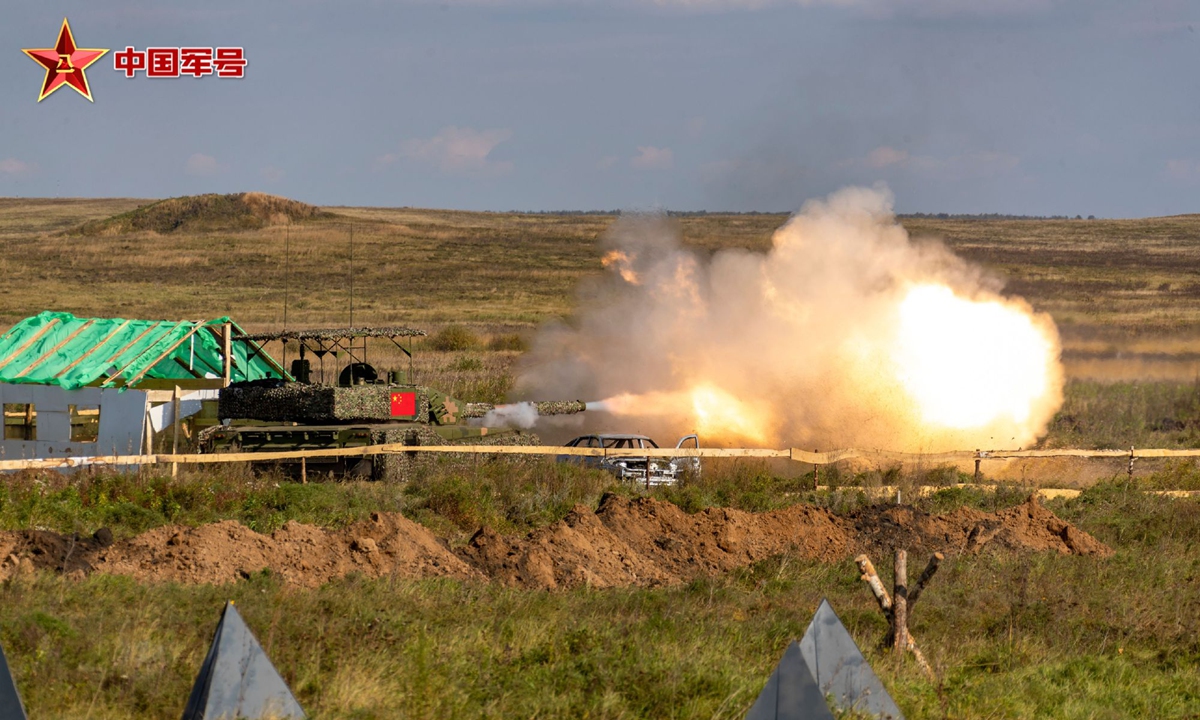
A Chinese PLA Type 99A main battle tank fires during the Center-2026 exercise. (Photo: China Military Bugle's official Sina Weibo account)
Chinese troops have completed their participation in Russia's Center-2026 (Tsentr-2026) exercise and begun withdrawing after joint training with forces from multiple countries wrapped up with a closing ceremony in Chelyabinsk on Friday, with the drills focusing on intelligence reconnaissance, command and control, fire strikes and comprehensive support, according to the PLA Daily.
The Chinese forces were drawn from the PLA Central Theater Command and deployed to the Chebarkul training ground in Russia through a combination of motorized movement, railway transport and air transport. During the field-training phase, the troops practiced three-dimensional reconnaissance, integrated information-fire strikes, guided entry, multi-directional assaults and rapid pursuit and annihilation, the report said.
Photos released by the PLA's official media account China Military Bugle showed Type 99A main battle tanks of the Chinese contingent taking part in the exercise. The Type 99A is a main battle tank currently in service with the PLA Army and has previously appeared in major Chinese military exercises.
Unmanned equipment also featured prominently in the exercise. China Central Television (CCTV) News reported on Saturday that drone "swarms" provided ground combat groups with precise target information, while tactical drones, attack helicopters and unmanned ground vehicles worked together to strike simulated frontline targets. Small groups also conducted multi-wave fire assaults from multiple directions against defensive positions.
According to official Telegram account of the Russian Ministry of Defense, Russian Defense Minister Andrey Belousov said earlier that preparations for Center-2026 took into account what Russia described as the "unique experience" gained from its "special military operation," as well as the features of combat operations in modern armed conflicts. A report from CCTV News citing Russian reports on the final stage of the exercise also said the exercise tasks drew on experience from the special military operation.
One important value of the exercise for the PLA is the opportunity to draw lessons from the combat experience accumulated by participating countries, Song Zhongping, a Chinese military affairs expert, told the Global Times on Saturday.
"In addition to experiences drawn from the Russian troops, countries such as Pakistan and some Central Asian participants also have experience from years of counterterrorism operations," Song said. "By training together, the participating militaries can learn from each other's strengths and improve their respective capabilities," the expert added.
Song noted that recent conflicts have also highlighted growing threats to traditional armored formations. Instead of the large-scale armored clashes seen in earlier wars, tanks and other armored vehicles are now vulnerable to attacks from large numbers of drones as well as precision-guided weapons.
For the PLA, studying the difficulties and losses encountered by armored forces in recent conflicts can help improve its ability to respond to such asymmetric threats, the expert said.
The combination of Type 99A main battle tanks with drones and unmanned ground vehicles during the exercise also reflects the growing integration of traditional manned platforms with unmanned systems, Song pointed out.
Unmanned systems can conduct reconnaissance or undertake higher-risk missions ahead of manned forces, helping reduce risks to personnel and crewed equipment, while also extending the reconnaissance and targeting reach of armored formations, Song said. Such coordination could allow platforms including the Type 99A to operate more effectively while improving their battlefield survivability.
The PLA Daily said the high-intensity exercise, conducted in unfamiliar terrain overseas and in a multinational environment, tested the Chinese troops' capabilities in long-range strategic deployment, cross-border logistics support and joint operational command. Chinese forces participated at multiple levels, ranging from exercise scenario design and operational command to field training.
Following the exercise, the Chinese troops began withdrawing from the Chebarkul training ground by air and railway. The PLA Daily said the troops will review their experience in multinational operational planning, joint live-force operations, long-distance cross-border deployment and operational coordination after returning to their units.