


Visualizing new horizons for the disabled
In the quiet elegance of Beijing Normal University's auditorium, 21 Chinese students stepped forward on the red carpet one by one, white canes in hand, to receive their graduation certificates and commemorative badges.
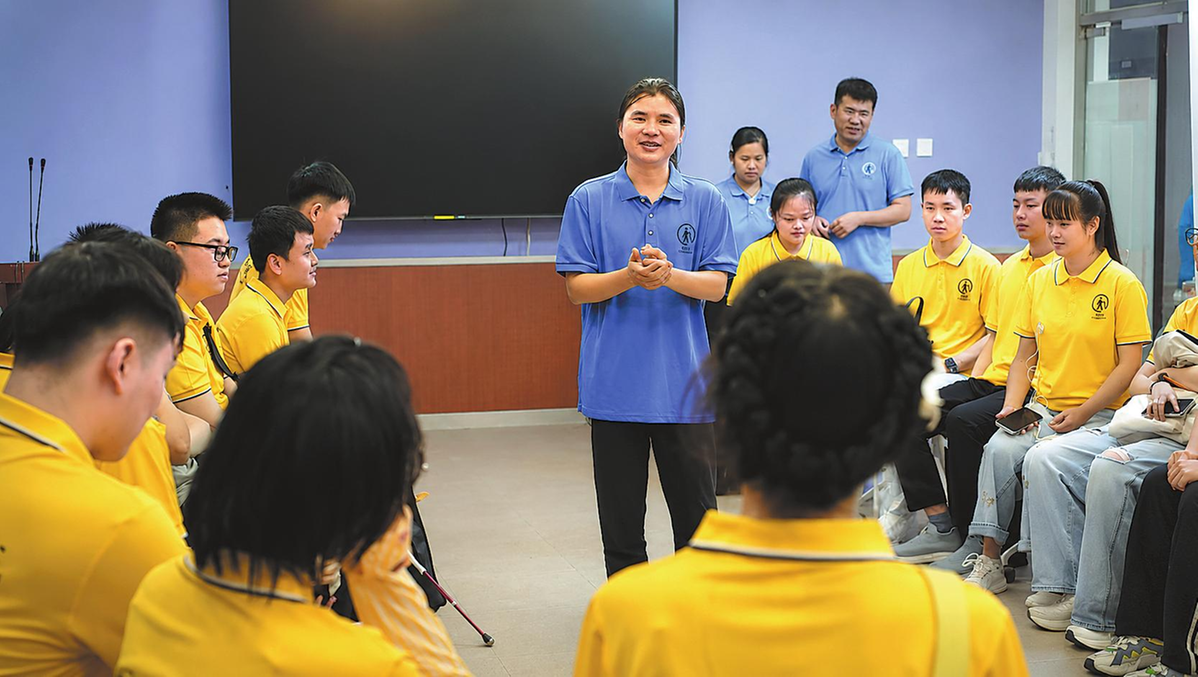
An instructor introduces the program to participants during the "ice-breaking" session in Beijing on Aug 3. (Photo: China Daily)
The ceremony marked the end of a transformative nine-day residential program designed to prepare visually impaired students for life at mainstream Chinese universities. The poignant moment was profoundly symbolic. The white canes, a symbol of independence, represented their commitment to independent mobility and a readiness to accept their identity as visually impaired young adults.
For many participants, the nine-day Jinmangzhang, or Golden Cane, program was more than a technical skills boot camp: it was a gateway to confidence, community and lifelong independence as they prepared to embark on their academic journey.
New campus realities
For Wu Yujia, 19, from Ya'an, Sichuan province, the program has been a transformative experience. Before joining the annual initiative tailored for visually impaired incoming undergraduates, she had barely touched a laptop. Yet, as she prepared to enroll at a university in central China's Henan province, digital skills became essential.
On the first day of the program, Wu sat frozen before a computer screen, unfamiliar with its basic operations. But by the end of the intensive course, she could independently create and edit documents — a transformation she describes as a leap "from zero to one".
However, the most meaningful growth was internal. Wu, who has low vision, can distinguish basic shapes though she cannot read fine print. She spent years rejecting the label of visually impaired because her partial sight allowed her to attend mainstream classes throughout primary and secondary school.
But without a peer group that understood her daily barriers, Wu navigated academic life in isolation. The program gave her a real sense of belonging and community she had long missed.
Across China, a growing number of visually impaired students are gaining admission to mainstream universities. According to the China Disabled Persons' Federation, more than 100,000 students with disabilities were enrolled in colleges and universities as of 2025, with upward of 30,000 disabled students gaining admission to higher education institutions annually from 2022 to 2024.
Yet, despite campuses upgrading physical accessibility in recent years, experts say significant gaps remain in providing inclusive education. Most institutions lack screen-reader-compatible learning materials, reliable campus navigation markers and clear faculty guidelines for accommodating disabled students.
The Jinmangzhang precollege program was designed to bridge this critical gap. Organized by the Shanghai Youren Foundation, supported by Beijing Normal University's Institute of Special Education and funded by the Huang Yi Cong Foundation, this nine-day intensive training brought together 21 students from 15 Chinese provinces.
The curriculum combined handson technical training, independent travel drills and community building to equip visually impaired college freshmen with practical life skills and social confidence to build self-reliance before their university enrollment.
Personal breakthroughs
For 18-year-old Li Hongjia, a Sichuan native studying acupuncture and tuina massage at a vocational college in Henan, the program reshaped more than her technical abilities. Raised in an overprotective family that long discouraged solo outings, Li often clashed with her parents over her desire for personal freedom.
At Jinmangzhang, she learned effective communication strategies to negotiate independence with her family, rebuilding her self-confidence in the process. "This preparatory course helped me rebuild my confidence," Li said. The tight-knit cohort became "a second home" — a judgment-free space where she no longer needed to prove her ability or fight to make her own decisions.
The program changed the very perception of disability for Chen Xinrui, a Fujian province native who will study law at Liaocheng University in Shandong province. "Impairment is a condition, not an illness," Chen said, a mindset inspired by the program. Before joining the camp, Chen avoided public outings, fearing judgmental stares from strangers.
However, the program's urban navigation training in Beijing dispelled her fears, revealing that most passersby were willing to offer assistance. The newfound confidence inspired her to pursue her career goal: specializing in accessibility rights legal work and advocating for disabled communities.
Hands-on training
Classroom coursework was only one aspect of the immersive program. Students engaged in real-world urban navigation drills, dubbed "check-in missions", under the supervision of "shadow volunteers".
The support staff avoided over-assisting participants and intervened only to prevent safety risks, letting students build independent problem-solving skills.
Most participants had rarely traveled alone until then. Over nine days, they learned to use the city's public transit system independently, navigated busy commercial districts and cultural sites including the Palace Museum, and learned to orient themselves using traffic sounds, environmental cues and spatial landmarks.
The curriculum covered topics that are not in standard secondary education. A workshop titled "Youth Without Confusion" facilitated open, guided discussions on romantic relationships, personal boundaries and sexual health.
Evening student-led clubs expanded students' hobbies and capabilities: a beauty group practiced makeup techniques with AI feedback, an aromatherapy club taught essential oil scalp massages, and an AI creation team built a customized accessible English-learning tool with word banks, error logs and text-to-speech functions. Students also staged comedy skits and spoken-word performances, processing shared experiences and bonding as a community.
Future outlook
Jinmangzhang Project Director Yang Qingfeng emphasized that technical training was never the core mission of the program. Instead, the initiative prioritized cultivating a resilient, solution-oriented mindset among visually impaired youth.
The program teaches students to adapt when navigation tools fail, digital materials are unavailable or social situations feel overwhelming, Yang said. True respect for disabled youth means trusting them to take calculated risks rather than shielding them from all hardship.
Yang noted that demand for the program was growing rapidly as more visually impaired students enroll in China's mainstream universities. However, the nine-day summer camp can only serve roughly 20 participants per cohort. Organizers prioritize applicants with the greatest support needs — including fully blind students and those who acquired visual impairment later in life. There are no academic grade requirements for admission.
Going forward, the team plans to expand its impact beyond the annual camp training. Yang suggested offering small grants and professional guidance for alumni to establish peer support circles on their university campuses, helping build sustainable local support systems for future visually impaired undergraduates.
The program's transformative spirit resonated during the closing oath ceremony, where all 21 students stood in unison to recite a collective vow. "Though I live with visual impairment, it shall not fetter my ideals nor stop my pursuit of truth," the students pledged. "I will accept my disability, uphold independent living and critical thinking, and strive my utmost for a fulfilling university experience, for autonomous life and for my life goals."
Zhang Yuexin, a special education expert from Beijing Normal University, said the program fills a critical gap in China's higher education support system. While mainstream universities have made incremental improvements for disabled enrollees, on-campus accommodations remain incomplete amid rising student numbers, she said.
Visually impaired undergraduates often seek small but vital adjustments: advance access to lecture slides for pre-class preparation and extended time for exams, among other basic accommodations. "Programs like Jinmangzhang shine a light on the real, unmet needs of disabled students, driving steady, systemic improvements in higher education accessibility," she said.