


China extends gold purchases for 23rd straight month in September
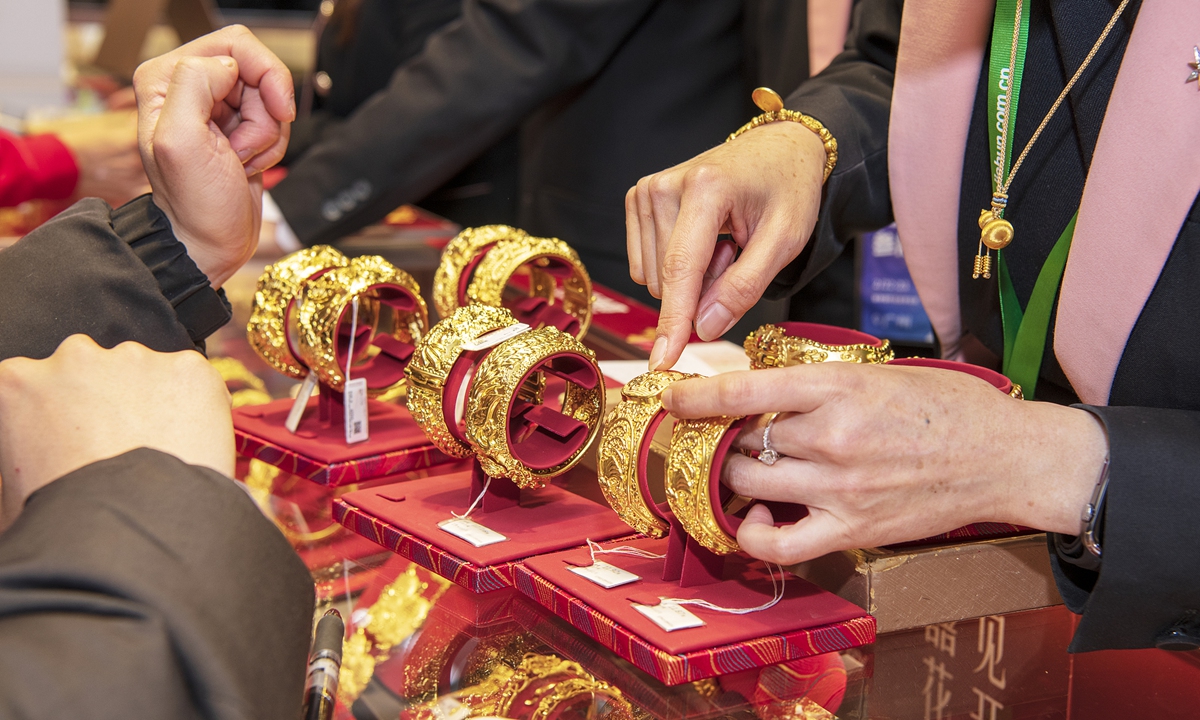
A sales representative shows a piece of gold jewelry at an expo in Guangzhou, South China's Guangdong Province. (File photo: VCG)
China stepped up its gold purchases in September despite gold market fluctuations - a move an expert said will help hedge against international financial and geopolitical risks while creating favorable conditions for prudently and steadily promoting the yuan's internationalization.
The People's Bank of China (PBC), the country's central bank, increased its gold reserves for the 23rd consecutive month in September, bringing China's official gold holdings to 77.47 million ounces, up from 76.73 million ounces in August, official data showed on Wednesday.
The monthly addition of 740,000 ounces marks a further expansion from the monthly addition of 650,000 ounces recorded in August, the data showed.
Despite price fluctuations, increasing gold holdings is necessary for the PBC to optimize its reserve structure, Li Changan, a professor at the Academy of China Open Economy Studies at the Beijing-headquartered University of International Business and Economics, told the Global Times on Wednesday.
On the one hand, gold investment attributes are also evolving: Whereas gold was previously seen primarily as a hedge against inflation, going forward it will increasingly serve to hedge international financial and geopolitical risks. On the other hand, gold is a universally accepted ultimate means of payment, and central bank purchases of gold can enhance the credibility of the sovereign currency and create favorable conditions for the steady and prudent internationalization of the yuan, according to Li.
The expert said that the PBC is likely to continue increasing its gold holdings.
According to data released by the State Administration of Foreign Exchange (SAFE) on the same day, China's foreign exchange reserves totaled $3.4003 trillion at the end of September, down by $38.1 billion, or 1.11 percent, compared to the end of August.
In September, influenced by the global macroeconomic environment and the monetary policies of major economies, the US dollar index rose and prices of major global financial assets declined overall. Driven by the combined effect of exchange rate translation and changes in asset prices, the country's foreign exchange reserves fell over the month, the SAFE noted.
Supported by a steady economy, China remains well-positioned to maintain the overall stability of its foreign exchange reserves, according to the administration.