


Chinese scientists develop high-efficiency membrane to cut energy, costs of carbon capture
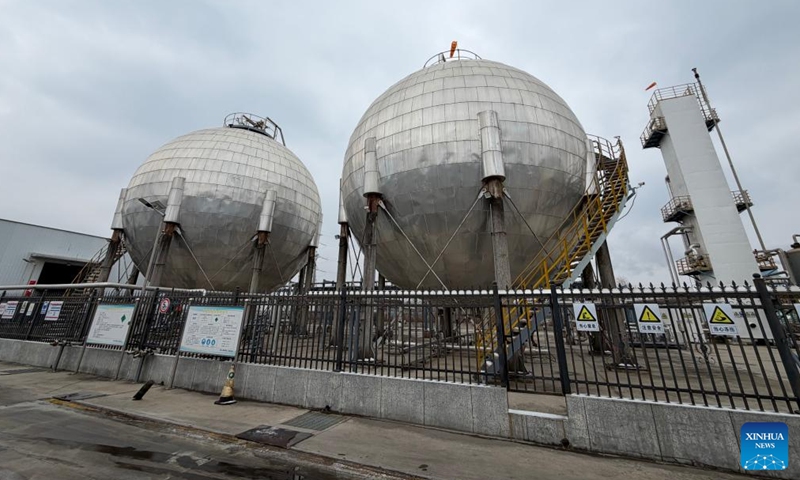
This photo taken on Jan. 21, 2026 shows a waste carbon dioxide recovery facility in the petrochemical industrial park of Jiujiang Economic and Technological Development Zone in Jiujiang City, east China's Jiangxi Province. (Photo: Xinhua)
A Chinese research team has developed a new type of all-organic mixed-matrix membrane that addresses a longstanding bottleneck in combining high separation performance with stability and processability. It could offer a new materials route to low-energy, low-cost industrial carbon capture, according to a statement the research team sent to the Global Times on Thursday.
"Our preliminary estimates put the cost of capturing one ton of carbon dioxide [by our new approach] at about $38, which could significantly lower the economic threshold for industrial carbon capture. Thus, the technology has strong potential for scale-up, with controllable manufacturing costs. It could help key sectors such as thermal power and steel carry out carbon dioxide capture at lower cost, offering an energy-saving and practical route toward China's dual carbon goals," Jiang Zhongyi, a professor at Tianjin University who leads the research team, told the Global Times on Thursday.
A 2025 Nature Sustainability study of pyridinic-graphene membranes estimated capture costs as low as $25 to $50 per ton of carbon dioxide for coal-fired power and cement plants, and $50 to $100 per ton for natural-gas plants.
According to the Tianjin University team led by Jiang and fellow professor He Guangwei, the new all-organic mixed-matrix membrane is a next-generation gas separation technology for carbon capture. Membrane separation works like a molecular sieve, pulling carbon dioxide directly out of the gas mixture. This is why the new approach sharply cuts the energy used in capture compared with conventional chemical absorption processes.
Carbon capture is a key part of achieving China's dual carbon goals. Industrial gases emitted by power plants, cement plants and steel mills have relatively low concentrations of carbon dioxide but are produced in enormous volumes, while separating carbon dioxide using conventional methods is energy-intensive and costly. In contrast, membrane separation is a green, low-carbon and energy-saving technology, and is considered as highly promising for carbon capture.
The membrane is the sieve in this separation technology. It has long been challenging to develop a membrane material that could allow carbon dioxide in industrial flue gas to pass through quickly, hold back other gases, remain stable over time, and be easy to manufacture at scale.
A mixed-matrix membrane could address the issue by combining the good processing of a polymer with the efficient gas transport of a porous filler. However, the two materials have very different properties, so the first challenge is ensuring their compatibility. In this context, the research team from Tianjin University proposed what the researchers describe as a "weak-interaction inlaying" strategy, combining a polymer with a single-crystal covalent organic framework (COF), which has ordered pores, to make an all-organic mixed-matrix membrane, according to the statement.
By designing a filler with low surface energy while balancing its interactions with the polymer and other filler particles, the filler particles bind firmly enough without sticking together and clumping. The COF can then be incorporated at high loadings and dispersed evenly, preserving its structure and doing the real work of separation.
The resulting membrane retains the flexibility and solution processability of the membrane material while creating fast transport pathways for carbon dioxide.
The study was published online in the journal Nature Energy on Wednesday. In tests with a simulated flue-gas mixture, the all-organic mixed-matrix membrane developed by the Chinese team achieved an order-of-magnitude increase in carbon dioxide permeability, setting a new record and reaching about 70 percent of the theoretical value predicted for a pure COF membrane. The membrane also demonstrated good long-term stability, maintaining stable performance under test conditions involving moisture, sulfur oxides and nitrogen oxides.