


Hillsides turn green, rivers and lakes run clear: Lüliang continues to improve Yellow River Basin environment
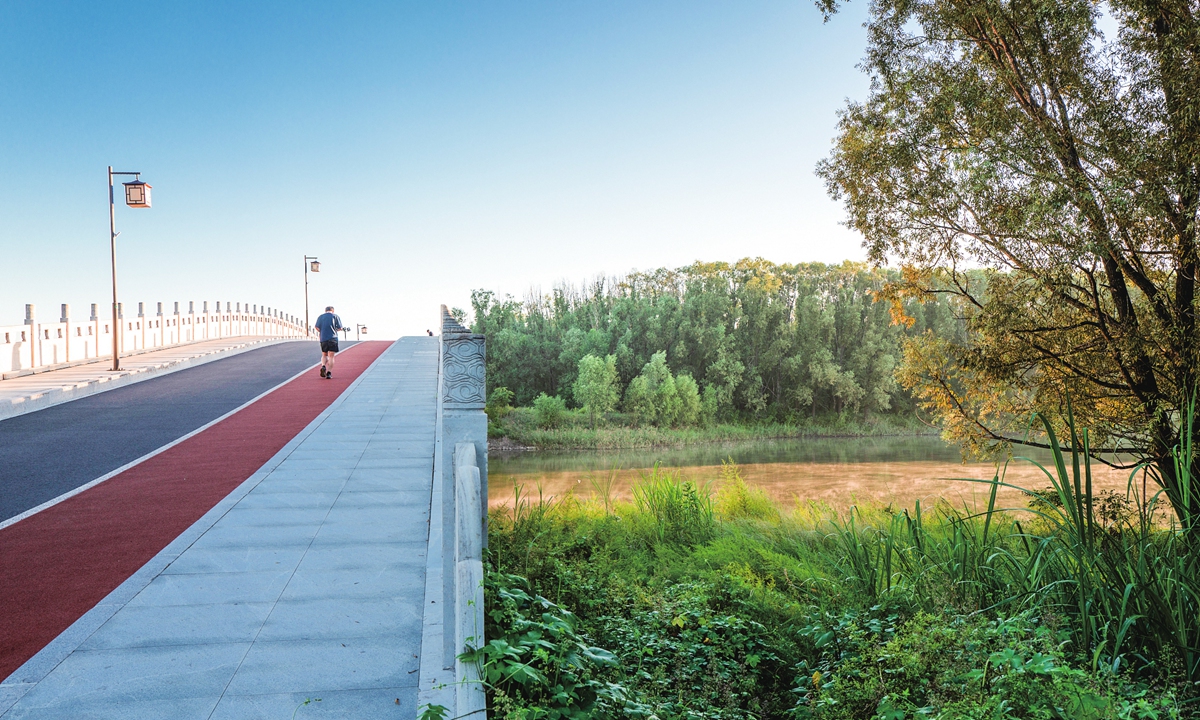
A man runs along a road in the Xiaohe National Wetland Park in Xiaoyi, North China's Shanxi Province, on August 30, 2026. Photos: VCG
As autumn sets in, a breeze sweeps across the Xiaohe National Wetland Park in Xiaoyi, North China's Shanxi Province. Reeds sway and waterbirds skim the surface, while small groups of residents stroll along the riverside paths, enjoying the refreshing air.
On September 30, Yan, a visitor to the wetlands, filmed the scenery along the banks of the Xiao River. She explained that she was recording the video to share with friends living elsewhere and show them the changes in her hometown. "The air is fresh and the environment is lovely; it's incredibly pleasant to come here in the evening."
However, in the past, the idea of filming a video by the Xiao River would never have crossed her mind. Back then, the water quality was poor and the banks were overgrown with weeds, causing residents to give the area a wide berth.
The changes extend beyond Xiaoyi. During the 14th Five-Year Plan period (2021-25), Lüliang made full use of leftover urban spaces, abandoned sites, and reclaimed land to create pocket parks, compact green spaces of 400 to 10,000 square meters. A total of 29 new parks were built, bringing the citywide count to 102 and making them all fully accessible to the public.
The green space in the city's built-up areas surged to 40.46 percent, turning the vision of "seeing greenery upon opening the window and entering a park upon stepping outside" into a tangible reality.
Managing the Yellow River requires a focus on both conservation and active control. For Lüliang, also in Shanxi Province, the solution lies not in massive engineering works on the main river itself, but in the gullies at its headwaters; by shouldering the responsibility for soil and water conservation - and utilizing thousands of silt-arresting dams alongside widespread afforestation - the region effectively traps sediment within its intricate network of ravines and valleys.
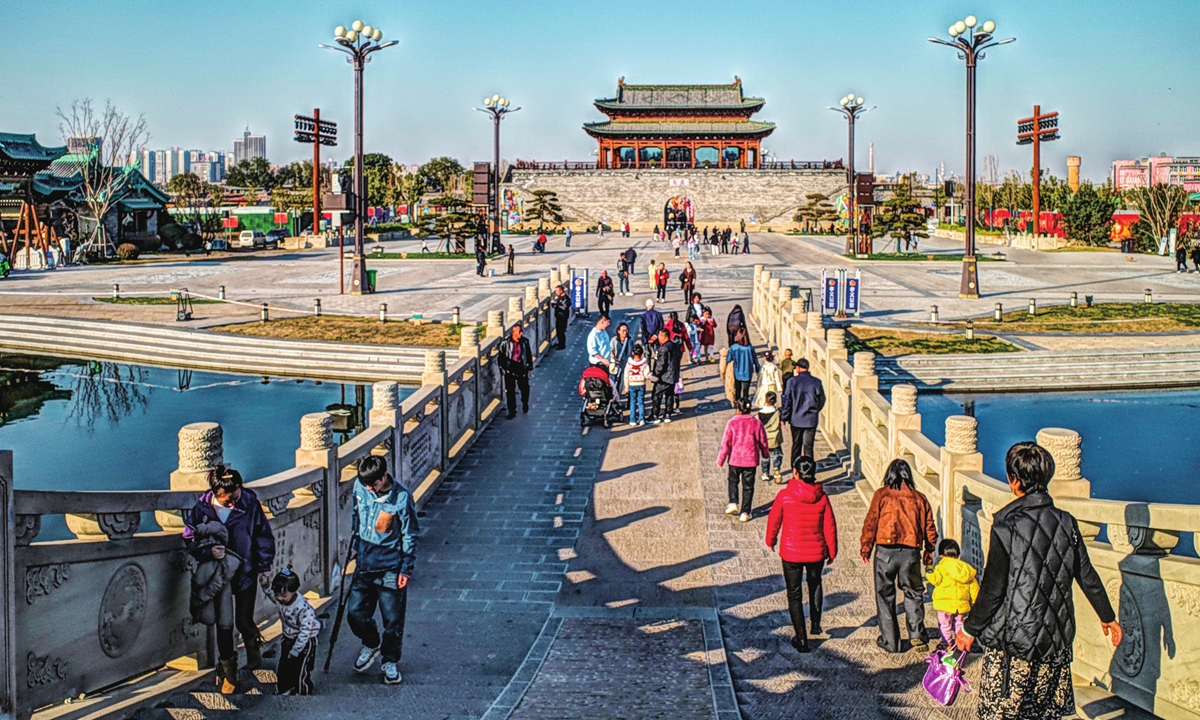
Tourists walk toward the ancient gate tower in Xiaoyi Ancient City, North China's Shanxi Province, on November 2, 2025.
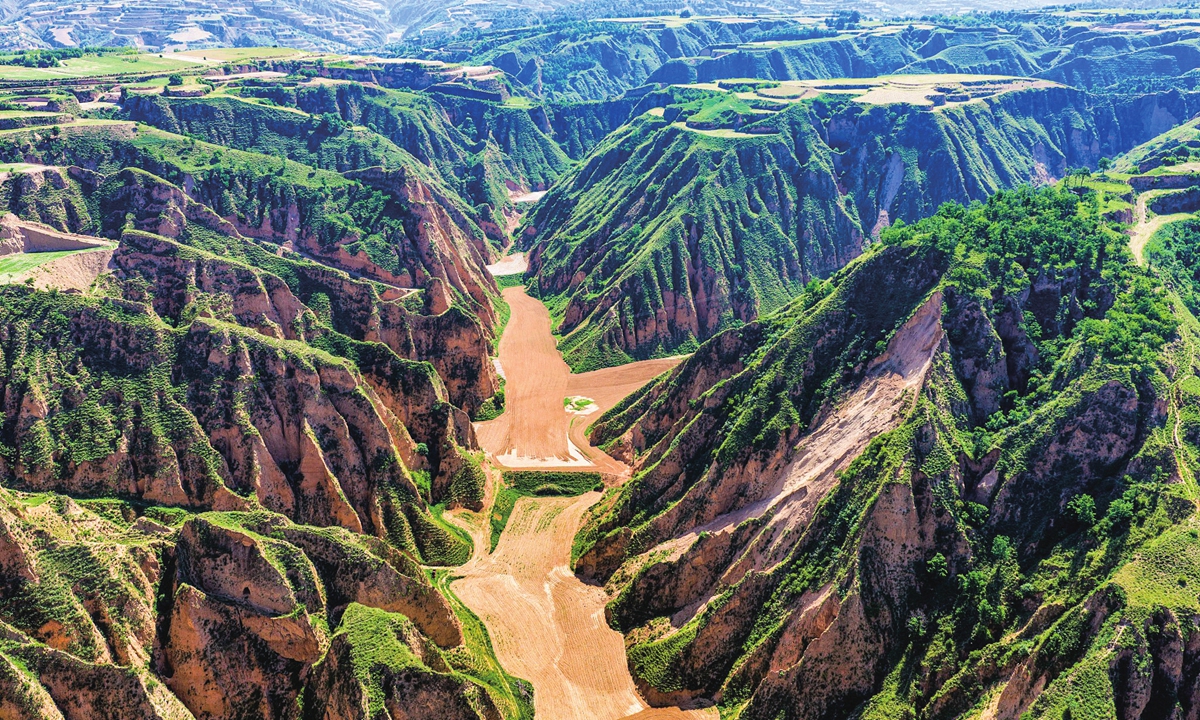
Looking down from a high vantage point, one can see dams dotting the gullies and ravines of Lüliang. Known as silt-arresting dams, these are a highly effective engineering measure for soil and water conservation on the Loess Plateau.
According to data from Lüliang City's Key Points for Citywide Water Conservancy Work in 2025, the city has constructed a total of over 12,000 silt-retention dams - accounting for one-third of the provincial total - including 549 large and medium-sized ones. These dams are nestled one by one within the gullies to trap silt and sediment, forming a comprehensive network.
The Liuyu River basin in Shanxi's Liulin county serves as an example of this integrated management model in practice. Soil erosion in the basin was once severe. Adhering to an integrated approach that encompasses mountains, waters, forests, farmlands, lakes, grasslands, and sandy areas, the locality has coordinated a systematic program involving sediment-trapping dams, river channel regulation, land improvement, and vegetation restoration. A series of sediment-trapping dams, arranged in a cascading layout along the gullies, intercept runoff at multiple levels, thereby forming a comprehensive gully protection system.
Liu Zhijun, project manager for Liulin county's integrated protection and restoration initiative, said, "Last year, the main construction work for this project - with a total investment of 220 million yuan ($32.82 million) - was completed. Through these protection and restoration efforts, the ecological environment will see significant improvement, crop yields will rise further, and soil erosion will be effectively controlled."
Win-winThe effective approach is that dams trap the sediment in the gullies, while tree planting addresses soil erosion on the slopes.
In the mountains of Shilou county, many slopes are so steep - at angles of 70 or 80 degrees - that one can barely stand.
With ropes tied around their waists, members of the afforestation cooperative slowly descend from the hilltop, suspended in mid-air to dig planting holes and set out saplings.
Wang Yonghong, a villager, said, "The slope is incredibly steep - getting even steeper as you go down. It's frightening, certainly, but planting these trees benefits future generations."
Carrying the saplings up the slope on one's back is not only exhausting but also dangerous. To address this, the cooperative purchased drones to transport batches of Chinese pine and forsythia up the hillside.
At Huayuanzeding in Chenjiawan Town, Liulin, the transformation is immediately apparent: Rows of trees on the distant slopes merge into a continuous expanse, completely blanketing the yellow earth so that the wind no longer kicks up dust.
During the 14th Five-Year Plan period, across the Lüliang region, a cumulative 1,560.3 square kilometers of sloping farmland underwent remediation, while 6,888.7 square kilometers were planted with soil and water conservation forests, economic forests, and grass; the soil and water loss control rate reached 80.2 percent.
Tree planting is more than just an ecological initiative. Lüliang has pursued a strategy of mutually reinforcing environmental greening and income growth; leveraging over a thousand specialized forestry cooperatives, the city has advanced the greening of barren hills across the region while developing distinctive ecological industries - such as sea buckthorn and kernel-producing apricots - tailored to local conditions.
A robust mechanism linking forestry development with farmers' livelihoods has enabled hundreds of thousands of mountain residents to increase their annual per capita forestry income by over 2,500 yuan, transforming the patches of green across the Loess Plateau into genuine "ecological wealth" that benefits the people.
According to the Lüliang Ecological Environment Bureau, all 36 key projects under the "Clear Waters Flowing into the Yellow River" initiative had been completed by the end of 2025.
Over the past three years, 388.6 kilometers of new urban sewage pipeline networks have been built, increasing treatment capacity by 117,000 tons per day. In rural areas, 26 sewage treatment stations have been built, and the remediation of 214 foul-smelling ponds has been completed.
The project rehabilitated 37 kilometers of river channels, leading to continuous improvement in the aquatic ecosystems of the Fenhe River and Lanhe River in Shanxi.
The story is based on a report from Shanxi Daily, compiled by the Global Times