


China aims to return Mars samples around 2031, scientist says
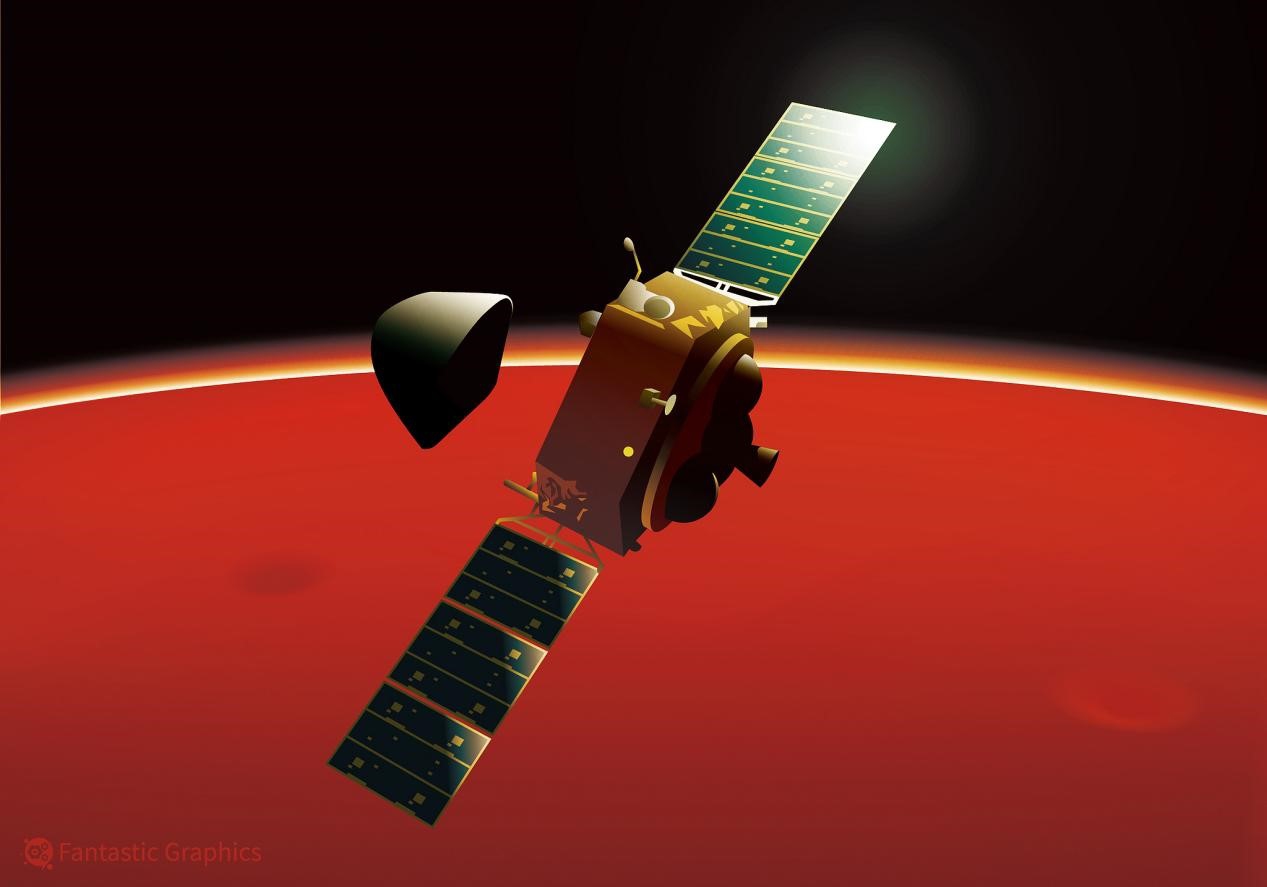
China's Tianwen-3 mission is scheduled to launch around 2028 (Schematic diagram: VCG)
China aims to return samples from Mars to Earth in around 2031, with the Tianwen-3 mission scheduled to launch around 2028, Zhang Jiajun, an associate research fellow at the Shanghai Astronomical Observatory of the Chinese Academy of Sciences, wrote in an article titled "Why do we venture to Mars?" published by the People's Daily on Saturday.
Zhang noted that three major challenges must be addressed before humans can establish a presence on Mars: the exchange of information between Earth and Mars, the transport of materials between the two planets, and human survival on the Red Planet.
For communication and spacecraft navigation, the very long baseline interferometry (VLBI) orbit determination system led by the Shanghai Astronomical Observatory can precisely measure the trajectories of spacecraft traveling to Mars, helping ensure successful orbital insertion. The technology has been preliminarily validated during China's Tianwen-1 Mars mission, Zhang wrote.
The second challenge is the exchange of physical materials between Earth and Mars. While humans can send spacecraft to the planet, they have yet to develop the capability to collect Martian material and return it to Earth, Zhang noted.
On May 15, 2021, a lander carrying China's first Mars rover touched down on Mars, marking the first time China has landed a probe on a planet other than Earth, Xinhua reported.
China plans to return samples from Mars to Earth around 2031, with the Tianwen-3 mission scheduled to launch around 2028, Zhang said.
The third challenge is ensuring human survival. Mars has extremely low temperatures, high radiation levels, low gravity, low atmospheric pressure, and limited access to water and oxygen. How to use the planet's local resources to support human activities remains an area requiring further exploration, Zhang wrote.
Despite these challenges, Mars remains an attainable target as humanity ventures beyond the Earth-moon system into deep space, Zhang said.
Mercury is too close to the Sun, Venus has a hostile environment, and other celestial bodies are much farther away. By comparison, Mars offers more favorable conditions, including a thin atmosphere, water ice, and a rotation period and seasonal cycles similar to Earth's. These characteristics make it a suitable stepping stone for humanity's journey toward an interplanetary civilization, he wrote.
"My work focuses on cosmology, and my colleagues and I are working toward a dream that can be realized, taking one step at a time to make a round trip to Mars a reality," Zhang said.
Global Times