


Manila slammed for harassing China's normal scientific research activities in South China Sea
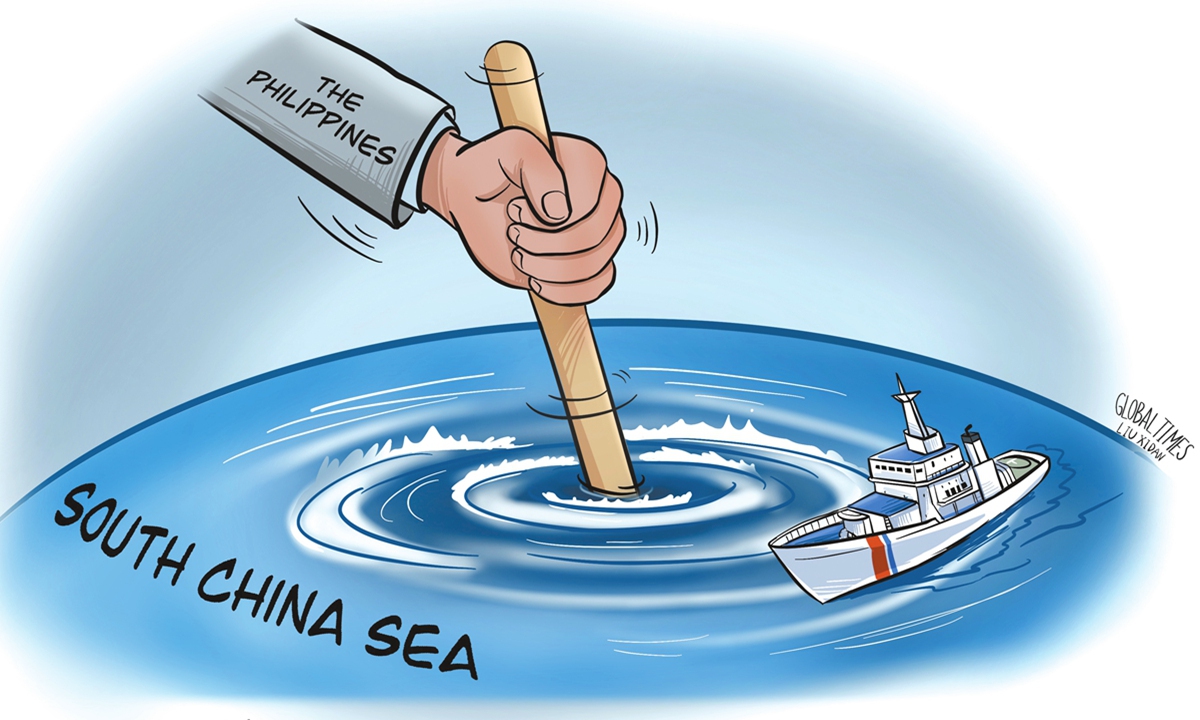
Philippines South China Sea Illustration: Liu Xidan/Global Times
The Chinese Embassy in Manila on Sunday evening rejected Philippine claims about Chinese scientific research activities in the South China Sea, stating that the activities are legitimate, lawful and entirely aboveboard.
"Chinese research vessels have been conducting scientific research activities in the South China Sea on a regular, scheduled basis for many years," the embassy said.
The response followed Philippine Coast Guard (PCG) claims that the Tan Suo Yi Hao was operating without authorization within the Philippines' so-called exclusive economic zone near Banlu Jiao in the South China Sea, according to Philippine media outlet ABS-CBN.
A source familiar with the vessel and its mission told the Global Times on Monday that the ship had continued its research normally, unaffected by the PCG's actions.
The PCG deployed an aircraft and patrol vessels to challenge the Chinese deep-sea research ship, the Manila Bulletin report claimed.
According to ABS-CBN, a PCG Islander aircraft located the Tan Suo Yi Hao approximately five nautical miles west-northwest of Banlu Jiao on Sunday morning. It also claimed to have spotted two China Coast Guard vessels and two People's Liberation Army Navy vessels in the surrounding waters. PCG Commandant Admiral Ronnie Gil Gavan subsequently ordered PCG vessels to the area to directly challenge the research ship and disrupt its operations, the report claimed.
The Philippines' deployment of aircraft and ships to interfere with China's normal research activities was intended to further hype up the South China Sea issue, Yang Xiao, a research fellow at the Institute for Peace and Development of the Chinese Academy of Social Sciences, told the Global Times on Monday.
The PCG knows it lacks the capability to disrupt China's normal research operations, Yang said. Instead, Manila seeks to collect aerial photographs and video footage to sensationalize China's normal activities in the South China Sea, he said.
In its statement, the embassy set out China's position on the waters concerned, saying that China has sovereignty over Nansha Qundao, including Banlu Jiao, Xianbin Jiao and Nanfang Qiantan (Southern Bank), and their adjacent waters, and sovereign rights and jurisdiction over the relevant waters.
"The Chinese research vessel was conducting normal scientific research activities in waters under China's jurisdiction as scheduled, while Chinese naval and China Coast Guard vessels were conducting routine patrols and law enforcement operations in the relevant waters. These activities were fully consistent with Chinese domestic law and relevant international law," it said.
"The Philippine Coast Guard, invoking its unilateral claims, interfered with the Chinese research vessel that was engaged in normal operations, infringing upon China's sovereign rights and jurisdiction in the relevant waters and violating international law and the norms governing international relations," the embassy said.
"China urges the Philippines to earnestly respect China's sovereign rights and jurisdiction in the relevant waters, exercise effective restraint over its military and law enforcement agencies, and cease provocations and harassment targeting China's normal scientific research activities," it said.
The embassy also highlighted the international benefits of the research, saying that some of these research expeditions are open to the participation of foreign scientists, and their findings serve marine research, ecological conservation, disaster prevention and mitigation, and other purposes, providing a wealth of international public goods from which the Philippines has also benefited.
It said PCG spokesperson Jay Tarriela "ignores these facts and has fallen into a state of 'persecution delusion', seeking to attack and smear China by sensationalizing China's normal scientific research activities."
"Such attempts will not succeed," the embassy said.
This was not the first time that the Philippines harassed China's legitimate scientific research activities in the South China Sea. On May 6, while China's Xiangyanghong 33 was conducting routine ecological and environmental surveys in waters near the Houteng Jiao, a PCG aircraft deliberately approached to create disruption. The CCG followed, monitored and took control measures in accordance with the law and regulations to safeguard the safety of the Chinese vessel's operations.