


China's first batch of national parks delivers notable ecological progress
BEIJING, Oct. 12 (Xinhua) -- China's first batch of national parks has achieved substantial results since the official designation of five such parks in 2021, the National Forestry and Grassland Administration said on Monday.
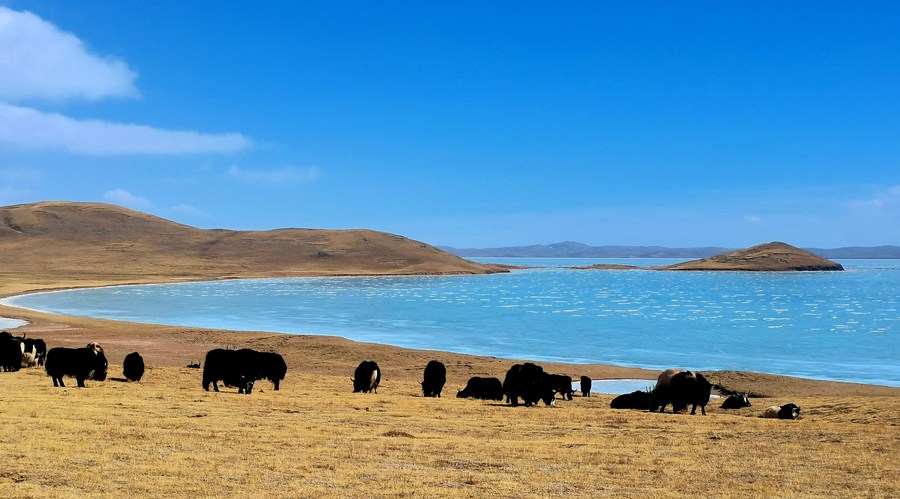
This photo taken on March 12, 2022 shows the view of Gyaring Lake at the Yellow River source region of Sanjiangyuan National Park in northwest China's Qinghai Province. (File photo: Xinhua)
Over the past five years, a national park system with Chinese characteristics has taken basic shape, the quality of natural ecosystems in key areas has continued to improve, and populations of flagship species have grown steadily, according to the administration.
In 2021, China established its first national parks: the Sanjiangyuan National Park, the Giant Panda National Park, the Northeast China Tiger and Leopard National Park, the Hainan Tropical Rainforest National Park and the Wuyishan National Park.
The five national parks cover a total area of 230,000 square kilometers and incorporate more than 120 nature reserves of various types and levels.
By implementing a series of measures like habitat restoration, ecological corridor connectivity, and regulation of human activities, the five national parks have delivered notable ecological successes over the past five years.
For instance, as "the water tower of China," the Sanjiangyuan National Park has significantly enhanced its water conservation capacity, channeling an average of 80 billion cubic meters of high-quality water downstream annually. The Giant Panda National Park has opened up 13 ecological corridors linking isolated wild giant panda populations, greatly improving habitat connectivity.
In terms of flagship species protection, the Tibetan antelope population in the Sanjiangyuan National Park has recovered to more than 70,000. In the Northeast China Tiger and Leopard National Park, the number of wild Amur tigers has increased from 27 to 72, and that of wild Amur leopards from 42 to 115.
Meanwhile, national park construction has coordinated ecological protection with livelihood improvement. Nearly 50,000 local residents have been hired as ecological rangers, earning annual wages of 12,000 yuan (around 1,782 U.S. dollars) to 21,000 yuan per person.
China has also implemented the national park law and revised regulations on nature reserves, marking a new stage of law-based and standardized development for the nature reserve system with national parks as the main body.
During the 15th Five-Year Plan period (2026-2030), China will continue to promote high-quality national park development and establish new national parks in an orderly manner, the administration added.