


China International Industry Fair showcases latest industrial innovations
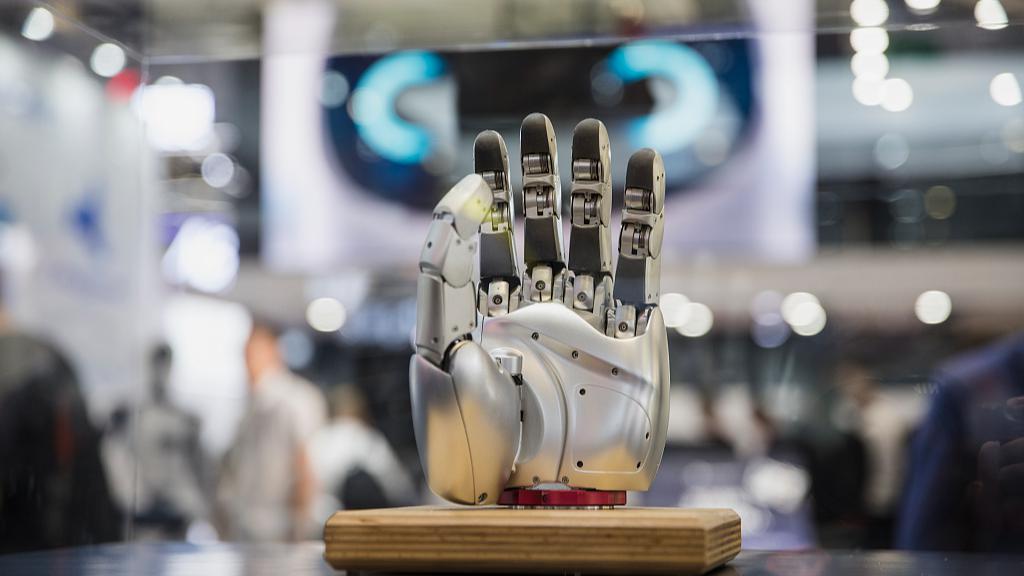
A robotic hand is seen at the 26th China International Industry Fair in Shanghai, China, October 12, 2026. (Photo: VCG)
The 26th China International Industry Fair (CIIF) opened in Shanghai on Monday under the theme "Intelligent Economy, Limitless Smart Manufacturing."
Covering 310,000 square meters, the fair has attracted more than 3,200 enterprises from 24 countries and regions. Nearly 300 cutting-edge technologies and products are making their global or national debuts, including recyclable carbon-fiber robot components and an industrial-grade physical artificial intelligence (AI) simulation platform.
A series of major initiatives and achievements were unveiled at the opening ceremony. The 2026 Shanghai Industrial Map was released, outlining 30 industrial clusters, each with an output value of over 100 billion yuan (about $15 billion), across key sectors including integrated circuits, biomedicine and AI. The map is designed to help businesses identify investment locations and potential partners.
An initiative that aims to build global industrial and supply chains that are secure, stable, efficient, open, inclusive and mutually beneficial was also launched. It was jointly proposed by six organizations, including the Shanghai Federation of Industrial Economics, the European Union Chamber of Commerce in China, the Benelux Chamber of Commerce in China and the German Association of the Automotive Industry.
Shanghai also launched an action plan to accelerate the development of next-generation intelligent manufacturing. The plan includes four major projects and 19 key tasks to deepen the integration of AI and manufacturing and build a next-generation intelligent manufacturing system.
By 2028, Shanghai aims to cultivate 500 advanced-level smart factories, develop more than 2,000 AI application scenarios in manufacturing, create 10 advanced, industry-specific large AI models, and introduce 300 high-performance AI agents.
The city also plans to raise industrial robot density to 600 units per 10,000 employees and deploy 8,000 humanoid robots in factories. It aims to grow the output value of AI-enabled intelligent manufacturing equipment to more than 200 billion yuan and that of intelligent manufacturing system integration to 100 billion yuan.