


China's foreign trade growth in first three quarters hits five-year high
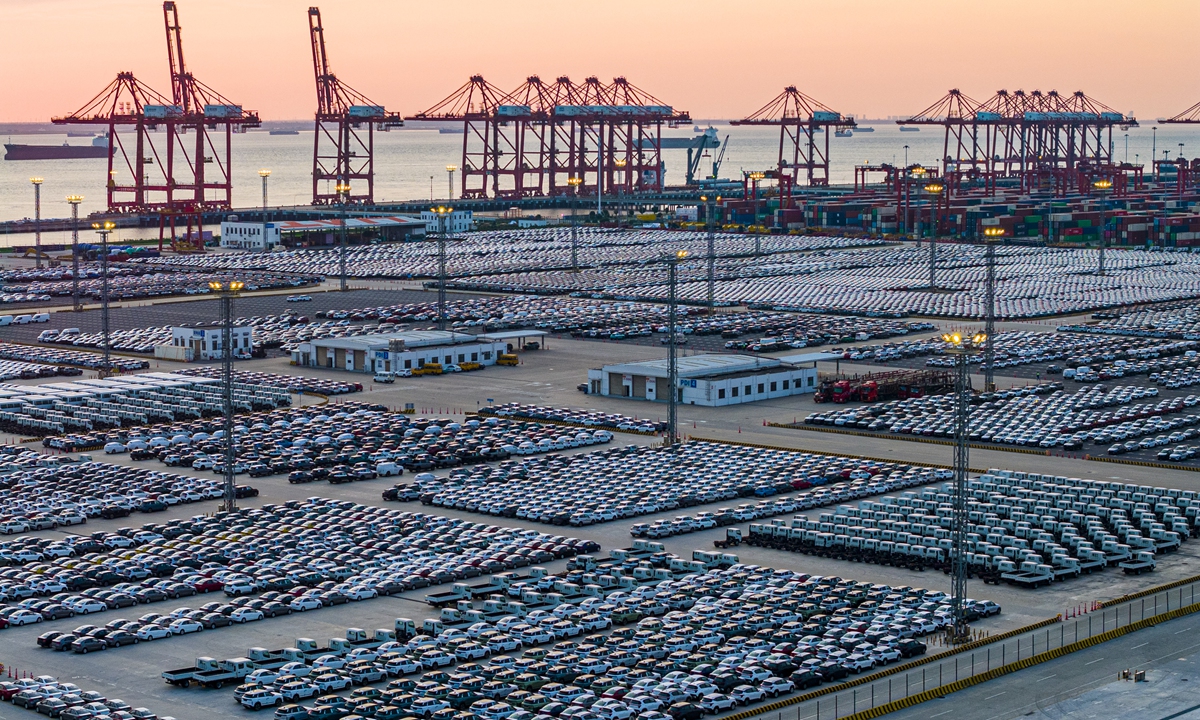
Domestically produced vehicles are ready for export overseas at the Taicang port zone of Suzhou Port, East China's Jiangsu Province on July 14, 2026. Photo: CNS Photo
China's total imports and exports reached 39.94 trillion yuan ($5.94 trillion) in the January-September period, soaring 18.8 percent year-on-year, marking the highest level for the same period in five years, data from the General Administration of Customs (GAC) showed on Wednesday. Chinese experts noted that these better-than-expected figures highlight the strong momentum of China's foreign trade, demonstrating the competitiveness and resilience of the country's manufacturing sector.
Pushing back against Western media hype regarding the so-called expansion of China's trade surplus, these experts argued that rising trade protectionism, the overstretch of the national security concept and policy unpredictability - not China's surplus - are the factors that have widened global imbalances in recent years. These issues require joint efforts to resolve, rather than for pinning the blame on China, they stressed.
Better-than-expected growthFrom January to September, China's exports increased by 16.4 percent year-on-year to 23.2 trillion yuan, while imports expanded by 22.3 percent to 16.74 trillion yuan, according to data released by the GAC.
Foreign trade growth in the first three quarters was the fastest for the same period in the past five years, with both quarterly and monthly growth rates generally accelerating, said Wang Jun, GAC's deputy head.
"Latest international data show that such a growth rate ranks among the top among major economies, and China remains the world's largest trader of goods," the official stated at a press conference on Wednesday.
In September alone China's total imports and exports reached 5.16 trillion yuan, up 27.5 percent from a year earlier and crossing the 5-trillion-yuan mark for the first time. This figure also marked the sixth consecutive month of double-digit monthly growth.
"Despite a complex and volatile external environment, China's trade in goods has sustained strong growth momentum - a testament to the solid backing of its comprehensive industrial system and the powerful boost from technological innovation," Tian Yun, a Beijing-based economist, told the Global Times.
In the first three quarters, China's exports of integrated circuits (ICs) jumped by 99.1 percent, while computer parts and accessories tripled, and storage components, including Solid State Drives, more than doubled, ensuring a steady supply of intermediate goods for global computing power supply chains, data from the GAC showed.
Meanwhile, the country's server exports rose by 7.2 percent, bolstering global computing infrastructure. AI glasses, biomimetic robots and other Chinese smart products are gaining traction overseas, broadening AI application scenarios worldwide.
"China's exports have remained elevated for three main reasons. First, the ongoing global AI investment boom is fueling record growth in chip and related exports. Second, AI-driven global growth has outweighed the drag from the Middle East conflict, with external demand firming further in September and lifting export growth across the board. Third, years of manufacturing upgrading in China are paying off, visibly boosting exports of new energy vehicles and high-tech products," Feng Lin, an analyst with Orient Golden Credit Rating, wrote in a note sent to the Global Times.
Strength rooted in competitivenessHowever, some Western media outlets - neglecting China's role as an anchor of stability for global industrial and supply chains - keep hyping up China's so-called "trade surplus."
"Many of China's trading partners are facing weak growth prospects and are fearful of their manufacturing industries being overrun by exports from China," The Associated Press claimed in a report on Wednesday, citing an analyst.
"Generally, trade surpluses tend to emerge in economies with robust manufacturing capacity," Wan Zhe, a professor at Beijing Normal University, told the Global Times.
Deficit economies typically feature low savings, high consumption and fiscal deficits, which create financing gaps that have to be covered by external capital. Surplus economies display the opposite pattern, Wan noted, adding that the shifting landscape of surplus nations reflects the relocation of manufacturing capacity - this is driven by economic realities of industrial migration, rather than deliberate policy choices alone.
The rising trade protectionism, the overstretching of the concept of national security and policy unpredictability are key factors contributing to worsening global imbalances in recent years, Wan said, noting that addressing such imbalances requires countries to advance their own structural reforms. =
Committed to promoting balanced trade growth, China has intensified efforts to expand imports this year. According to the GAC, China's imports rose by 22.3 percent in the first three quarters of this year, with the growth rate exceeding 20 percent for seven straight months since March. In September, the country's monthly imports broke the 2 trillion yuan mark for the first time.
Co-op opportunitiesLooking ahead, China's foreign trade prospects are bright. Against a backdrop of frequent disruptions to global supply chains and rising energy and geopolitical risks, China - with its comprehensive industrial system and stable, smoothly functioning supply capacity - is becoming a reliable anchor for the global market, Tian said.
"We continue to expand market access. Since the beginning of this year, we have granted market access to hundreds of agri-food products, including bananas from Myanmar, corn from Pakistan and apples from Belgium. We have successfully held eight editions of the China International Import Expo (CIIE), which has attracted a cumulative 27,000 exhibitors from more than 180 countries and regions, with intended transaction volume exceeding $580 billion. The CIIE provides a premium platform for quality products from around the world to better access the Chinese market," Wang said.
At the upcoming ninth CIIE to be held in Shanghai next month, a wide array of cutting-edge and hard-tech products will debut. To support the event, China's customs authority has rolled out 18 facilitation measures spanning the entire process - from exhibit import and customs supervision to post-exhibition handling. This includes a new provision allowing bonded goods in bonded warehouses to be displayed after a guarantee is provided. These concrete measures are designed to help more quality products access the Chinese market.
"With all restrictions on foreign investment in the manufacturing sector now fully removed and national treatment for foreign-invested enterprises steadily ensured, we are confident that more foreign companies will choose to deepen their roots in China - achieving mutual success and growing together with Chinese firms, and sharing the dividends of 'China Opportunity 2.0,'" Wang said.