


ADASpace expands space computing constellation with new satellite launch
ADASpace, a Chengdu-based private company, deployed the second group of satellites in its space-based computing network on Wednesday, marking another step toward building a large-scale orbital computing constellation.
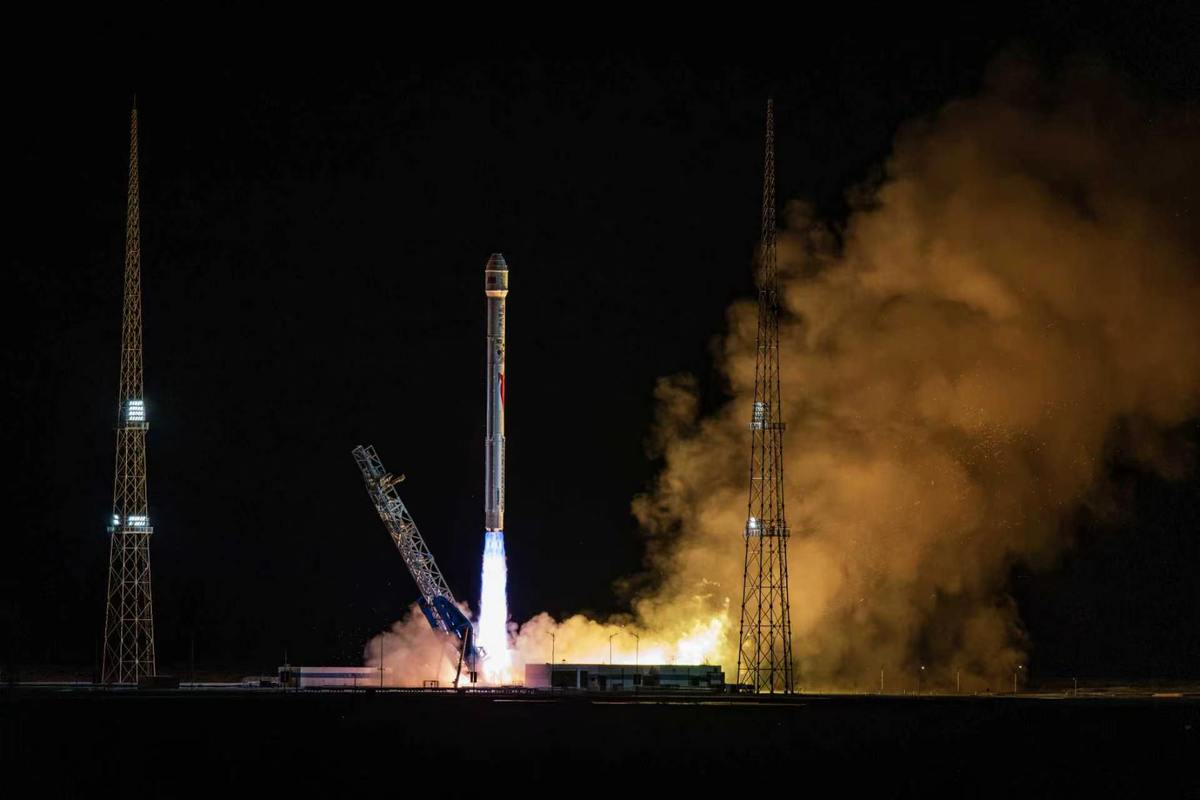
A LandSpace ZQ 2E rocket blasts off at 7:40 pm from the Jiuquan Satellite Launch Center in northwestern China on Wednesday. (Photo provided to chinadaily.com.cn)
The eight satellites were carried by a LandSpace ZQ 2E rocket, which blasted off at 7:40 pm from the Jiuquan Satellite Launch Center in northwestern China. They were placed in a dawn-dusk orbit, a special type of sun-synchronous orbit, to begin operations for the Xingsuan, or Star Computing, constellation.
According to ADASpace, the satellites are equipped with high-performance computing payloads, high-speed laser communication systems for inter-satellite and satellite-to-ground links, and low-light cameras, among other equipment.
They will conduct in-orbit verification of key technologies, including liquid cooling fluid loops in the 10,000-watt class, ultra-large deployable radiative cooling wings, and the in-orbit training of a large language model, the company said.
ADASpace added that it would conduct trial operations of the new satellites in orbit and release relevant results in due course.
The Xingsuan program is being jointly developed by ADASpace and 108 domestic partners, including universities, research institutes, listed companies and investment firms.
ADASpace has said the constellation will eventually comprise 2,800 computing satellites, including 2,400 equipped with inference computing devices and 400 carrying training computing payloads. Once networked, the satellites are expected to form a computing network spanning land, sea, air and space, with an inference computing capacity of 100,000 petaflops and a training computing capacity of 1 million petaflops.
In May 2025, the Chengdu-based company launched the program's first group of 12 satellites, which it described as the world's first operational space computing constellation.
Wednesday's launch also carried two experimental laser communications satellites into orbit, in addition to the eight Xingsuan satellites.