


China's space program opens new frontiers for international collaboration
On September 14, a special gift from the far side of the moon went on display at the United Nations headquarters in Vienna, Austria. Lunar regolith samples collected by China's Chang'e-6 mission, formally donated to the United Nations, will be permanently exhibited there.
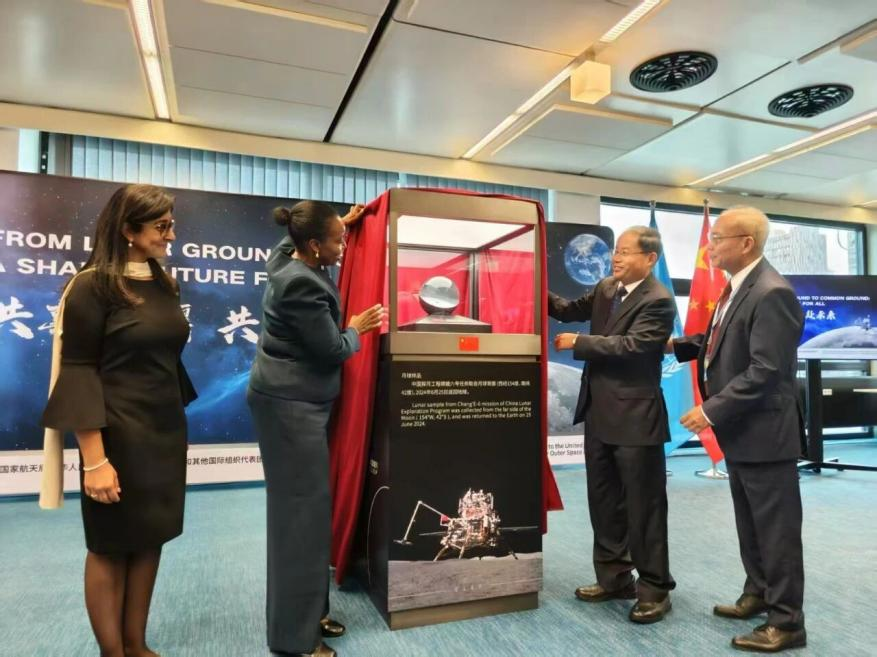
A ceremony to present the lunar soil samples collected by Chang'e-6 to the United Nations was held in Vienna, Austria, Sept. 14. (Photos from the official website of the China National Space Administration)
Brought back to Earth by a Chinese spacecraft, this carefully preserved material symbolizes humanity's collective pursuit of cosmic discovery.
October 8 marked the 70th anniversary of China's space program. Milestones ranging from Tianzhou supply missions to China's space station, to breakthrough research based on Chang'e-6 lunar samples, illustrate a trajectory defined by both indigenous innovation and global partnership. China's ever-evolving "space suitcase" tells a story of remarkable advances in independent innovation over seven decades. It also reflects China's openness to the world and its commitment to space exploration through international cooperation.
Space exploration is a shared endeavor for all humanity. China's "space suitcase" has always had room for international partners.
On May 3, 2024, Pakistani ICUBE-Q set off for the moon aboard the Chang'e-6 mission, heralding Islamabad's inaugural lunar mission. The prospect quickly captured public imagination across Pakistan.
Chang'e-6 undertook the unprecedented challenge of autonomously collecting samples from the far side of the moon and returning them to Earth. Despite the extremely limited payload capacity available for the mission, it carried four international payloads, including ICUBE-Q.
Joint development between Chinese and Pakistani teams began in early 2023. The project faced a tight schedule, with multiple payload configurations, complex interfaces and procedures, as well as challenges arising from cultural differences and time zones.
To navigate these complexities, a Chinese engineering team led by Wu Shufan, a professor at the School of Aeronautics and Astronautics at Shanghai Jiao Tong University, worked closely with its Pakistani counterparts to overcome technical hurdles and successfully develop the cube satellite weighing 6.5 kilograms, with a total payload mass of 9 kilograms.
"Despite its compact size, the satellite features several key technological advancements," Wu said. The team developed a communications solution tailored to the cube satellite's lunar exploration and overcame key technical challenges in tracking, telemetry, and command, as well as data transmission, over the vast distance between Earth and the Moon for nanosatellites.
A bilateral working group was established to address technical and administrative matters promptly. Throughout the development phase, Pakistani engineers gained hands-on experience alongside their Chinese counterparts, advancing capabilities in satellite architecture and systems integration.

Pakistan's ICUBE-Q captures a photo of the Sun and the Moon, May 9, 2024.
At 4:14 pm on May 8, 2024, Pakistan's cube satellite successfully separated from the spacecraft in lunar orbit. Shortly thereafter, it captured a striking photograph depicting the Sun and Moon in a single frame. Widely shared by international media and scientific institutions, the image has come to symbolize the spirit of cross-border collaboration in space exploration.
The satellite was designed to operate for five hours under the mission plan, but it actually remained operational in orbit for 55 days. During that time, it continuously transmitted images and monitoring data, delivering invaluable firsthand insights for Pakistan's nascent lunar research program.
From the cube satellite jointly developed by China and Pakistan to a growing number of partners joining hands to explore space, the story of cooperation continues. China's space cooperation network is expanding, and its "space suitcase" brings together the knowledge and ingenuity of people around the world.
Guided by a vision of inclusive space governance, China has strengthened practical partnerships with over 50 nations and international bodies. Collaboration spans satellite co-development, third-party payload integration, scientific data sharing, capacity building, and multilateral space policy dialogue. Notably, nine experiments representing 17 countries were selected for the inaugural cohort of international research projects aboard the Tiangong space station, which is also preparing to host its first non-Chinese crew member.
With the same global outlook, China is working to ensure that the benefits of space exploration are shared more widely. In May this year, the Solar wind Magnetosphere Ionosphere Link Explorer (SMILE), a joint China-Europe satellite mission, was launched to investigate the interaction between the solar wind and Earth's magnetosphere. In Brazil, a China-Brazil Earth Resources Satellite helps protect tropical rainforests. In Egypt, the satellite MISRSAT-2 provides high-resolution imagery for urban planning and national land and resource surveys. In Tajikistan, personnel responsible for the Sarez Lake dam use China's BeiDou Navigation Satellite System to monitor dam deformation.
Shan Zhongde, head of the China National Space Administration, said, "Going forward, we will continue to advance international cooperation in space across a range of areas, including joint satellite development, space data sharing and global governance of outer space, while promoting innovation in space science, space technology and space applications."