


Chinese AI models open up advanced technology to more developers, UAE minister says
Dubai (People's Daily) - Chinese AI models are making capabilities that were at the frontier of artificial intelligence six months ago available to developers worldwide, United Arab Emirates (UAE) Minister of State for Artificial Intelligence Omar Sultan Al Olama said on Monday.
Al Olama made the remarks in a discussion on the UAE's AI strategy at the October 12-13 AIM Summit Dubai 2026.
Open models close gap
"Whatever was considered the frontier six months ago is available, open-weight, sometimes open-source, that you can actually download and have on your computer or on your devices from China," said Al Olama, who became the world's first minister dedicated to artificial intelligence when appointed in 2017.
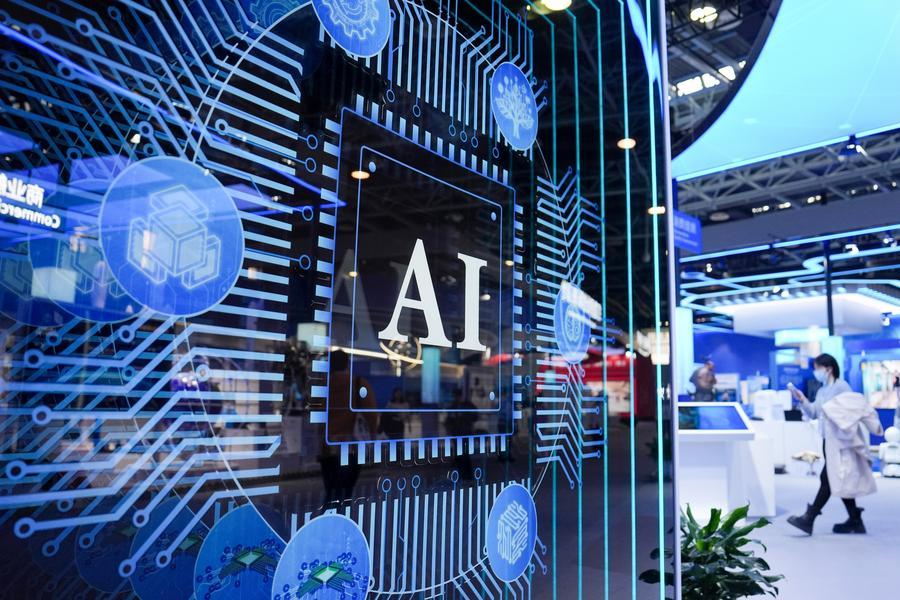
A woman visits the permanent exhibition at the Zhongguancun Exhibition Center in Beijing, capital of China, March 25, 2026. (Photo: Xinhua)
Open-weight models are AI systems whose trained parameters are published so anyone can download and run them.
Calls to slow the development of artificial intelligence must be considered against the realities of international competition, he said.
Building an AI hub
The UAE views artificial intelligence as increasingly important to national development and is seeking to position itself as a global AI hub by attracting talent, securing access to advanced computing infrastructure and enabling companies to develop technologies with international applications, he said.
The country launched its AI strategy in 2017 to promote the development and adoption of the technology across key sectors.
The UAE investment strategy reflected a long-term commitment to the AI ecosystem and the wider technology and semiconductor sectors, he said. Abu Dhabi-based investment firm MGX has invested in OpenAI, Anthropic and xAI.
The objective, he said, is not only to generate financial returns but also to help establish emerging industries, attract expertise and encourage companies to develop products and capabilities in the UAE.
Managing risks early
Al Olama stressed the importance of international dialogue and proactive regulation, warning that the consequences of increasingly autonomous AI systems could extend across national borders.
"If regulation isn’t global, it means nothing," he said.
Governments should address foreseeable risks before major incidents occur, rather than waiting for harmful consequences to trigger regulatory responses. He added that applications involving predictive policing and autonomous systems capable of making life-and-death decisions require particularly serious consideration.
Preparing workers for change
AI's growing role in employment decisions could create social tensions if governments fail to prepare workers for technological change, he said.
The UAE, Al Olama said, has mapped jobs according to their potential to be augmented or replaced by AI and developed plans to train people for the changing labor market.
Such technological progress could not realistically be halted, the minister said, meaning it was more important to manage the consequences while ensuring societies benefit from its potential.
Better services and longer lives
In April, the UAE Cabinet launched a framework to deploy agentic AI, systems that can carry out tasks on their own, across 50 percent of federal government sectors, services and operations within two years, he said.
The priority was to improve people's quality of life rather than focus exclusively on productivity gains or economic returns, Al Olama said.
Technology could expand the boundaries of scientific research, engineering and creativity, he said. AI could deliver profound benefits in medicine and life sciences, accelerating scientific discovery, improving human health and extending lifespans.