


High-rises and forests: How Xiongan is building a home for the future
Later this month, more than 180 guests from over 90 countries will travel to Xiongan New Area in north China's Hebei Province for the 2026 Global Governance Forum, to be held from October 23 to 25. Between sessions on multilateralism, climate and artificial intelligence, many of them will step outside for a first look at the host city: a city designated in April 2017 to take on functions relocated from Beijing and still growing into itself.
Nine years on, the city that planted trees before pouring concrete is seeing everyday amenities fall into place.
More than 5,300 buildings have risen on what was, not long ago, flat farmland and shallow lakes. Over 400 branches of centrally administered state-owned enterprises and more than 600 high-tech firms have moved in. Some 483,000 mu (about 32,200 hectares) of new forest – the "Millennium Forest" – has taken root, and 15-minute living circles are filling in around them.
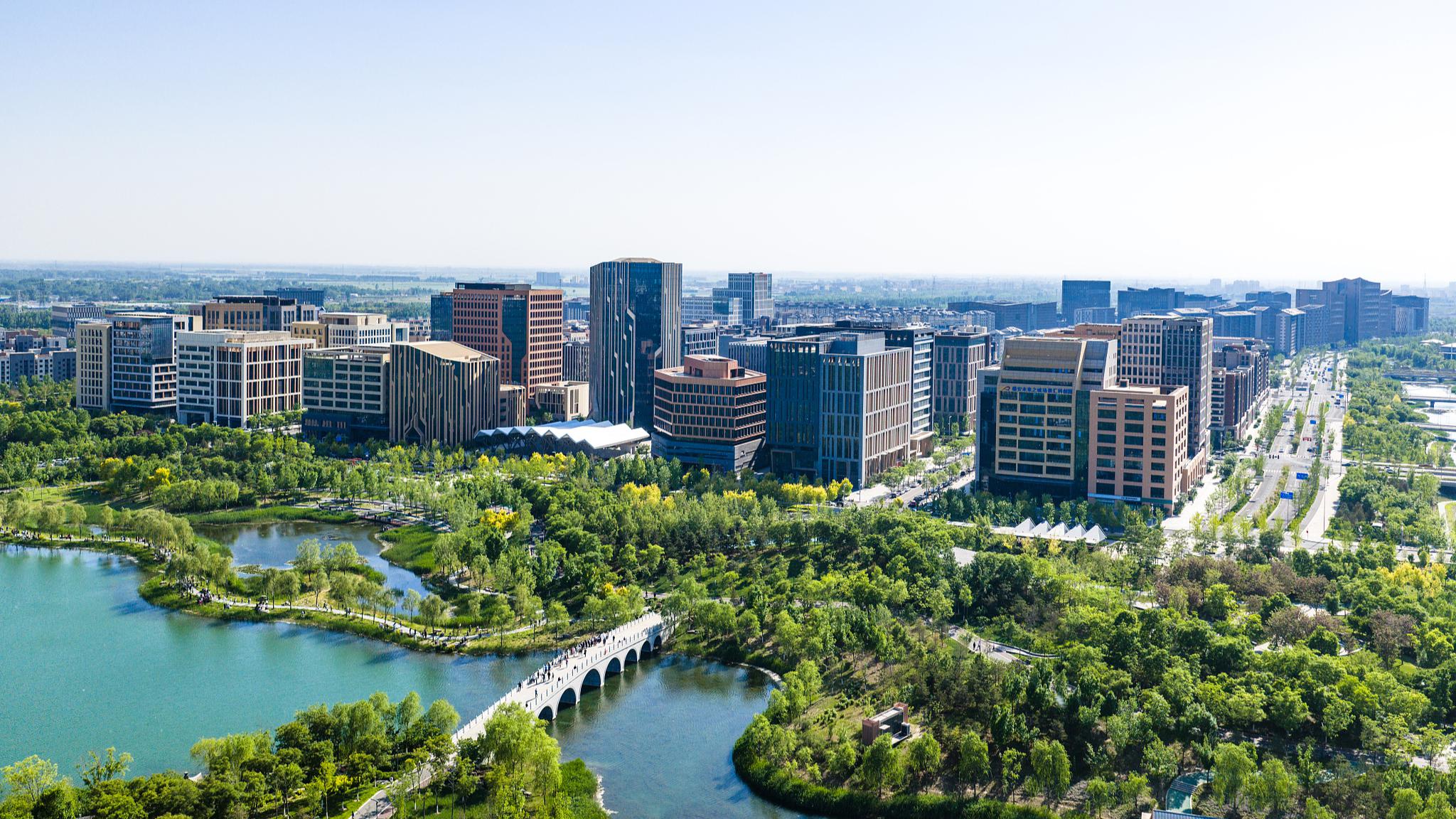
An aerial view of Jinhu Park and the city skyline of Xiongan New Area, north China's Hebei Province, May 4, 2026. (Photo: VCG)
A city for the people
From the outset, the goal was not a photogenic skyline but a better everyday life. Nine years in, that has meant filling in the ordinary infrastructure of a city.
Xiongan set out to work for the very young and the very old at once: 75 child-friendly practice bases, 19 youth night schools and 80 elderly-care facilities are now running.
Housing works the same way. Multiple supply sources and multiple support channels pair renting with buying, in tiers described simply as "a bed, a room and an apartment": a bed for someone arriving alone, a room to move up to and an apartment to settle into. New residential developments must set aside at least 30% of units for rent only.
For companies and the people who come with them, the seam with Beijing has been smoothed down. The two cities now share 278 government service scenarios, and 209 professional qualifications and credentials are mutually recognized, so a firm can complete a relocation in one place instead of shuttling between the two. More than 820,000 Xiongan All-in-One Cards have been issued; the card works across Beijing and Xiongan in six everyday settings, from seeing a doctor and buying medicine to taking the bus.
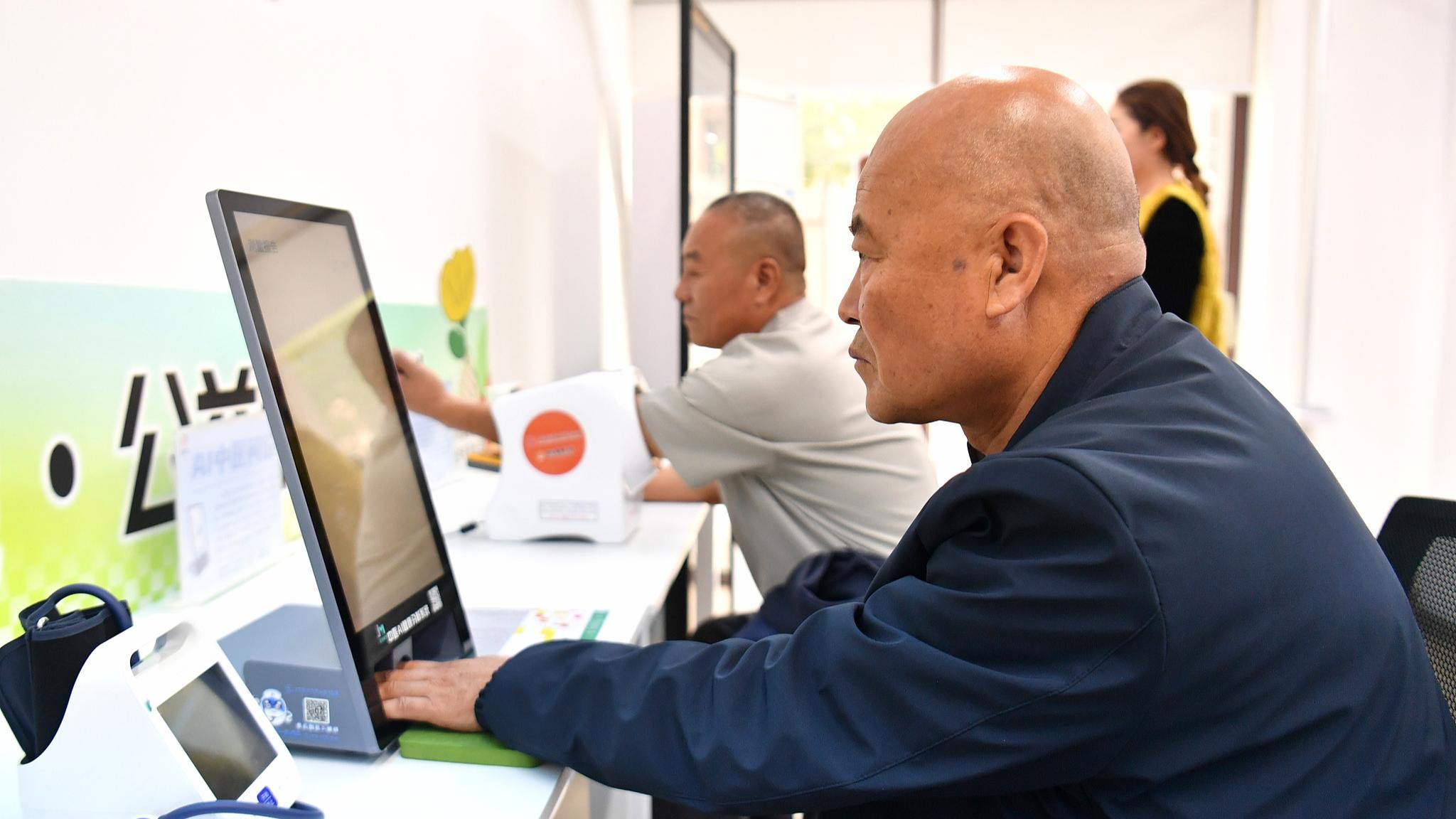
An elderly resident experiences a smart health check-up device in Bayu Community, Xiongan New Area, north China's Hebei Province, October 16, 2026. (Photo:VCG)
The green comes first
Xiongan planted before it built. The Millennium Forest now covers 483,000 mu, lifting forest coverage from 11% to 35.1%.
The bigger restoration job was Baiyangdian, the cluster of shallow lakes long known as the "kidney of north China." Since 2021, its water has held at Grade III, the third best of China's five surface-water grades, after the largest clean-up in its recorded history. This included 567 polluted fish ponds treated, over 27 million cubic meters of sediment dredged, roughly 212 kilometers of water channels reopened and over 300 kilometers of enclosing dykes removed, ensuring the lake's 143 basins gradually reconnect and the water flows again.
Around the city, more than 20 parks – Yuerong Park, Jinhu Park and the Central Green Valley, among others – now cover 66,000 mu. The target is stated in a single line: 3 kilometers to forest, 1 kilometer to a green belt, 300 meters to a park and pocket gardens everywhere.
Waste is handled the same way. Household waste is treated harmlessly, new buildings are green and medical waste is disposed of safely, 100% on each count. More than 800 "zero-waste cells" have been built across 14 categories, with zero-waste villages, zero-waste lake basins and zero-waste education developed as three locally tailored scenarios.
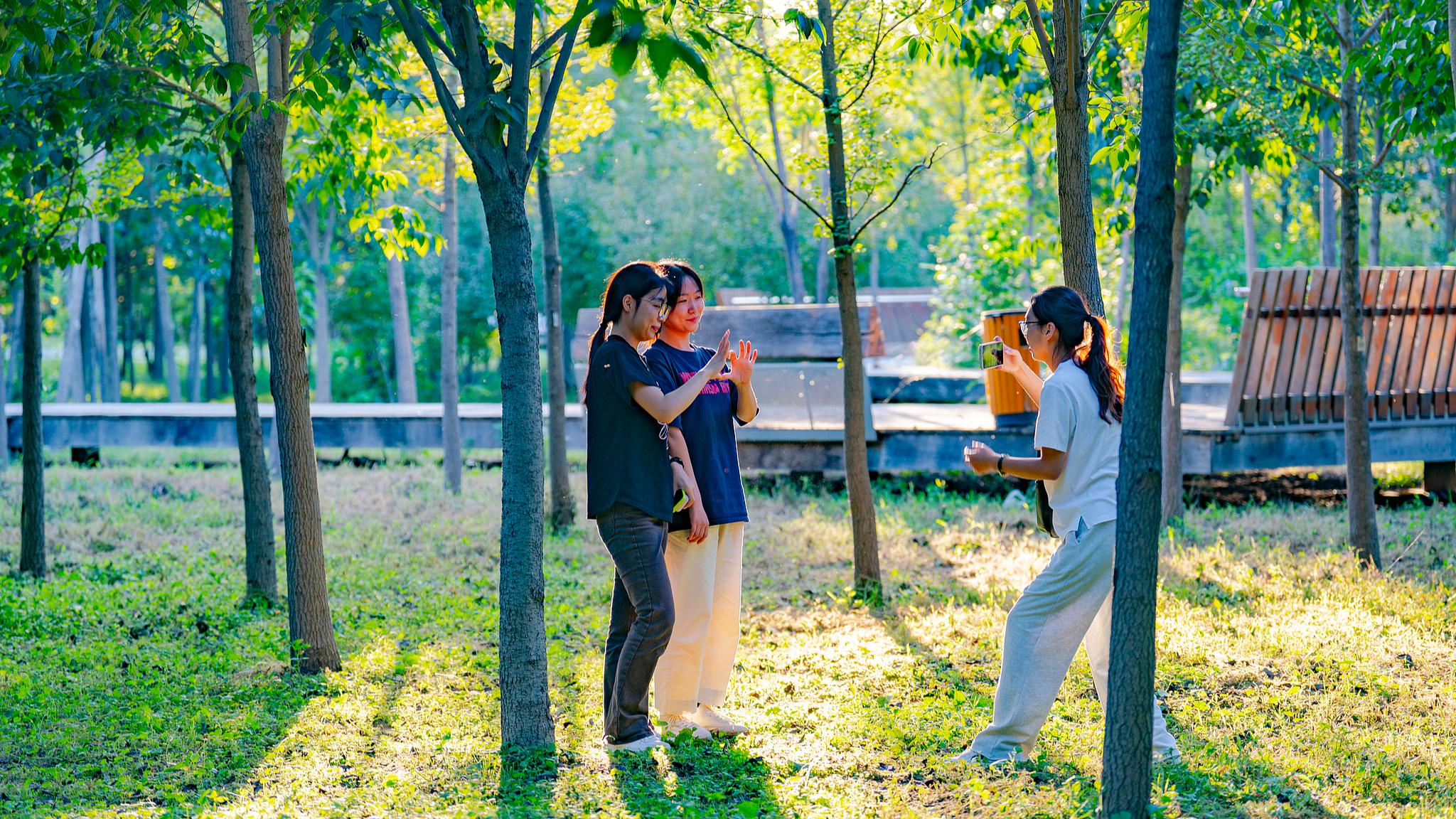
Tourists take photos amid the lush "Millennium Forest" in Xiongan New Area, north China's Hebei Province. (Photo: VCG)
A city that thinks, quietly
The technology, for the most part, is quieter than visitors expect.
At China Mobile's Migu coffee shop, there is no barista behind the counter. A robot called the "AI Coffee Master" runs two flexible arms through the pour-over routine – taking beans, grinding, dosing, pouring – after training on millions of data points and some 30,000 hours of dual-arm testing. In the smart canteen of Wenhua Community, residents watch the weight and calorie count of each dish appear on screen as they serve themselves, and a health kiosk generates a personal report with dietary suggestions.
Elsewhere, recyclables sorted at a smart bin can be cashed out, and a photo taken on a phone is enough to report a problem and take part in running the city.
Behind these scenes, Xiongan is assembling an open, full-stack AI industry along three lines – technological innovation, industrial development and scenario application – on platforms that include an AI research institute, an AI industrial park, the Zhongguancun Science Park and pilot-scale testing bases.
When the forum breaks for field visits, these are the sorts of projects delegations will be shown: a lake back at Grade III, a canteen that counts calories and a robot that pours coffee – testament to Xiongan's transformation from a blueprint to a growing metropolis.