


Beijing to become a super-aged society by 2035, with one-third of its population aged 60 or older: reports
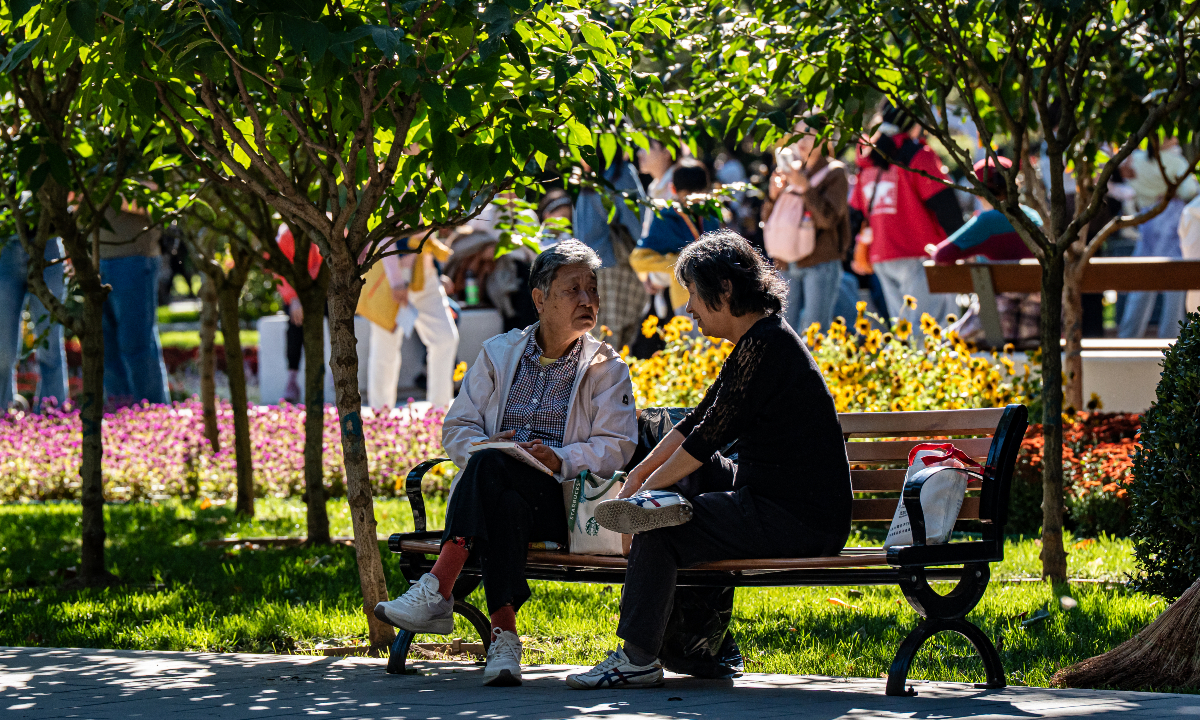
Elderly people relax and chat at Ritan Park in Beijing on October 9, 2026. (Photo: IC)
Beijing is expected to become a super-aged society by 2035, with one-third of its population aged 60 or older. To address this trend, the Chinese capital has stepped up efforts in recent years to strengthen legal protections for elderly care, improve social security, promote the integration of elderly care services with related industries, expand medical-care partnerships and reinforce its multi-tiered pension system, Beijing Daily reported on Saturday.
According to data released at a recent industry forum ahead of the Double Ninth Festival, also known as the Chongyang Festival, in Beijing, Beijing had 5.288 million permanent residents aged 60 and above at the end of 2025, accounting for 24.3 percent of its population.
The proportion is expected to exceed 33 percent by 2035, meaning one in every three residents will be aged 60 or above, according to Beijing Daily.
As a megacity, Beijing is stepping up efforts to address its rapidly aging population. In January, it introduced its first comprehensive, foundational local regulation on elderly care services, making it the first city in China to establish a three-tier elderly care service network covering districts, subdistricts (townships) and communities (villages) through local legislation.
Beijing has also raised basic pensions for urban and rural residents year after year and established a system of allowances and subsidies for elderly care services. In 2025, it disbursed about 3.51 billion yuan ($525 million) in such allowances and subsidies, benefiting older people facing financial hardship, those unable to care for themselves and those of advanced age, with a total of 11.958 million beneficiary instances.
Meanwhile, Beijing is pursuing an integrated approach to developing elderly care services and related industries. To date, Beijing has 620 registered elderly care institutions, 168 regional care centers and more than 1,500 community care stations, providing a total of 155,000 beds across various types of facilities.
In response to the trend toward an increasingly aged population, Beijing prioritizes care for the oldest-old population through preferential services, fee reductions and waivers, regular welfare visits and emergency assistance.
Given that the vast majority of older people prefer to age at home, Beijing is continuing to develop a 15-minute elderly care service network. Beijing has nearly 3,000 registered meal service sites serving older residents, covering 90 percent of the city’s urban and rural communities. Over the next three years, the city plans to add 30,000 home-based elderly care beds.
Official statistics showed that China had 323.38 million people aged 60 and above at the end of 2025, accounting for 23 percent of its population.
Rising care needs among older people with disabilities, dementia and those living alone are intensifying demand for care services, while a shortage of professional elderly care workers remains a key challenge, according to the Legal Daily.