


Qualcomm seeks deeper AI cooperation with China, citing its strengths in tech commercialization
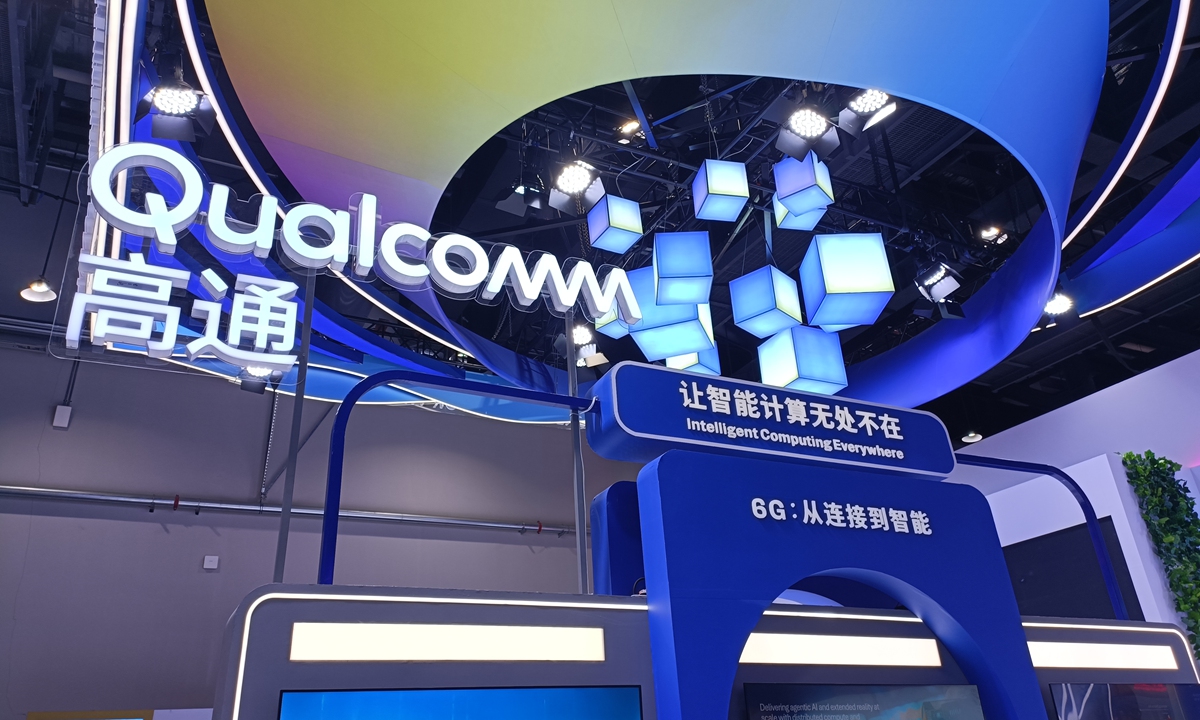
The Qualcomm booth at the 2026 China International Fair for Trade in Services (CIFTIS) in Beijing on September 9, 2026. (Photo: VCG)
US chipmaker Qualcomm is seeking to deepen cooperation with Chinese partners to bring artificial intelligence (AI) into more devices and industries, underscoring China's growing role in turning technological innovations into large-scale industrial applications, as US technology companies continue to pursue business opportunities and industrial partnerships in the Chinese market.
China's advantages extend far beyond the size of its market, said Meng Pu, chairman of Qualcomm China, at an AI industry conference in Shenyang, Northeast China's Liaoning Province, on Saturday, according to People's Daily-affiliated Jintai Information.
China's comprehensive industrial system, diverse application scenarios, vibrant innovation ecosystem and large pool of skilled engineers provide favorable conditions for new technologies to progress from technical validation and product development to large-scale application, Meng said.
China is not only an important market but also a major global force in accelerating the deployment and large-scale application of new technologies, Meng said, pointing to the country's growing importance as AI expands across industries.
Qualcomm has worked with Chinese companies for more than three decades, through the evolution of 3G, 4G and 5G mobile communications and the mobile internet. Last year, it teamed up with Chinese mobile operators, device manufacturers and AI model developers to launch an AI acceleration initiative.
The automotive sector in China illustrates how such partnerships translate into commercial applications. Since 2021, Qualcomm's Snapdragon Digital Chassis solutions have supported Chinese automakers in more than 300 connected vehicle models, according to Meng.
Qualcomm is not alone in highlighting opportunities in China. During a meeting with Chinese Commerce Minister Wang Wentao on Thursday, Apple Executive Chairman Tim Cook voiced optimism about China's development prospects and vowed to further expand the company's business in the country. The two sides also discussed AI development and bilateral economic ties, according to China's Ministry of Commerce (MOFCOM).
US chipmaker Intel also announced a strategic collaboration with China's Lens Technology in July, aimed at developing new technologies for advanced semiconductor packaging. According to Intel's official statement, the two companies will leverage their respective strengths in advanced semiconductor packaging, precision manufacturing, glass substrate research and development, and process innovation to support the growing demands of AI, data center and specialized computing applications.
The continued engagement of US technology companies reflects a broader shift in China's role in global innovation, veteran tech industry analyst Liu Dingding told the Global Times on Sunday. Once viewed primarily as a vast consumer market and destination for large-scale technology deployment, China is increasingly emerging as a hub for developing, testing and commercializing advanced technologies, Liu said.
"For multinational companies, deeper integration into China's innovation ecosystem can accelerate commercialization, while Chinese manufacturers can leverage international partnerships to advance industrial upgrading," Liu said. "Such complementary strengths offer opportunities for both sides to benefit from AI's expansion into more industries."
The corporate emphasis on cooperation comes as China and the US seek to strengthen communication on AI. During their eighth round of economic and trade consultations in September, the two sides established an AI dialogue and held their first discussions on AI-related risks and benefits. Another dialogue is scheduled before the end of November, according to MOFCOM.
During Thursday's meeting with Cook, Wang said China advocates safe, controllable and inclusive AI development and cooperation on AI governance. He also expressed hope that Apple would help promote stable China-US economic and trade relations.
Liu, the expert, said the continued engagement between US technology companies and their Chinese partners highlights the commercial logic of cooperation despite bilateral technological differences. "Decoupling and disrupting supply chains is neither realistic nor in the interests of businesses," he said, adding that multinational technology companies can also serve as bridges for communication between the two countries' technology industries.