


France rocked by nationwide unrest as protests turn violent with more than 2,000 arrested
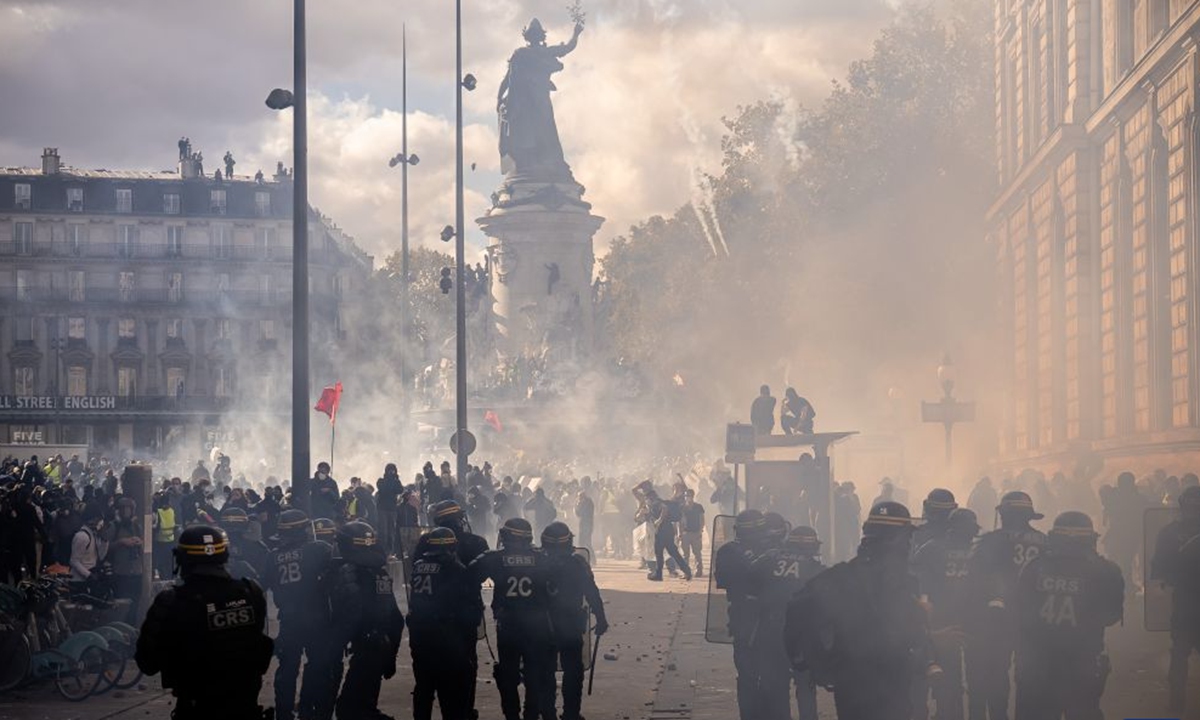
Demonstrators face off with law enforcement officers during a protest in Paris, France, on October 17, 2026. (Photo: Xinhua)
Burning cars, shattered shop windows and clouds of tear gas filled the streets of Paris on Saturday as nationwide protests over soaring living costs and deteriorating public services descended into violent clashes across France. More than 2,000 people have been arrested during violent protests across France on Saturday, French Interior Minister Laurent Nunez said Sunday.
More than 600 police officers, gendarmes and firefighters have been injured in the violence so far, he said, citing provisional figures.
The unrest, described by Reuters as some of the worst violence France has witnessed in decades, spread to major cities including Marseille, Lyon and Lille, where masked groups set buildings ablaze, ransacked shops and stormed government offices, Reuters reported.
In Paris, groups of masked protesters torched parked vehicles, smashed storefronts and looted shops as riot police deployed water cannons and tear gas to disperse crowds. Entire streets in the capital had been "devastated," Paris Mayor Emmanuel Grégoire said, according to AFP.
In the central French city of Limoges, masked rioters set fire to the historic City Hall, built in 1883, after torching a police vehicle and smashing windows to enter the building. Flames engulfed the 143-year-old landmark, causing its roof to collapse and destroying around two-thirds of its facade. Local prefect Maurice Barate described the destruction as a "catastrophe of heritage," saying the building was largely lost, according to France 24.
In the southern port city of Marseille, protesters forced their way into City Hall, overturning a bust of Marianne, a symbol of the French Republic, and smashing furniture before being driven out by police.
Several protesters sought to draw parallels with the French Revolution of 1789, according to the AFP. "It's the Revolution - we're taking the Bastille!" some shouted in Marseille during the forced entry into the mayor's offices. In the western city of La Rochelle, marchers streamed behind a placard reading: "Revolution or death." And in the southern city of Montpellier, a giant blue sign reading "The people will win" was unfurled above a central square.
French President Emmanuel Macron vowed on X that "those who carried out vandalism, attacked administrative offices or businesses, or carried out looting - even in our town halls, will be prosecuted and punished."
Opposition politicians vying to replace Macron in presidential elections in April and May next year seized on the chaos.
Far-right candidate Marine Le Pen condemned "the rioters" and claimed that the party of her far-left rival for the presidency, Jean-Luc Melenchon, had "legitimized the violence."
She said on X that, if she came to power, she would protect the French "from the violence of the extreme left."
Melenchon, who had prominently supported the demonstrations and the student protests preceding them, urged demonstrators to stay away from any looting, describing it as "contrary to our methods."
France's Yellow Vest movement, which eight years ago staged street protests against Macron's government over planned fuel tax hikes, had called for Saturday's "yellow and youth" demonstrations.
The latest unrest follows weeks of student-led protests that began on September 17 in Créteil, a southeastern suburb of Paris, before spreading across France.
The movement was initially driven by complaints over teacher shortages, overcrowded classrooms, deteriorating school facilities and overloaded timetables, according to a statement by French high school students' union Union Syndicale Lycéenne (USL), cited by Le Monde on September 29.
The protests subsequently escalated into confrontations with police in several cities, including Strasbourg, Lyon and Rennes, where officers fired tear gas while some protesters set fires in the streets and hurled projectiles, Reuters reported on October 6.
According to a survey released on October 8 by French research institute L'ObSoCo in partnership with Sciences Po's political research center CEVIPOF, 45 percent of French respondents cited inflation and purchasing power among their main concerns, reflecting mounting pressure from rising energy and living costs.
The French government has pledged measures to address students' grievances, including the deployment of around 3,000 additional teachers to ease staffing shortages, Al Jazeera reported on October 8.
The unrest comes ahead of France's presidential election, scheduled for April 18 and May 2, 2027, according to the French government's official election schedule and the constitution published by the Élysée Palace.
Beyond the immediate violence, the unrest has exposed deeper strains in French society, from mounting economic pressures and deteriorating public services to growing political polarization. Chinese experts told the Global Times that years of unresolved structural problems, compounded by fiscal constraints, have left the government with limited room to address public grievances, while the approaching 2027 presidential election could further sharpen political divisions.
Chen Hong, director of the Institute of Region and Country Studies at East China Normal University, told the Global Times that the unrest reflects structural pressures in France's economic and social model. Sluggish growth and fiscal constraints have strained public services, while unequal opportunities have fueled frustration and distrust of political elites.
Looking ahead to the 2027 presidential election, Chen said the unrest could deepen political divisions, with the left emphasizing social welfare and wealth redistribution and the right focusing on security and order. The greater challenge, he argued, is whether France's next leadership can offer credible reforms and rebuild public trust.
Dong Yifan, an associate research fellow at the Academy of Country and Area Studies at Beijing Language and Culture University, said that compared with the Yellow Vest movement in 2018, France now faces greater economic and social pressures. He noted that limited reforms have failed to address underlying problems, while mounting fiscal constraints have restricted the government's ability to increase spending on public services and other livelihood-related priorities.
Dong said France has a long tradition of street protests as a means of expressing public grievances. With the government preparing its budget for the coming year and Macron approaching the end of his presidency, the latest demonstrations also reflect growing public pressure for political and social change ahead of the 2027 presidential election.
With high public debt and persistent budget deficits forcing the government to tighten spending, its ability to address longstanding inequalities in education and public services has become increasingly constrained, Qian Feng, an international affairs expert with the Tsinghua University said.
Qian also warned that the turmoil could intensify political polarization ahead of the 2027 presidential election, as rival political forces seek to capitalize on public discontent. Disputes over fiscal austerity, immigration, public security and deteriorating public services could become central election issues, potentially deepening divisions within French society.