


China's former revolutionary base areas embrace new chapter of development
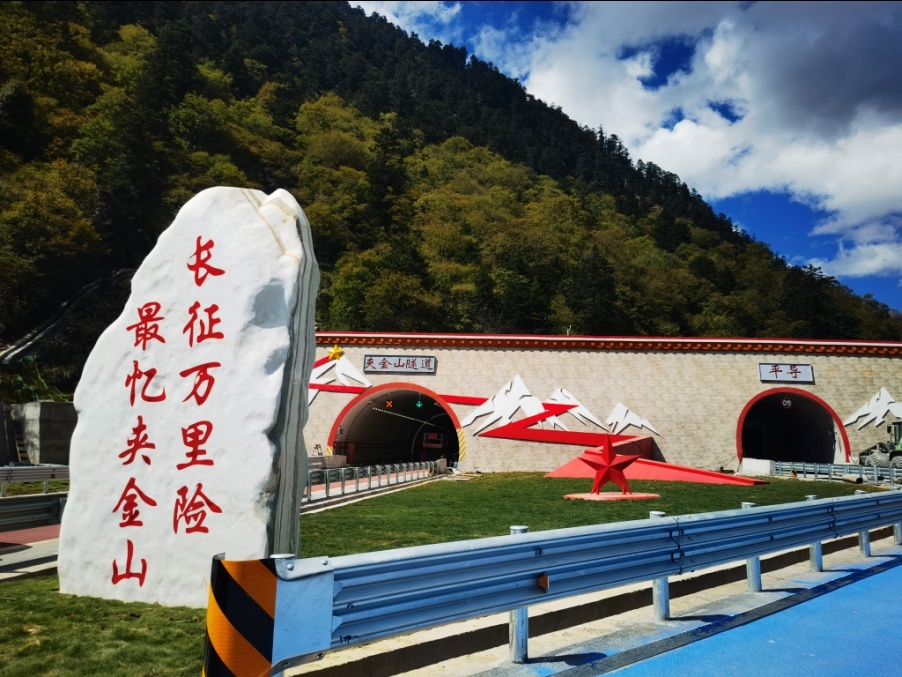
Photo shows the Jiajin Mountain Tunnel in southwest China's Sichuan province. (Photo from People's Daily app)
Two bridges over the Huajiang River in southwest China's Guizhou province offer a striking glimpse into the remarkable transformation of China's former revolutionary base areas.
The first is the Huajiang Chain Bridge. With its iron chains and wooden-plank deck, it spans a section of the Beipan River.
In 1935, as the Right-Flank Column of the Central Red Army advanced into southwestern Guizhou, the 11th Regiment of the Third Red Army Corps held its position here, buying precious time for the main force.
This wartime lifeline embodied the determination to overcome every challenge and fight for victory.
The other one, the Huajiang Grand Canyon Bridge, is pushing the boundaries of bridge construction in mountainous terrain through intelligent construction, innovative materials, advanced wind-resistant designs, and environmentally friendly building techniques.
Its construction, which has set multiple world records, has effectively bridged the "gaps" created by the mountains and canyons.
The old and new bridges now stand within sight of each other, offering a vivid picture of how former revolutionary base areas have changed, and Guizhou is far from the only example.
The opening of flights at Ruijin Airport in east China's Jiangxi province has given people in southern Jiangxi and western Fujian, both former revolutionary base areas, a new "air corridor" linking them with the rest of the country.
The Jiajin Mountain Tunnel in southwest China's Sichuan province has entered trial operation, turning the arduous journey "over" the mountain into a smooth passage "through" it and freeing local residents from worries about mountain closures caused by winter snow and ice.
Bridges spanning valleys, passenger planes roaring overhead, and tunnels piercing through mountains -- the path to modernization for old revolutionary base areas is growing ever broader.
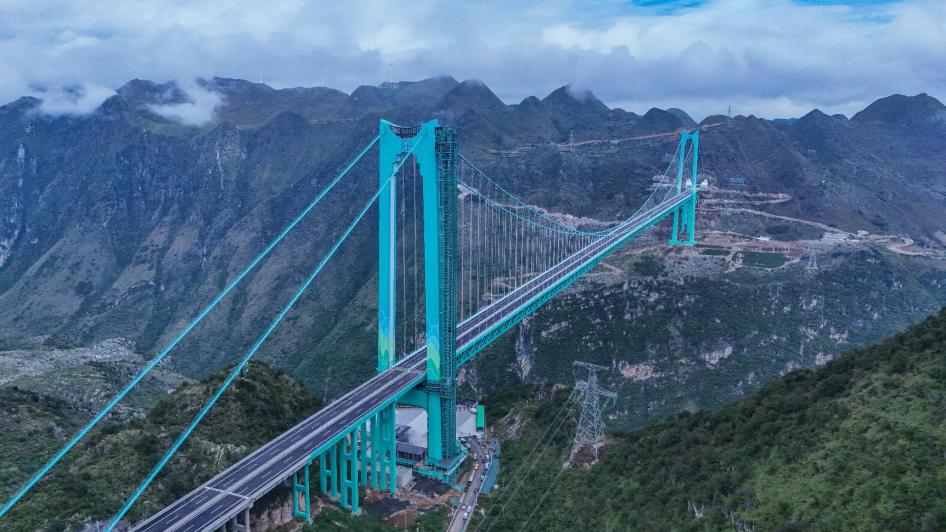
Photo shows the Huajiang Grand Valley Bridge in southwest China's Guizhou province. (Photo/Li Yunfeng)
What is driving these once-remote areas to take on a new look?
Major undertakings call for riding the tide of the times. Development anchored in the prevailing trends of the era ensures the right direction and provides a strong driving force. That once-remote regions are no longer isolated, and less-developed areas no longer lag behind, owes much to their ability to seize opportunities of the times and align themselves with broader development trends.
Deep in the mountains of Baisha township in Jishui county, Jiangxi province, fruit farmers are now able to sell their produce through livestreaming. This mountain hamlet, where people once "shouted to communicate and traveled on foot", is now equipped with 5G base stations, bringing new vitality to rural revitalization.
Today, China boasts nearly 4.6 million 5G base stations and over 30.53 million gigabit-capable network ports, achieving gigabit-level connectivity for every county and 5G coverage in every township.
From snow-capped mountains peaks to seashores, from the depth of dense forests to desert steppes, digital infrastructure functions like an intricate neural network, bridging the digital divide and bringing the benefits of digital and intelligent technologies to every corner of the country.
For many regions, abundant resources and convenient locations offer a head start. Yet experience shows that the availability or scarcity of resources and other factors of production is never an absolute determinant. With the right approach and by building on their own strengths, regions can turn limitations into new advantages and cultivate new growth drivers from what they already have.
During the Chinese People's War of Resistance Against Japanese Aggression, the people and soldiers of the Shaanxi-Gansu-Ningxia Border Region stepped up production to break the enemy's blockade, turning Qingyang in Gansu into the "granary of eastern Gansu."
Today, Qingyang has once again taken stock of its strengths, drawing on its abundant energy resources and cool climate to develop data centers. Massive volumes of data can travel from Shanghai to the city in a matter of seconds, while computing power in Qingyang enables entrepreneurs in Guangdong in south China to render 3D models at high speed.
As server lights replace oil lamps and streams of digital data flow across the land, data and computing power have become a new kind of "grain," helping drive local development while serving the needs of the country as a whole.
Industrial upgrading and regional development both require a focus on local strengths and core industries, as well as openness to wider cooperation and integration.
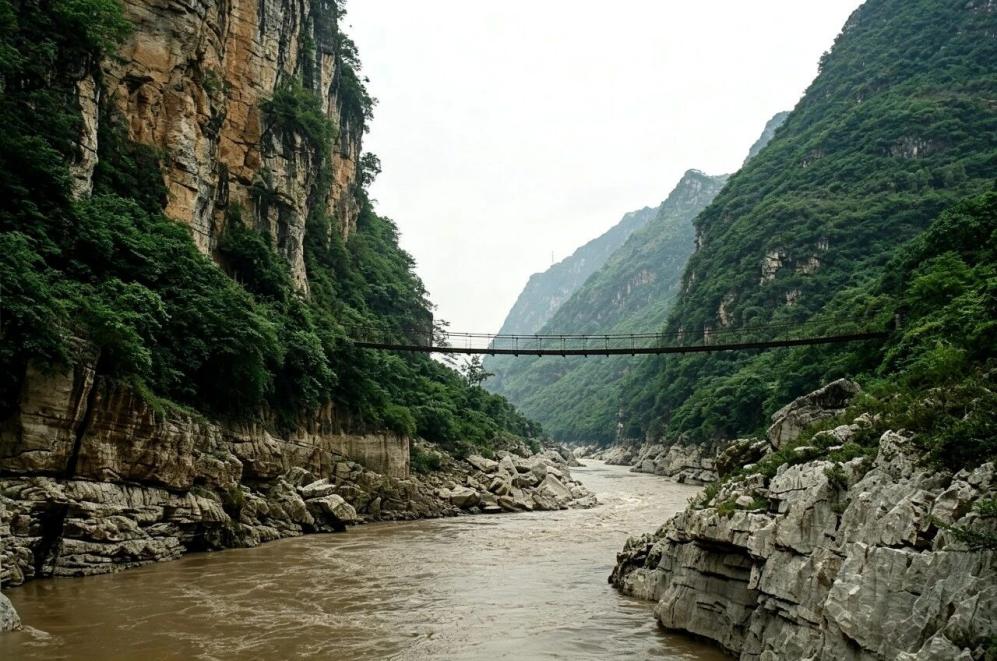
Photo shows the Huajiang Chain Bridge. (Photo from the official account of the media center of Zhenfeng county, Guizhou province on WeChat)
The Fujian-Ningxia collaboration is a case in point. New forms of cooperation, such as "Fujian enterprises + Ningxia resources" and "Fujian headquarters + Ningxia production bases," are deepening and expanding. Freight trains under Ningxia's multimodal transport "single-document system," a system featuring one unified transport document covering the entire journey across different transport modes, carry full loads of goods bound for Fujian, Guangdong and beyond.
Mountains and seas no longer stand as barriers. What began as one-way assistance has evolved into two-way mutual collaboration. Cross-regional reconfiguration of production factors has made regional cooperation more resilient and substantive.
From the transformation of former revolutionary base areas to coordinated progress across regions, and from these changes to the steady and high-quality growth of China's economy, China is continuing along its Long March in the new era, moving forward with courage and opening up new horizons.