


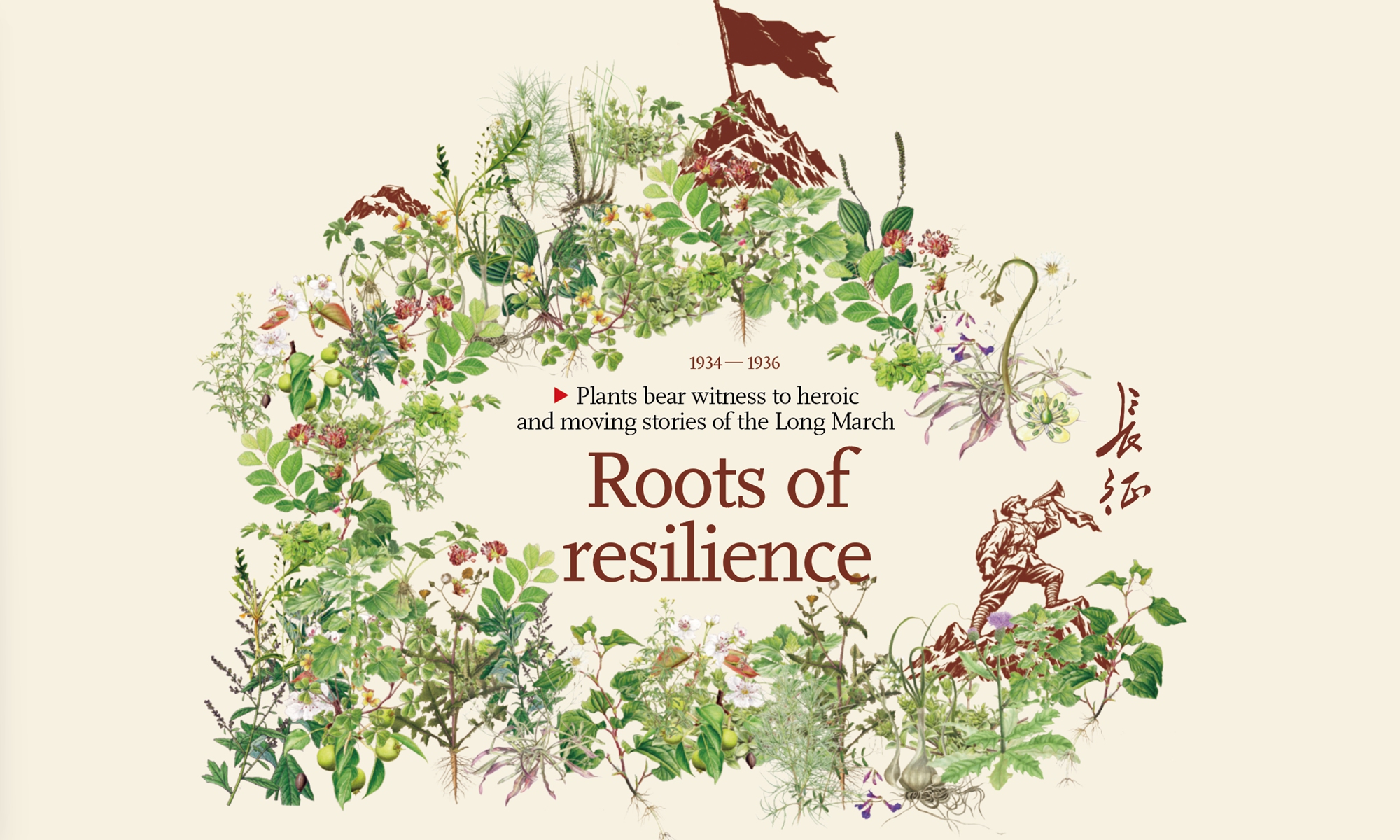
Plants bear witness to heroic and moving stories of the Long March
Editor's Note:
More than 90 years ago, Red Army troops assembled and set out on an expedition that would take them across countless rivers and mountains.
During the long and arduous journey, Red Army soldiers fought more than 600 battles and engagements against enemy forces, crossed nearly 100 rivers and climbed more than 40 towering mountains and treacherous peaks, including over 20 snow-capped mountains rising above 4,000 meters. They traversed vast grasslands known as "death traps," pushing the limits of human survival through sheer determination.
The Long March has long transcended its origins as a strategic military relocation to become an enduring monument in the history of human civilization.
Today, as we look back on this extraordinarily arduous expedition, we can still feel the warmth of history in the smallest details and hear its echoes in the present. A blade of grass, a tree, a handful of roasted flour… Though silent, they bore witness to this extraordinary human feat of breathtaking magnitude, as well as to the profound transformations that have swept across China over the past 90-plus years.
To mark the 90th anniversary of the victory of the Chinese Workers' and Peasants' Red Army's Long March, the "Witness" series has been launched, inviting readers to reflect on the inspiring strength and spirit that defined this great expedition.
'Long March grass' from Songpan grasslands
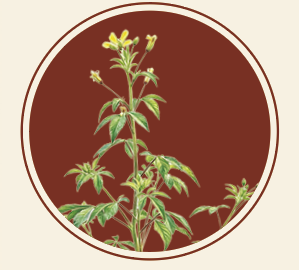
Yellow-flowered herb
July 1, 1936. The Songpan grasslands.
Red Army soldier Liu Yi fixed his gaze on a scattering of bright yellow blossoms along the banks of the Gequ River. He knew they were a type of yellow-flowered herb that, although poisonous, would not be fatal if eaten.
Several days earlier, advance troops had reported that the lamb's quarters, plantain and wild onions ahead had all been picked clean. The last handful of highland barley in their grain bags had to be rationed grain by grain. Liu and his fellow soldiers began gathering the yellow-flowered herb, which would serve as their staple food for some time to come.
Liu carefully picked two intact specimens of the plant and placed them in a small box.
Between the scarcity of plants safe to eat and the abundance of highly poisonous vegetation, the yellow-flowered herb occupied a delicate middle ground: Its toxic effects developed slowly, the symptoms were observable, and it was not directly fatal. It became the optimal point in an equation of survival - a precarious balance between the risk of death and the need for energy, just sufficient to keep life going.
After emerging from the grasslands, Liu continued his military career, moving from one battlefield to another. In 1975, he made an important decision: He would donate the two specimens he had preserved for nearly 40 years to the Museum of the Chinese Revolution, now part of the National Museum of China.
Before making the donation, he wrote an explanation of the yellow-flowered herb on a sheet of paper. One passage read:
"Among the comrades who gathered wild vegetables with me, some gloriously gave their lives for the Party and the people, dying of starvation, freezing to death or falling in battle in the grasslands and snow-covered mountains… These two wild plants accompanied me through 40 years of marching, fighting and revolution, inspiring me to endure hardship and struggle, and to fight across the country. They reminded me never to forget the Long March in times of difficulty…"
The vitality and hope of spring
Shepherd's purse
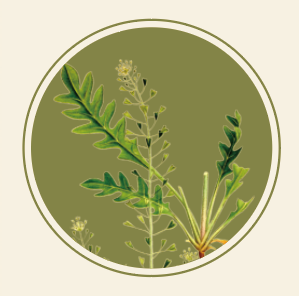
Many years later, the soldiers who had crossed the grasslands and climbed over snow-capped mountains could still recall the taste of shepherd's purse from that early spring - slightly bitter at first, followed by a lingering sweetness, a momentary tightness in the throat as they swallowed, and then an endless sense of gentle warmth.
In early spring 1935, the mountains along the border between Hunan and Guizhou provinces had yet to fully awaken from their winter slumber. The cold rain fell like needles. On a damp, overcast afternoon, a scout crossed a low mountain hollow. Patches of lingering snow still covered the shaded entrance to the hollow, while the sun-facing slope was already covered with a soft carpet of green. He crouched down and brushed aside the withered grass from the previous year - beneath it lay a whole patch of shepherd's purse, its serrated leaves pressed close to the ground like countless tiny seals stamped neatly across the earth.
The wind swept in from the other side of the hollow, carrying a fresh, faintly sweet fragrance - the scent of shepherd's purse, the scent of early spring, and, more than anything, the scent of being alive. When soldiers later recalled those days, they often said that along the Long March, the sight of shepherd's purse in bloom meant the coldest days were finally over.
The entire shepherd's purse plant can be used in traditional Chinese medicine, with properties believed to cool the blood, stop bleeding, clear heat and dispel dampness. A young medic remembered one incident: A soldier developed a persistent nosebleed during a march, but the medical unit had run out of medicine. An army officer, who had previously practiced traditional Chinese medicine, instructed someone to gather fresh shepherd's purse, crush it and extract its juice for the soldier to drink. Remarkably, the bleeding gradually stopped.
During spring marches, shepherd's purse was one of the Red Army soldiers' favorite wild vegetables. Its pleasant taste and the fact that it required little preparation made it a welcome addition to their otherwise monotonous diet of wild greens. Its appearance heralded the arrival of spring, bringing a glimmer of vitality and hope to their arduous journey.
The healing properties of the five-element herb
Purslane

Purslane has a rather elegant Chinese name, "five-element herb," but Red Army soldiers called it "longevity vegetable" or "lifesaving herb."
When the Long March stretched into summer, water became even more precious than food. Soldiers' throats were parched and their lips cracked. At such moments, spotting purslane was like finding water. They would pluck a handful, stuff it into their mouths and chew, releasing a refreshing burst of juice. The liquid tasted slightly sour and astringent, but as they swallowed, the burning sensation in their throats would suddenly subside.
More important than quenching thirst was purslane's ability to treat illness. Sanitary conditions along the Long March were poor, and dysentery quietly spread through the ranks. Yet in some units, the disease failed to take hold. After observing them for a long time, medics discovered something these units had in common: Purslane grew around their campsites, and soldiers would dig it up and eat it whenever they were hungry or thirsty.
Purslane juice can clear heat and remove toxins, and has an inhibitory effect on dysentery-causing bacteria. This scientific explanation was understood only later. At the time, the soldiers knew just one thing: After eating purslane, their dysentery symptoms gradually eased.
Years later, when someone asked veteran Red Army soldiers which wild vegetable they remembered most vividly from the Long March, some answered purslane. It looked unremarkable, but at critical moments, it could truly save lives.
A readily available remedy for swelling
Plantain
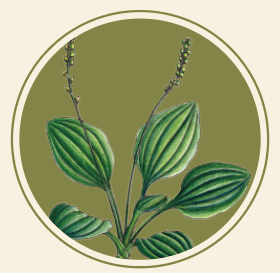
During long marches, soldiers' feet were especially vulnerable to injuries, redness and swelling. Plantain provided a readily available remedy for swelling. Soldiers would chew its leaves and apply them to wounds, or boil the plant in water to soak their feet, effectively relieving fatigue and swelling.
While crossing Jiajin Mountain, many soldiers discovered plantain growing in sheltered rock crevices. Its leaves had turned purplish red from the cold, yet the plants still clung tightly to the rock faces. Medics found that crushing these frostbitten leaves and applying them to chilblains worked better than using leaves gathered on lower ground. Perhaps the cold had concentrated their medicinal properties, some suggested. Botanists offered another explanation: This reflected the plant's resistance to environmental stress - its cell sap contained large amounts of soluble sugars and proline, which acted as natural antifreeze.
While crossing the grasslands, plantain seeds somehow found their way into the folds of many soldiers' clothing and the seams of their backpacks. These tiny black seeds, coated in a sticky mucilage, clung firmly to the coarse fabric. When the soldiers reached northern Shaanxi and took apart their uniforms for washing, they were delighted to discover seeds hidden in the folds of their clothing. Some had even sprouted. They carefully shook these tiny lives, which had traveled across countless rivers and mountains with them, onto the slopes outside their cave dwellings in northern Shaanxi. The following spring, lush clusters of plantain emerged across many hillsides.
A 'pungent' gift from snow-covered mountains
Wild garlic
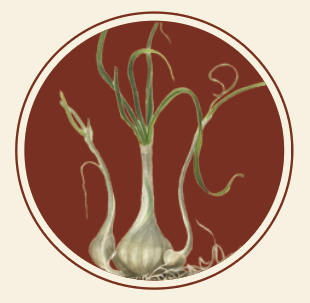
During the Long March, when salt and cooking oil were scarce, wild garlic was a precious seasoning. Soldiers added it to wild vegetable soup, not only to enhance the flavor but also to stimulate their appetites, induce sweating and ward off the cold.
In June 1935, the Central Red Army was preparing to cross Jiajin Mountain. An advance unit discovered large patches of wild garlic growing on slopes below the snow line. Although the bulbs had become somewhat shriveled, their pungent aroma remained strong. The medics immediately recognized their value: The pungency could stimulate blood circulation, while sweating could help the body withstand the bitter cold at high altitudes.
The soldiers remembered one particular detail: Before dawn on the day they crossed the snow-covered mountain, the cooking squad handed out two wild garlic bulbs to each person. The moment the soldiers put them into their mouths, a burst of pungent heat seemed to explode on their tongues and rush straight into their noses, bringing tears to their eyes. Soon afterward, however, they began to sweat slightly, and their previously frozen fingers started to regain sensation.
In fact, wild garlic was valued not only for keeping soldiers warm but also for treating injuries. Crushed into a paste, wrapped in cloth and applied to the joints of soldiers suffering from frostbite, it gradually produced a warming sensation that seemed to penetrate the affected areas. One veteran recalled that after leaving the poultice on overnight, the swelling would subside somewhat by the following day.
A familiar and easily recognizable 'comrade'
Dandelion

Dandelions were familiar "comrades" to Red Army soldiers. They grew almost everywhere, were easy to identify and were non-toxic. They could effectively help prevent edema and served as an important source of vitamins for the troops.
Dandelions grew among the gravel along roadsides, on gentle slopes at the foot of Jiajin Mountain, and in the wetlands along the edges of the Songpan grasslands. They were easy to recognize - their oblanceolate leaves spread out close to the ground, with irregularly toothed edges. Snap a leaf stalk, and milky-white sap would immediately ooze out.
During the Long March, that sap became a natural anti-inflammatory remedy. Mosquitoes and other biting insects swarmed across the grasslands, leaving soldiers covered in itchy welts. Scratching sometimes broke the skin, causing infections and festering sores. Medics would crush dandelion leaves, squeeze out their juice and apply it to the sores, or apply the milky sap from broken stalks directly onto swollen and inflamed areas.
Diaries and oral accounts of Red Army soldiers repeatedly mentioned this "silent comrade." They recalled that dandelions grew everywhere, were easy to recognize and were non-toxic. Digging up their roots and boiling them provided something to eat and helped stave off hunger. Although they tasted somewhat bitter, the soldiers found that the swelling in their legs and feet seemed to ease after consuming them.
A 'canteen of sweet water' along the march
Cogongrass

From the hills of southern Jiangxi and western Fujian, to the mountains of Hunan, Guangxi, Guizhou and Yunnan, the highlands of northwestern Sichuan, and the loess-covered lands of Shaanxi and Gansu - cogongrass grew in many places along the routes taken by the Red Army.
It was one of the sweet memories of the Long March. When food ran out, soldiers pulled up cogongrass and chewed its white root stems. Although the fibers are coarse, the juice is sweet and refreshing, capable of satisfying hunger and quenching thirst. It truly gives new meaning to "grassroots" food.
Between January and March 1935, the Central Red Army repeatedly maneuvered back and forth across the Chishui River. Red Army soldiers later recalled that their water bottles had long since run dry, leaving their lips cracked and parched. Cogongrass grew thickly along the riverbanks, so they dug up its roots and chewed them. The juice was pleasantly sweet, and a single mouthful immediately soothed their dry throats.
Similarly, in the Wumeng Mountains, according to the military history of the Second Front Army of the Red Army, troops undertook forced marches for more than 10 consecutive days during a series of maneuvering operations, alternately running out of water and food. Cogongrass became their portable "canteen of sweet water."
Beyond satisfying hunger and thirst, cogongrass was also valued for its ability to clear internal heat and cool the blood. The Long March was a long journey, and soldiers were frequently exposed to the scorching sun and sweated heavily, making them prone to symptoms associated with excessive internal heat. Scant, dark-red urine and bleeding from the mouth and nose were common among troops with little access to medicine or medical care. In traditional Chinese medicine, cogongrass rhizomes are considered sweet in flavor and cold in nature, and are used to clear heat, promote urination and cool the blood.
(Source: Global Times)