


Chinese FM shares four takeaways from Eurasian trip at joint press briefing with Bulgarian counterpart
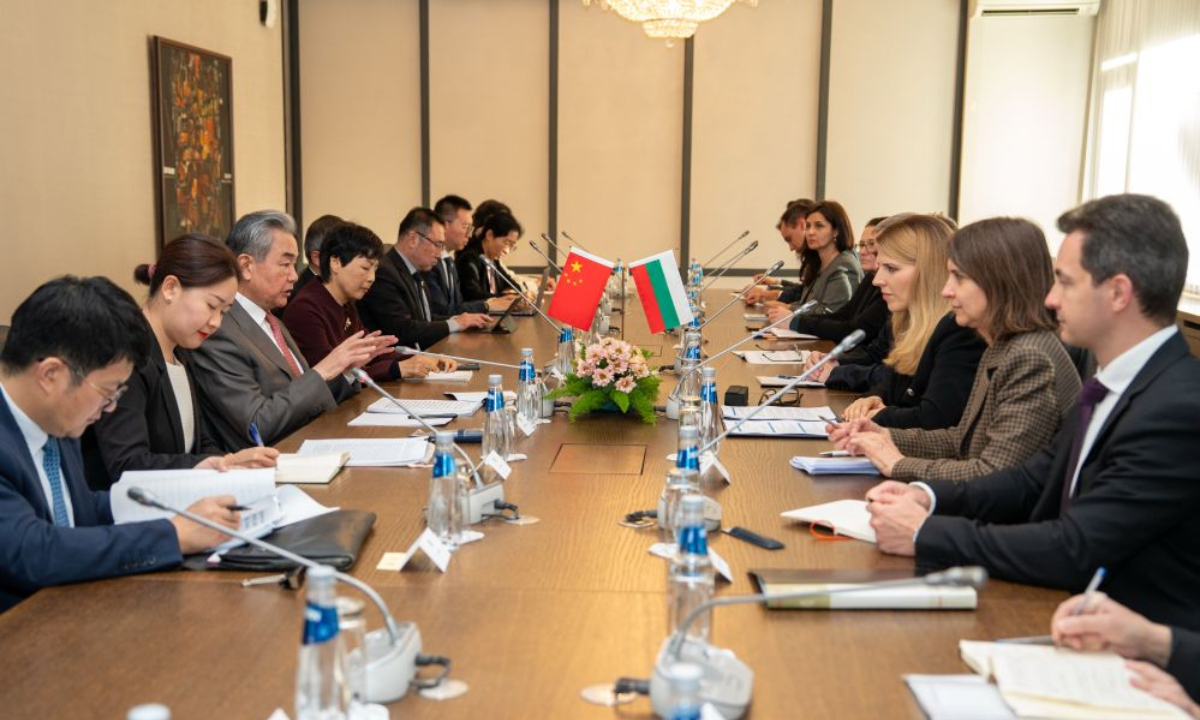
Chinese Foreign Minister Wang Yi, also a member of the Political Bureau of the Communist Party of China Central Committee, holds talks with Bulgarian Foreign Minister Velislava Petrova, in Sofia, Bulgaria, on October 19, 2026. (Photo: Xinhua)
Chinese Foreign Minister Wang Yi, also a member of the Political Bureau of the Communist Party of China Central Committee, met with reporters alongside with Bulgarian Foreign Minister Velislava Petrova in Sofia, Bulgaria, on Monday, sharing four key takeaways from his Eurasian trip.
During the trip, Wang attended the Seventh Summit of the Conference on Interaction and Confidence Building Measures in Asia held in Baku, Azerbaijan, and visited Azerbaijan, Croatia, Montenegro and Bulgaria.
In Bulgaria, Wang met with Bulgarian leaders including President Iliana Iotova. During the meetings, the two sides held comprehensive and in-depth discussions and reached a broad consensus. Both sides agreed that new prospects are emerging for Bulgaria’s development, and that the strategic cooperation between China and Bulgaria is also facing new opportunities, Wang said.
China is ready to work with Bulgaria to seize these opportunities and build on the momentum, jointly serving as strategic partners in development and revitalization, Eurasian connectivity, and upholding multilateralism. The two sides also aim to promote the positive development of China-EU relations through a more proactive, pragmatic and dynamic China-Bulgaria relationship.
Sharing takeaways from his Eurasian trip, Wang stressed the importance of trust, friendship, cooperation and partnership.
Wang said that China's foreign policy is to “build partnerships rather than alliances, and engage in dialogue rather than confrontation,” and China advocates building a new type of international relations and advancing the democratization of international relations.
The three Balkan countries he visited are all good friends and partners of China, and they all hope to see healthy and stable development of China-EU relations and look forward to strengthening cooperation between China and Central and Eastern European countries, Wang said.
Wang said China is ready to serve as a reliable, long-term strategic partner for the Balkan countries, saying bilateral ties, regional cooperation and China-EU relations are mutually reinforcing, with partnership at their core.
According to Wang, recent positive progress in China-EU trade and investment consultations shows that China and the EU can fully resolve their differences appropriately through dialogue and consultation. China firmly believes that “openness leads to progress, while isolation inevitably results in backwardness,” and China is willing to work with the EU to uphold multilateralism, champion free trade and achieve mutually beneficial cooperation at a new and higher level, Wang said.
Wang also said trust is essential to peace in a turbulent world. From the Ukraine crisis to conflicts in the Middle East, resolving conflicts requires trust, and building trust requires communication. As a responsible major country, China has consistently worked to promote peace, the Chinese foreign minister said.
Wang said that cooperation is a strong driving force. China is ready to deepen cooperation with the four countries he visited in trade, investment and infrastructure, align the Belt and Road Initiative with the Middle Corridor, and expand collaboration in AI and green transformation to drive economic development and revitalization.
Wang also said China's longstanding friendships with these countries carry forward the spirit of the ancient Silk Road and exemplify civilizational exchange across Eurasia, calling for these ties to be strengthened with renewed relevance in the modern era.