


China's semiconductor companies report strong earnings in first 9 months as AI explosion drives growth
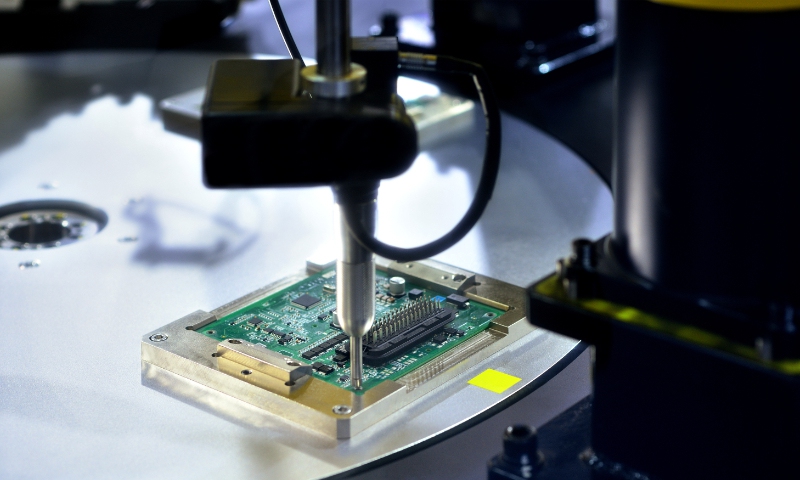
(Production of semiconductor chip. File photo: VCG)
Chinese semiconductor companies reported strong earnings in the first nine months of 2026, as demand for artificial intelligence (AI) computing, rising memory-chip prices and market-driven progress in home substitution boost their business prospects.
Hygon Information Technology, a Chinese chip designer, disclosed on Tuesday that its revenue reached 14.95 billion yuan ($2.24 billion) in the first nine months, up 57.58 percent year-on-year, while net profit attributable to shareholders rose 45.12 percent to 2.847 billion yuan. The company attributed the growth to rapid AI development and a shift in domestic substitution from policy-driven progress toward market-driven demand.
China's leading dynamic random-access memory (DRAM) chipmaker CXMT showed a forecast revenue of 265 billion to 270 billion yuan in the first nine months of 2026, up 725.96 to 741.54 percent year-on-year. Net profit attributable to shareholders was projected at 131 billion to 132.5 billion yuan, compared with a loss of 5.28 billion yuan in the same period last year, according to the company's earnings forecast disclosure filed with the Shanghai Stock Exchange on October 17.
CXMT attributed the improvement to surging demand for AI computing, tighter global DRAM supply and sharply rising prices since the second half of 2025. The company also cited higher capacity utilization, improved production efficiency, continued research and development, and business expansion as factors supporting growth.
Meanwhile, Allwinner Technology, another Chinese chip designer, forecast its first-three-quarter net profit of 640 million to reach 670 million yuan, up 129.85 to 140.62 percent year-on-year, according to its earnings forecast filed with the Shenzhen Stock Exchange on October 12.
Tian Feng, president of the Fast Think Institute and former dean of the Intelligence Industry Research Institute at SenseTime, told the Global Times that rising memory chip prices, strong AI demand and faster progress in domestic substitution are the main drivers of the earnings growth. Tian noted that memory chip prices have played a particularly important role in the latest earnings surge.
WSTS's August data showed that global semiconductor sales doubled year-on-year in the first half of 2026, with memory-chip sales jumping 305 percent, far outpacing the 45-percent growth in logic chips.
The AI boom has also prompted manufacturers to prioritize chip production for data centers, tightening supplies in other segments and pushing up prices across the supply chain. As a result, the benefits have extended beyond AI chip designers to memory producers and other manufacturers, Tian said.
Meanwhile, China's semiconductor industry is seeing a shift from policy-driven domestic substitution toward stronger market demand. Chinese chip designers are securing more orders, while domestic equipment makers are expanding their market share.
The earning gains come as AI-related demand and shifts in global chip supply and pricing reshape the semiconductor industry.
The corporate results also came amid a broader expansion in China's semiconductor trade. Customs data showed that China's integrated circuit exports rose 99.1 percent year-on-year in the first three quarters of 2026. The increase outpaced the 16.4-percent growth in China's overall goods exports during the same period.
The global semiconductor market is also benefiting from the AI boom. The World Semiconductor Trade Statistics (WSTS) organization expects global chip sales to rise 90 percent to $1.51 trillion in 2026, with memory chips accounting for much of the growth. The market is forecast to expand by 27 percent in 2027, according to WSTS.
Tian said the semiconductor industry is likely to maintain strong growth into 2027, supported by continued AI investment and rising demand for computing power. lobal memory-chip supplies are expected to remain tight through much of 2027, which could help sustain prices and corporate earnings, he said.
However, that price increases could slow as new production capacity comes online and higher chip costs weigh on consumer demand. He said future growth would depend more on rising chip sales and sustained AI investment than on higher prices alone.