


China mulls policies to accelerate smart manufacturing
BEIJING, Oct. 20 (Xinhua) -- China is drafting policies for next-generation smart manufacturing to deepen the integration of artificial intelligence (AI) and manufacturing, the Ministry of Industry and Information Technology (MIIT) said Tuesday.
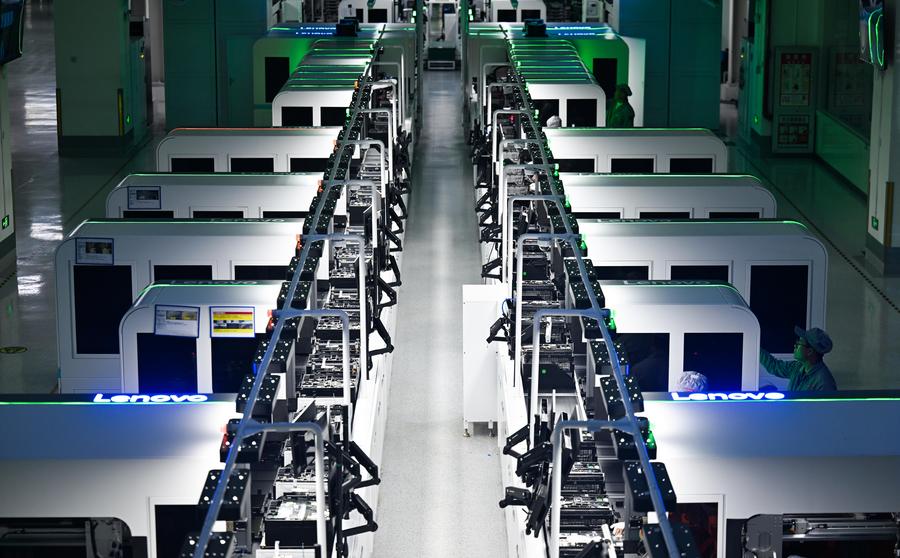
This photo taken on July 4, 2025 shows the laptop production line of the carbon-neutral smart manufacturing factory of Lenovo in north China's Tianjin. (File photo: Xinhua)
Wang Weiming, MIIT chief engineer, told a press conference that the measures aim to integrate AI across the entire manufacturing chain and develop new manufacturing models that help firms cut costs, raise efficiency and better meet diverse market demands.
To that end, a tiered approach will be taken to build smart factories and upgrade equipment, with basic and advanced factories expanding digital systems and AI use while top-tier plants explore next-generation architectures and future manufacturing models.
Support will also target smarter machine tools, robots, inspection and control equipment, as well as industry-specific models and industrial AI agents, Wang said.
Beyond domestic efforts, China will expand international cooperation in smart manufacturing, leveraging mechanisms such as BRICS to share standards and experience, and help partners build smart factories, he added.
These measures reinforce and expand upon prior accomplishments. China has already built over 13,000 advanced-level smart factories, and more than 1,000 application scenarios have been formed across 20 industries including steel, automobiles and pharmaceuticals, Wang noted.
Underpinning this push is a solid infrastructure base. By the end of September, China's smart computing power reached 2,592 EFLOPS, up 146 percent year on year. EFLOPS refers to a unit measuring computing performance, with each unit representing 1 quintillion floating-point operations per second.
Latest data from the National Bureau of Statistics (NBS) showed that China's gross domestic product (GDP) grew 4.6 percent year on year in the first three quarters to more than 107 trillion yuan (about 15.9 trillion U.S. dollars), with the manufacturing sector accounting for 25.7 percent of GDP.
New growth drivers have become a key engine of industrial growth. In the first three quarters, high-tech and digital manufacturing made up over 20 percent of industrial value-added output but generated more than half of industrial growth, NBS data showed.