


Global investors' stance improves on Chinese assets, eying AI and retirement sectors: former US regulator
The global investment community has shifted to a neutral stance regarding Chinese assets, after many years of analysts recommending reduced exposure to the country, Sheila Bair, a member of the International Advisory Committee of China's National Financial Regulatory Administration and former chairperson of the US Federal Deposit Insurance Corp, told the Global Times during the Annual Conference of Financial Street Forum (FSF) 2026, which kicked off in Beijing on Monday.
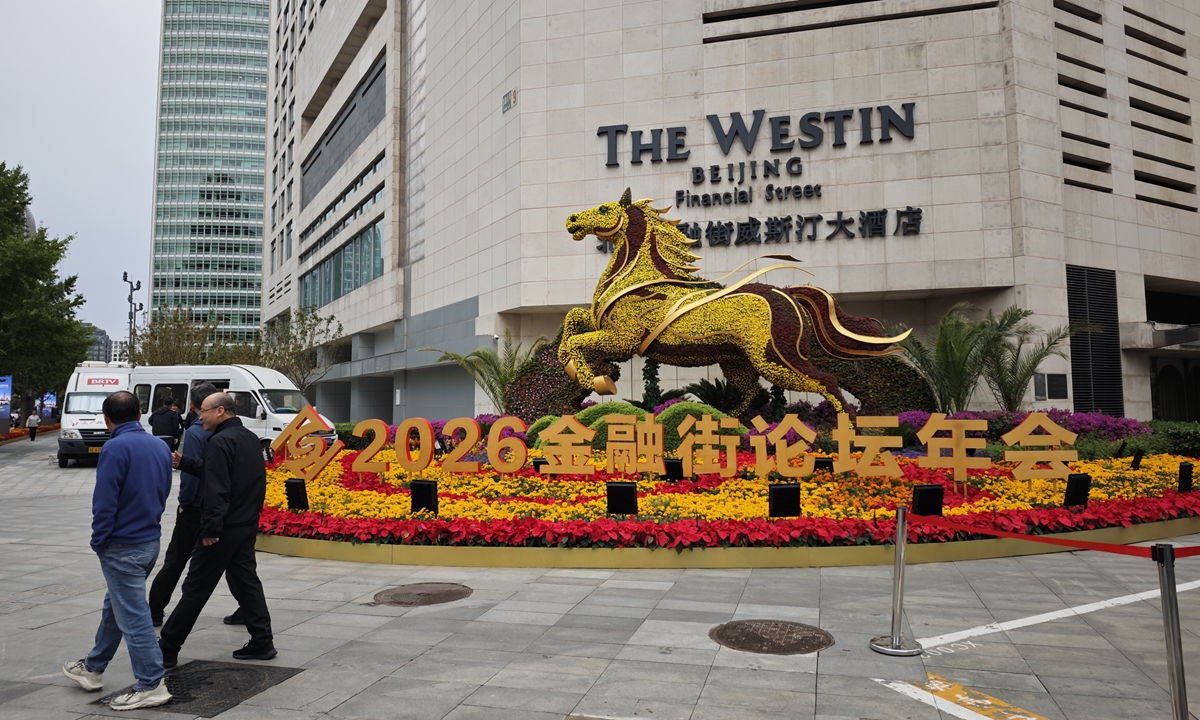
Photo: Yin Yeping/Global Times
"Institutional investors are now more willing to look at China for investment opportunities, although they are very selective, with technology investments - particularly artificial intelligence (AI) and related industries - receiving close attention," Bair said.
Her comments come as China accelerates efforts this year to build a modern industrial system and develop new growth drivers. Despite a challenging environment, the economy has continued to advance toward higher-quality, innovation-led development. The country's GDP expanded 4.6 percent year-on-year in the first three quarters, according to data released by the National Bureau of Statistics on Monday.
China's economy is stable though growth is uneven. "Exports and manufacturing remain strong, while consumer spending and the real estate market stay weak. Strains exist in parts of the financial system, especially in property development and local government debt, but observers believe China can address these issues over time. Smaller banks are under stress, yet the problems can be handled in an orderly manner. I do not see evidence of instability or risk of crisis," Bair said.
At the recent meeting between the two heads of state, China and the US reached important consensus on building a constructive and stable strategic relationship, further enriching the vision of this new positioning of bilateral ties and injecting greater certainty into global economic development and financial stability, Wu Qing, chairperson of the China Securities Regulatory Commission, said at the opening ceremony of the FSF on Monday.
As China's macro policies gain traction and innovation gathers momentum, the foundations for higher-quality development and sustained economic growth remain strong, he said.
"I deeply wish that China and the US could come to concrete agreements about the pace of AI innovation and the need to be able to understand, monitor, and control its risks," Bair said.
Under the theme of "Building an Open Collaborative and Inclusive Ecosystem for Global Financial Development," the Annual Conference of FSF 2026 is taking place in Beijing from Monday to Thursday. This year's event has attracted more than 400 prominent guests from more than 40 countries and regions. It features discussions on economic governance, financial innovation, AI, capital market development, cross-border financial cooperation and global financial governance, according to the official agenda.
"China's development of new quality productive forces, the market access dividends unleashed by the broader opening-up of the services sector, and the alignment of rules in the digital and green economies will provide new opportunities for international investors," Tian Lihui, dean of the Institute of Financial Development at Nankai University, told the Global Times during the FSF, noting that the concentrated investment of foreign capital in China's hard-tech and high-end manufacturing is clear evidence.
"At a time when global institutional predictability is scarce, what China's capital market offers is not the highest elasticity, but identifiable, accessible, and manageable structural opportunities," Tian said.