


Sichuan steps up protection of giant panda habitats through synergy of heritage site, national park
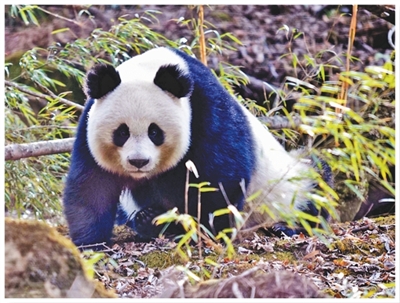
A giant panda is seen in the Tangjiahe area of the Giant Panda National Park in southwest China's Sichuan Province. (Photo/Ma Wenhu)
In the mountains of southwest China's Sichuan Province, giant pandas live alongside rare species such as the golden snub-nosed monkey and the dove tree. During this year's National Day holiday, crowds flocked to the Chengdu Research Base of Giant Panda Breeding in the provincial capital to see the pandas up close.
Sichuan ranks first in China in both giant panda numbers and habitat area. In 2006, the Sichuan Giant Panda Sanctuaries were inscribed on the World Natural Heritage List, making the province home to the world's largest and best-preserved giant panda habitat. In 2021, the Giant Panda National Park was established, with its Sichuan section covering most of the heritage site.
With both designations in place, Sichuan has safeguarded panda populations, expanded habitat restoration and brought local communities into the work. The species' conservation status has improved from "endangered" to "vulnerable."
At the Wolong Shenshuping base of the China Conservation and Research Center for the Giant Panda in Wenchuan county, Li Desheng, the center's deputy director and chief expert, watched the pandas with delight.
Shrinking habitats once pushed pandas to the brink of extinction, and captive breeding proved a stubborn challenge. After decades of work, China's captive panda population grew from fewer than 100 to more than 800 by the end of 2025.
"As the captive population grows steadily, we must take on new responsibilities," Li said, noting that releasing captive pandas into the wild is key to improving the genetic diversity of wild pandas and protecting small wild groups.
His team developed a "mother-led" training method: experienced mothers give birth in a rewilding enclosure, and their cubs learn survival skills from them early on. After several rounds of assessment, those that pass are released. Sichuan has so far sent nine captive-bred pandas into the wild, the first to survive there and help revive small, endangered wild populations.
As the national park has taken shape, Li and his colleagues have seen encouraging changes during field trips, including closed mines, decommissioned small hydropower stations and connected ecological corridors. "Wider habitats and stronger policy support have helped panda protection," Li said.
In Baoxing county, Ya'an city, southwest China's Sichuan Province, ranger Liu Hanqiang and his colleagues gathered at a ranger station at dawn before setting out on a daily patrol of nearly 10 kilometers. Baoxing is where the giant panda was first scientifically described. More than 81 percent of the county lies within the national park, and 181 wild pandas live there.
"It was once rare to encounter a panda," said Liu, who is in his 50s. Local residents once relied on the mountains for their livelihoods, and forests became depleted. Now, protecting forests is a "hard rule."
"The government has made great efforts to crack down on poaching and illegal logging, restore forests and protect panda habitats," Liu added.
The park's Sichuan section has restored 340,000 mu (about 22,667 hectares) of panda habitat and built corridors across another 21,300 mu. It has also divided habitat into 106 protection units and set up a grid system for monitoring wild pandas, using satellite, aerial and ground surveys. In key monitored areas, the annual panda count has risen from 178 to 185.
Protection extends beyond panda habitat to alpine wetlands, glacial remnants and other ecological features across Sichuan. More than 8,000 rare species are protected alongside the giant panda, among them snow leopards, golden snub-nosed monkeys and the dove tree.
Local people are also part of the work. In Guanba village, Pingwu county, Mianyang city, southwest China's Sichuan Province, 96.8 percent of the land lies within the national park. Complex forest ownership and unclear boundaries once made it hard for villagers to take part in conservation. The village has since set up a nature conservation center, with teams for patrolling and monitoring, and a separate effort to develop local industries. About 30 percent of households are involved.
Green industries have also improved local livelihoods. The village's bee-farming cooperative was authorized in 2022 to use the national park's brand on its products. "Honey used to fetch a poor price, but now the purchase price has doubled," said Gao Mingbin, a villager.
Sichuan has now established a multi-tiered framework for community co-management and co-development around the giant panda sanctuaries.
Infrared cameras have recorded at least six wild pandas living year-round in the village's 12.6-square-kilometer protected area. "The panda is our national treasure. We must protect them," Gao said.