


Q&A: How the Long March shapes the CPC and China's modernization today
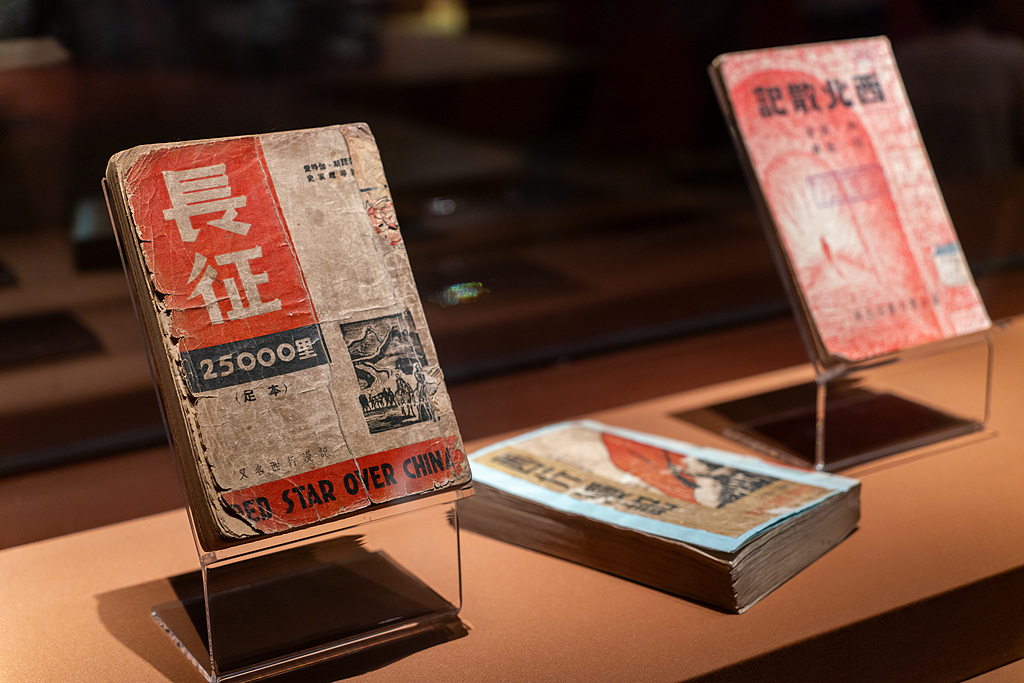
An exhibition commemorating the 90th anniversary of the victory of the Red Army's Long March held in the Guangdong Museum, south China's Guangzhou City, Guangdong Province, October 17, 2026. (Photo: VCG)
This year marks the 90th anniversary of the victory of the Red Army's Long March. From October 1934 to October 1936, the Red Army, the forerunner of today's People's Liberation Army (PLA), carried out the historic Long March – a massive strategic retreat and military maneuver undertaken amid intense fighting during the Chinese civil war.
How did the Long March shape the Communist Party of China (CPC) and the country's revolutionary history? And how can its experience and spirit help understand China's pursuit of modernization today?
To explore the historical significance of this epic journey and its enduring influence, CGTN spoke with Josef Gregory Mahoney, a professor of politics and international relations and director of the Center for Ecological Civilization at East China Normal University in Shanghai.
CGTN: How did the Long March shape the CPC, and what aspects of that experience continue to influence the Party today?
Josef Gregory Mahoney: The Long March did not only save the Party; it changed how the Party thinks. In October 1934, the Central Red Army left Jiangxi following a template, a strategy directed from outside and fought by the book. The battles at the Xiang River and the subsequent retreat took a devastating toll, reducing the Central Red Army's ranks from some 86,000 to about 30,000. At Zunyi, in January 1935, the Party let hard experience correct doctrine. Then came the Four Crossings of the Chishui, where Mao Zedong, judging the enemy by the actual situation rather than by military manuals, changed course, crossed back and evaded an encirclement by some 400,000 troops.
In my own work, I argue that this is where Chinese Marxism finds its character. Marxism brought China a materialist science of history and a way to organize against exploitation. China brought back to Marxism a habit of holding unity together with contradiction, and a practice that does not wait for a template before acting. Mao wrote this into theory in 1937, in On Practice and On Contradiction, but the Party lived it first, on a river in Guizhou.
Three things endure. The first is seeking truth from facts, the same instinct behind the reform-era image of crossing the river by feeling the stones. The second is the capacity for self-correction: the Zunyi Meeting shows a Party willing to change course when reality demands it. The third is the unity of theory and practice, which Chinese thought had long prized, from Wang Yangming's unity of knowing and acting onward, and which the Party has pursued ever since. Having visited sites such as Bazhong in Sichuan, Hadapu in Gansu and Yan'an in Shaanxi, I am struck by how beautiful these places are today. The Red Army's journey ran through landscapes that sustained it, and the people who lived there, and what it won was meant for them too.
CGTN: What does this history tell us about the importance of public support, ethnic unity and the relationship between the CPC and the people, and how does this dimension remain relevant in China today?
Mahoney: The Long March was a march through peoples as much as through terrain, and it could not have been completed without them. At Yudu, Jiangxi, in October 1934, local people gave doors, bed boards and even coffins to build the pontoon bridges that carried more than 86,000 soldiers across the river. Months later, in the mountains of Sichuan, the army reached Yi territory, where mistrust threatened its passage. At Yihai Lake in May 1935, Liu Bocheng and the Yi leader Xiaoyedan swore brotherhood according to Yi custom, using lake water in place of wine. The army sought trust rather than force, and it passed. At Huining in 1936, local people reportedly gave the arriving armies grain, cloth and hundreds of recruits.
The lesson is that the army survived because it was not only an army. It took local conditions, local customs and local needs seriously, and it was repaid in bridges, shoes, grain and trust. Ethnic unity here was not an abstraction but an agreement, made person to person, on terms each side could honor.
That dimension remains relevant because China's largest tasks still cannot be done from above alone. Consider China's efforts to advance ecological civilization. The Three-North Shelterbelt Program has raised forest cover in its region from 5.05% to 13.84%, and that is the work of generations of villagers, local governments and volunteers across China's arid north. Poverty relief, rural revitalization and green development in the western regions likewise depend on people seeing the benefit in their own lives. The Long March teaches that legitimacy is earned continuously, through shared hardship and shared results, and that unity is strongest when diversity is respected rather than set aside.
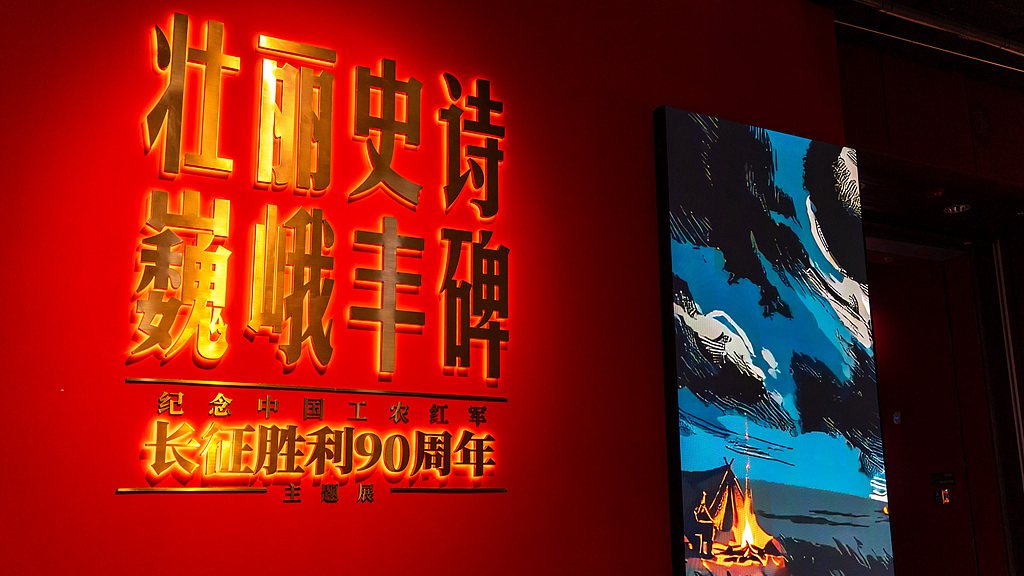
An exhibition commemorating the 90th anniversary of the victory of the Chinese Workers' and Peasants' Red Army's Long March held in the Guangdong Museum, south China's Guangzhou City, Guangdong Province, October 17, 2026. (Photo: VCG)
CGTN: How can the experience and spirit of the Long March help understand China's pursuit of modernization today?
Mahoney: The spirit of the Long March is often summarized as perseverance, but I would stress something more specific: the refusal to accept a ready-made template. At the Chishui, the Red Army did not succeed by following the prescribed route; it succeeded by finding its own. Chinese modernization has the same signature. It has drawn on the world's knowledge, including Marxism, while insisting that the path be worked out from China's own conditions. That is what the Party's language of integrating Marxism with China's concrete realities, and with its fine traditional culture, is reaching for.
It also explains the method. Reform proceeded by experiment, by trying, by correcting and by feeling the stones. Yet the Long March also teaches that a river eventually has to be crossed in deep water, where small adjustments no longer suffice and long-term strategy matters. That is where China stands in many fields now.
Ecological civilization is the clearest example. China has to be honest about the challenge: it remains the world's largest emitter, with coal still part of its energy mix. But it has also built the world's largest renewable capacity, seen desertification shrink across four consecutive monitoring periods, and reshaped places such as Shanghai's Suzhou Creek and Chongming Island from industrial corridors toward ecological ones. A modernization that enlarges the sea eventually drowns its own shore. The Chinese tradition has an image for this, the mythical bird Jingwei, carrying twigs and stones to fill an ocean that took her life. I read her as a warning, not a model: we must stop the sea from rising rather than carry stones forever. The Long March's lesson for modernization is to keep walking while reading the terrain honestly, and to treat the people walking beside you as the point of the whole journey.
CGTN: Ninety years after the Red Army completed the Long March, why does this historical experience continue to hold such significance?
Mahoney: Ninety years ago, in October 1936, the three main forces joined at Huining in Gansu and Jiangtaibao in Ningxia, and the march was complete. Its significance has not faded, because its central questions have not: how does a society facing an overwhelming challenge find a path that is its own, and how does it keep the people it serves beside it?
For international audiences I would offer three lessons. First, the Long March shows that China's trajectory has been one of problem-solving from its own conditions. The Party learned, at great cost, that imported formulas fail, and it has been reluctant ever since to treat any model, foreign or its own, as final. Seeing China as simply following or rejecting a template misses this.
Second, it shows that outcomes rest on relationships. The Red Army crossed some 100 rivers and nearly 40 great mountains with the help of ordinary people. Today's global challenges, climate above all, are the same kind of problem. No nation can cross them alone, and none will be carried across by a formula. I would call the right response a new internationalism: partner by partner, building shared capacity and confidence, particularly with the Global South, whose communities are least responsible for the rising sea and most exposed to it.
Third, it is a lesson in humility and endurance. The Long March began in retreat and nearly ended in annihilation. What carried it through was the willingness to look at facts, change course and keep going. Those habits are worth sharing with a world that needs them. The Long March is not a story for China alone; it is a reminder that the way across a river is found by walking it, together.