


Financial Street Forum in Beijing emphasizes legal safeguards for cross-border finance, Belt and Road cooperation
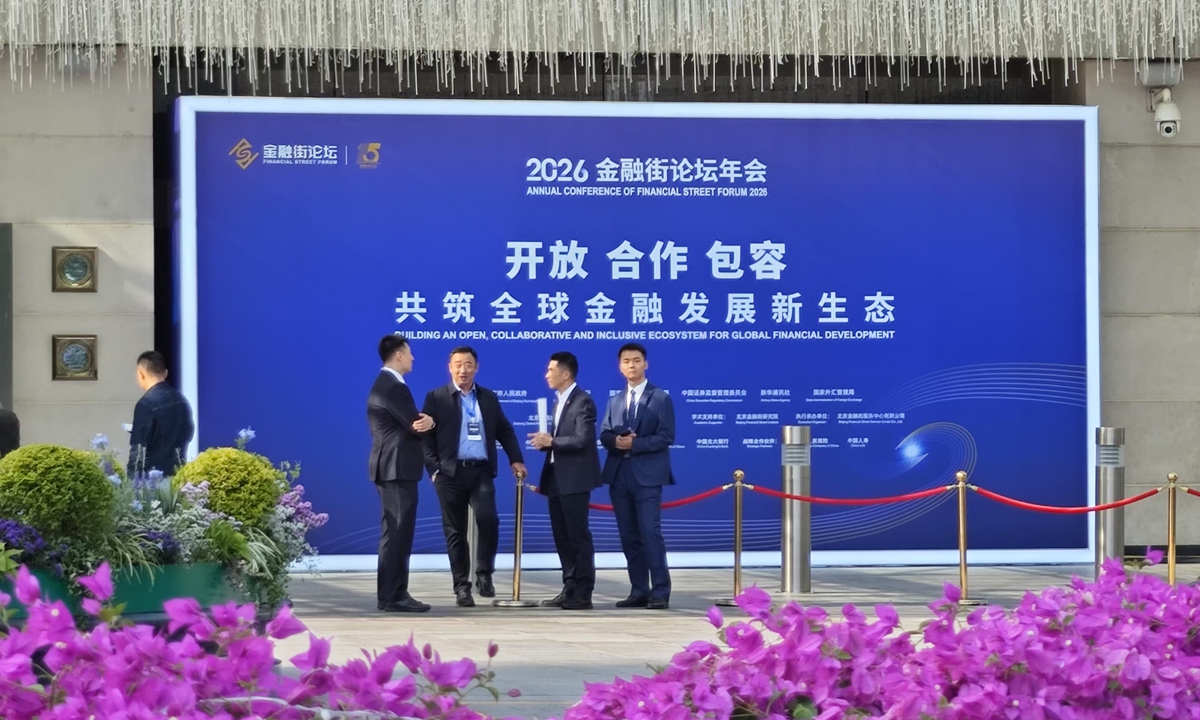
Visitors gather at the Annual Conference of Financial Street Forum 2026 in Beijing Photo: Yin Yeping/GT
China is strengthening its legal framework for cross-border financial activities and international judicial cooperation to support high-level opening-up, officials said at the ongoing Annual Conference of Financial Street Forum 2026 in Beijing. The forum saw the release of a white paper outlining legal safeguards for Belt and Road cooperation.
Organized by the Beijing Financial Court for the sixth consecutive year, the forum brought together more than 120 representatives from the Supreme People's Court, the Ministry of Justice, financial regulatory authorities, judicial and financial institutions to discuss legal coordination in cross-border finance and technology governance.
Strengthening the legal framework for financial opening-up was a key theme of the discussions. Speaking at the forum, Wu Zeng, vice minister of justice, outlined the role of financial rule of law in safeguarding high level opening-up and advancing the development of China into a financial powerhouse. She stressed the importance of upholding the leadership of the Communist Party of China and following the central leadership's decisions and arrangements on financial work.
Wu called for continued improvements to the country's financial legal system, including legislation in major financial fields and better rules governing cross-border investment and financing and outbound investment, to strengthen the legal foundations for institutional opening-up.
The official noted the need to strengthen legal services for foreign related financial activities by developing coordinated online and offline service networks connecting domestic and overseas services.
Looking ahead to the 15th Five Year Plan (2026-30), the Ministry of Justice will respond to the practical needs of economic development and place greater emphasis on coordinating the rule of law with reform, development and stability, Wu said, noting that these efforts will provide solid legal safeguards for accelerating the development of China into a financial powerhouse.
Judicial practice was another focus, particularly the role of financial justice amid changes in global financial governance. Wang Shumei, a senior justice, called for improved mechanisms for resolving disputes through multiple channels, and fair and efficient resolution of cross-border financial disputes, with the legitimate rights and interests of Chinese and foreign parties protected equally.
Wang called for an approach to technological innovation that combines incentives and tolerance for innovation with regulation in accordance with the law, with the judiciary guiding financial instruments to better support technology industries.
She called for deeper exchanges and mutual learning between legal systems, including signing civil and commercial judicial assistance treaties with more countries, improving mechanisms for judicial assistance between countries, and expanding cooperation with international organizations and judicial institutions in countries participating in the Belt and Road Initiative (BRI). These efforts would help build broader consensus on the rule of law and contribute to building a community with a shared future for humanity, she said.
The forum also released two research outcomes aimed at supporting cross-border financial opening-up and technological innovation. One was the White Paper on Financial Rule of Law Services and Safeguards for the BRI.
Focusing on coordinated governance among regulators, judicial authorities and the financial industry, the white paper identifies common risks in cross-border financial transactions, outlines judicial rules and dispute resolution approaches, and presents 10 typical cases. By turning judicial experience into practical guidance for market participants, the document seeks to support China's high-level opening-up and strengthen financial rule of law in Beijing.