


Digital Xiongan: How AI is shaping the smart 'City of the Future'
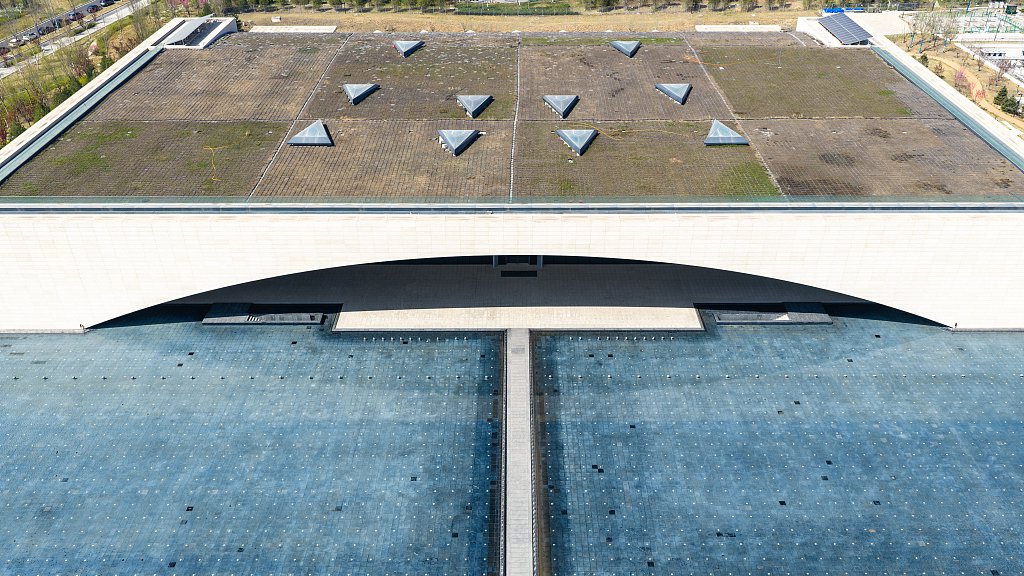
An aerial view of the Xiongan Urban Computing Center, north China's Hebei Province, April 5, 2026. (Photo: VCG)
Buildings have digital twins in the cloud-based platform, underground utility tunnels are monitored in real time, and traffic lights adjust to changing road conditions. In the Xiongan New Area in north China's Hebei Province, these futuristic scenarios have been part of everyday life.
A digital foundation for an intelligent city
Often referred to as a "city of the future," Xiongan is China's first city to develop its digital and physical infrastructure simultaneously across the entire area. Early in the planning phase, the city embraced a concept of building "three cities" together – a city underground, a city above ground and a city in the cloud.
The Xiongan Urban Computing Center serves as the "brain" of the digital city, providing essential support for the development of a digital urban environment. It supplies computing, storage and network services for the entire digital twin city, enabling integrated urban planning, unified construction supervision and coordinated city governance through a shared digital platform.
"If the digital twin city is a tree, the computing center is its roots and soil," said Liu Yao, manager of the information system department at the Xiongan Cloud Network Technology Co., Ltd.
The center currently supports more than 100 categories of urban operational data from over 20 government departments in Xiongan, covering six major dimensions, including geospatial information, Internet of Things (IoT) sensing and government services.
AI for smarter transport and urban management
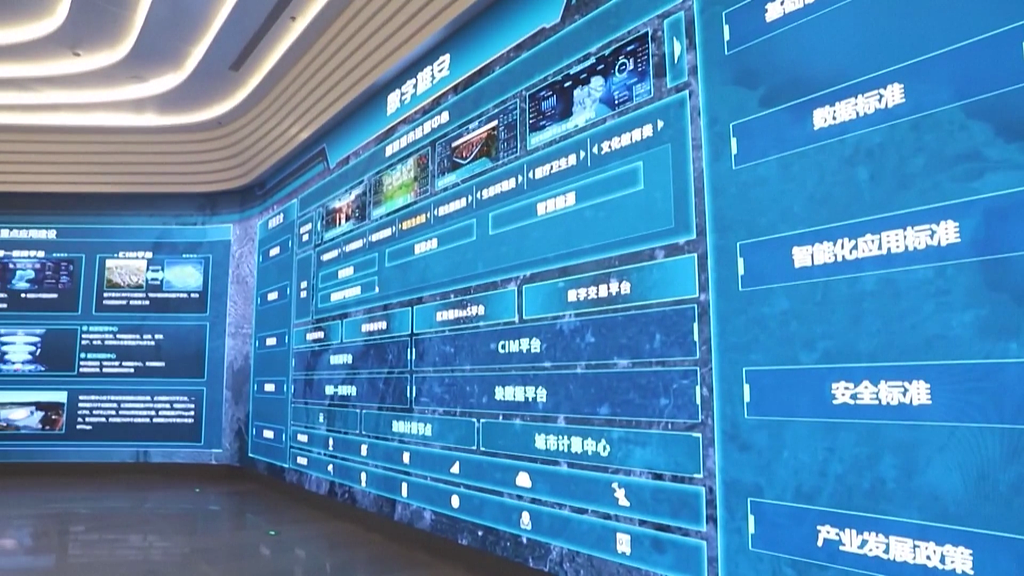
The digital screen in the Xiongan Urban Computing Center. (Photo: VCG)
Powered by the center, a wide range of innovative applications has been deployed across the city, transforming people's everyday life.
On the roads, sensors collect real-time traffic data, allowing AI algorithms to adjust traffic-light timings and improve traffic flow. In Rongdong District, lidar sensors and multifunctional roadside poles capture real-time traffic data and transmit it to the center, where AI algorithms analyze traffic conditions and optimize signal timings, allowing vehicles to run with fewer stops. This system has shortened morning and evening peak-hour travel times on major roads in the district by 15 minutes.
In communities, a smart utility-meter system integrates real-time water, gas and heating consumption data, which also helps to monitor the daily activity patterns of older people living alone. When unusual data triggers an alert, the system automatically assigns a task to community workers, who will visit the resident to check the condition and provide assistance.
For urban management, an AI-powered video system helps detect issues such as illegal parking, overflowing waste bins and potential fire hazards. Once a problem is identified, the system can automatically generate a work order for the relevant personnel, connecting digital detection with practical action. Digital twin models of underground utility tunnels display real-time data on flow, water pressure, temperature and humidity, enabling remote inspections and helping identify potential risks. "Inspections of underground utility tunnels can be carried out in the digital environment, helping ensure the safe operation at all times," said Liu
So far, Xiongan has built more than 500 kilometers of digital roads and over 130 kilometers of digital utility tunnels, deployed more than one million sensing terminals and connected over 100,000 video terminals.
Fostering innovation through integration
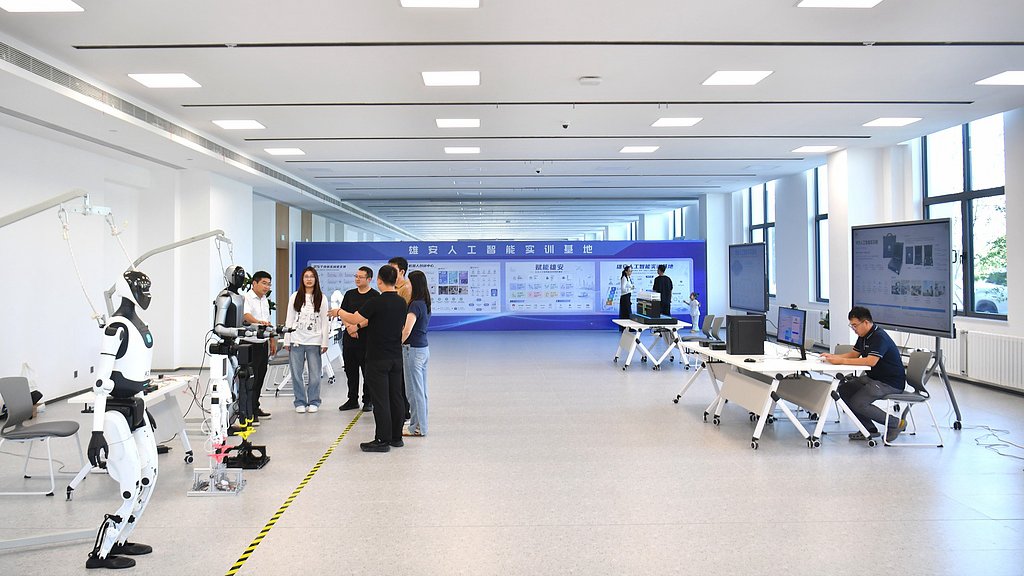
Inside the Xiongan AI Practical Training Base, north China's Hebei Province, September 4, 2026. (Photo: VCG)
Xiongan is strengthening collaboration among industry, academia and research institutions to foster innovation and cultivate talent.
It is deepening partnerships with universities, including Tsinghua University, to advance joint research, accelerate the commercialization of research achievement and develop AI applications tailored to real-world needs. The city is also working to attract leading researchers and high-caliber talent to strengthen its innovation ecosystem.
By opening real-world application scenarios to technology companies, Xiongan provides a testing ground for new products and technologies, while businesses feed improved technologies back into urban operations.
By 2027, Xiongan aims to attract and nurture five unicorn companies, 10 enterprises valued at 5-billion-yuan (about $750 million) level and 100 leading enterprises.
From strengthening the digital infrastructure to expanding smart-city applications, and from fostering AI enterprises to attracting skilled talent, Xiongan is harnessing AI to advance its vision of a model smart city, and exploring approaches that could offer valuable insights for digital urban development worldwide.