


Stretched, not squeezed: Why the Xizang quake was a 'pull-apart'
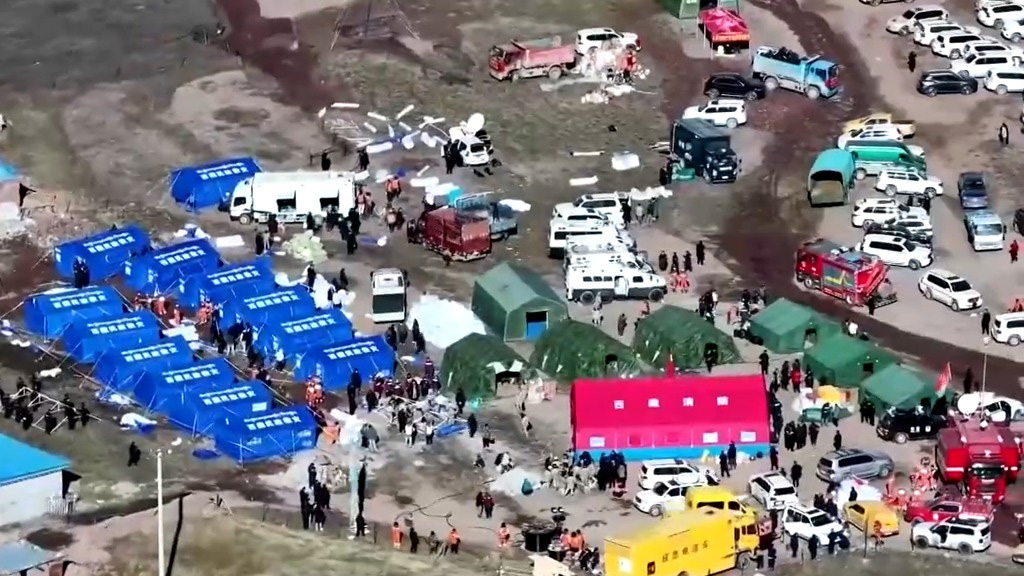
Tents are pitched at a resettlement site, southwest China's Xizang Autonomous Region. (Photo: China Media Group)
The magnitude-7.0 earthquake that struck Baqen County in southwest China's Xizang Autonomous Region late on Thursday was an extensional rupture inside the Qiangtang block, about 2 kilometers from the Baqen-Leiwuqi fault, the China Earthquake Networks Center (CENC) said.
The finding, released on Friday as rescuers worked across the high-altitude epicentral area, explains a counterintuitive feature of the event: the plateau is being squeezed, yet this fault was pulled apart.
"Simply put, an extensional rupture means the crust is stretched along a horizontal direction," said Han Yanyan, a senior engineer at the center's earthquake forecasting department. "Under tension and gravity, the upper block slides down along an existing fault, forming fractures."
The India-Eurasia collision lifted the plateau and thickened its crust, and the interior is subject to both north-south compression and east-west extension, producing two sets of faults that run roughly north-south and east-west.
The Qiangtang block has recorded six earthquakes of magnitude 7.0 or above since 1900, the largest being 7.5 in Shuanghu, 1997. No quake of that size had been recorded within 200 km of the epicenter, according to the CENC, which described the event as "a release of energy stored in the block."
By 9 a.m. on Friday, 23 aftershocks of magnitude 3.0 or above had been logged, the strongest measuring 4.3. Experts said felt tremors remain possible around the epicenter in the coming days.
At a press conference in Nagqu City on Friday, local officials said the combined effect of repeated aftershocks could further weaken the damaged buildings, warning that houses already cracked or tilted may collapse. Residents were told not to return to such houses until inspectors declare them safe.
The area sits at nearly 4,800 meters above the sea level – where cold nights and quake-loosened slopes potentially make rockfalls and landslides the main secondary hazard. Geologists have been assigned to patrol roads, and residents have been moved to open, flat ground away from hillsides.
At least 16 people were killed and 76 injured as of 1 p.m. on Friday, according to figures released at the press conference. More than 5,000 rescuers have been sent to the disaster zone.